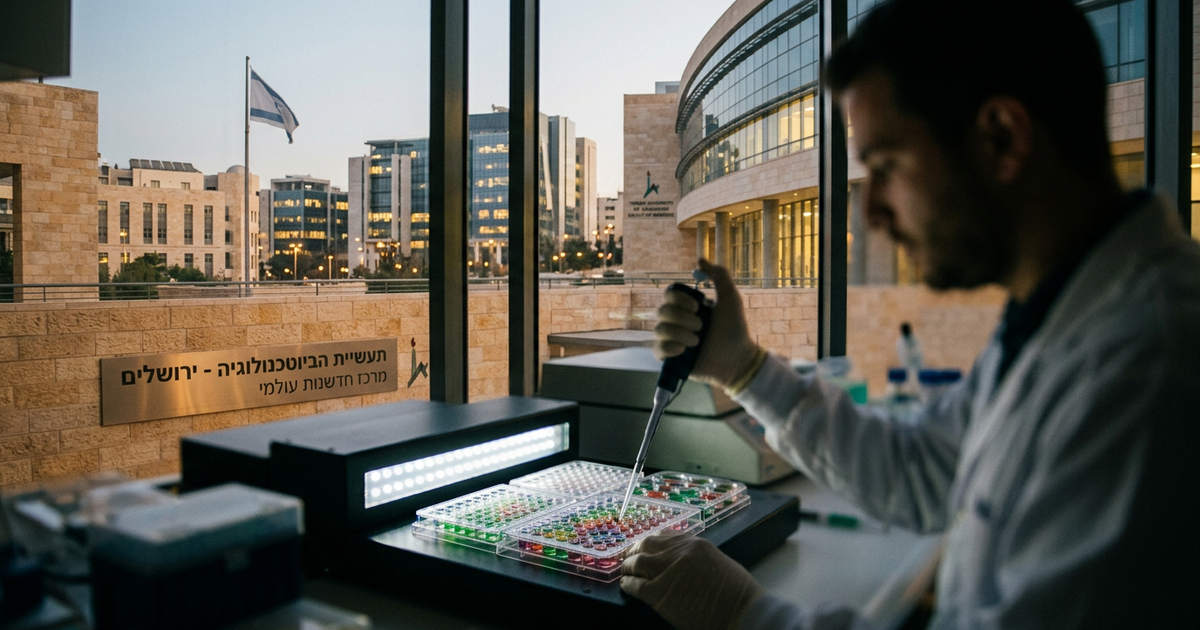

Israel's biotech decade is no longer a frontier story — it's a category. $1.2 billion a year in health-tech funding, AI-native drug discovery platforms from Converge Bio to Immunai, and diaspora capital flowing from Bessemer to Rehovot. How a Jerusalem-to-Tel-Aviv corridor became a global pharma hub.
How $1.2 billion a year, AI-native drug discovery, and diaspora capital turned a Jerusalem-to-Tel-Aviv corridor into a global pharma hub.
Israeli biotech is no longer a frontier story. It is a category.
Private health-tech funding in Israel reached $1.2 billion in 2024, with biotech taking a substantial share — and the trajectory has held into 2026. Israeli life sciences companies have raised more than $7 billion on the Nasdaq over the past decade. Life sciences now represents over a third of total Israeli high-tech funding. Pfizer, Johnson & Johnson, and General Electric run R&D centers on the ground. Hebrew University and three innovation centers anchor a Jerusalem cluster of roughly 140 biomedical companies.
The Capital Map
In January 2026, Arkin Capital closed Arkin Bio Ventures III, a $100 million early-stage fund backed by Phoenix Insurance, Clal Insurance, and Amitim Pension Funds. Arkin Bio now manages more than $600 million in biotech assets; Arkin Capital as a whole runs over $2 billion across 12 funds. The portfolio ledger: UroGen Pharma, Keros Therapeutics, Bluejay Therapeutics, Censa Pharmaceuticals, ImmPACT Bio, cCAM Biotherapeutics, and Hi-Bio — more than twenty IPOs and acquisitions.
AION Labs, operating out of Rehovot, was capitalized by Pfizer, AstraZeneca, Merck KGaA, Teva, Amazon Web Services, the Israel Biotech Fund, Amiti Ventures, and BioMed X. That partner list is not philanthropy — it is the major pharmaceutical companies treating Israel as core infrastructure for early drug discovery.
The AI Layer
Converge Bio (founded 2024, $25M Series A from Bessemer with participation from Meta, OpenAI, and Wiz executives) is in production with more than a dozen pharma and biotech customers for target discovery, antibody design, and protein manufacturing optimization. Immunai expanded its AstraZeneca oncology collaboration to $37.5M in May 2026. Starget Pharma raised $18M and entered clinical collaboration with MD Anderson. These are signed pharma deals, real revenue, validated platforms.
The Geography
Jerusalem — Hebrew University, Hadassah Medical Center, ~140 biomedical companies. Rehovot — Weizmann Institute, AION Labs, Israel Biotech Fund. Ness Ziona — Teva's historic operations, specialty therapeutics. Tel Aviv — the commercial and venture capital layer. Pfizer, GE, and J&J all operate R&D centers in Israel.
The Diaspora Capital Channel
The Converge Bio cap table tells the story. Lead investor: Bessemer Venture Partners. Participants: executives from Meta, OpenAI, and Wiz. The New York and Bay Area Jewish founder and operator community routing private capital into Israeli drug-discovery infrastructure. Foundation capital from American Jewish philanthropic networks continues to underwrite research at Hebrew University, Weizmann, Technion, and Tel Aviv University — the academic pipeline that produces the scientists and the IP.
What to Watch
The commercialization of AI-native drug discovery (2026–2028 is the proof window). Late-stage pipeline maturation (Bonus Biogroup Phase 3, Starget first human trials with MD Anderson). The next billion-dollar exit — Israel's biotech sector has not yet produced a defining late-2020s exit at the scale of Wiz. The candidate companies are visible.
Related — Israeli Health & Biotech
- Israel's Health and Biotech Industry: The Complete Map
- Israel Builds the Tools, Not the Drugs
- Teva's Long Road Back
- InMode
- Compugen
- Marius Nacht
- Yissum and the Hebrew University Engine
- BGN Technologies and the Negev Engine
- Why Israel Bet the Farm on the Protein Transition
How we report: Olam stories draw on public filings, company disclosures and named sources, checked by our editors. Read our methodology · Corrections