Global Luxury Brand Penetration in Israel: Watches, Jewelry, Fashion
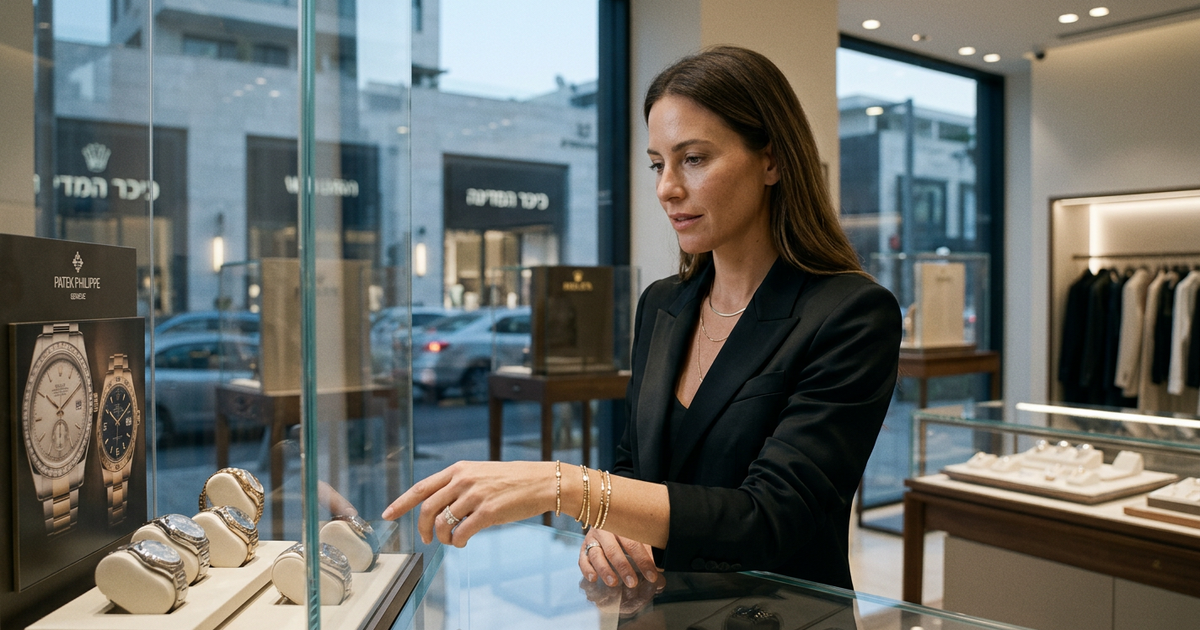
Global luxury brand presence in Israel has historically run below what the resident UHNW population would predict. The post-CEPA infrastructure, family-office migration, and ultra-luxury hospitality expansion have begun to compress the gap. The four-layer architecture mapped.
Global luxury brand presence in Israel has historically run below what the resident UHNW population would predict. A structural feature of the market's relative isolation from primary European luxury distribution. The gap has begun to compress over 2020–2026, driven by post-Accords regional infrastructure, accelerating family-office migration to Israel, and the maturation of Israeli ultra-luxury hospitality. The current architecture spans four layers: a small set of direct flagship positions (LVMH, Richemont, Rolex authorized dealership), a substantial multi-brand authorized retail layer led by Belle Boutique, a premium-fashion boutique layer concentrated in Tel Aviv and Herzliya Pituach, and a still-material cross-border purchasing pattern in Europe, the US, and the Gulf.
Key facts
- Tel Aviv premium retail concentrates along Rothschild Boulevard, the broader beachfront corridor, the Dizengoff Center premium expansion, and the Ramat Aviv Mall premium-retail zone.
- Luxury watch presence in Israel is anchored by authorized dealerships of Rolex, Patek Philippe, Audemars Piguet, and the wider LVMH and Richemont watch portfolios.
- LVMH brand presence includes direct positions for Louis Vuitton and adjacent flagship brands; the wider portfolio operates through multi-brand authorized retail.
- Richemont brands — Cartier, Van Cleef & Arpels, IWC, Jaeger-LeCoultre, and adjacent — maintain direct and authorized presence.
- Premium fashion runs substantially through multi-brand boutiques along the Tel Aviv beachfront, Ramat Aviv, and the Herzliya Pituach corridor.
The historical gap
For most of the post-1948 period, Israeli global luxury brand presence ran well below what the UHNW population would predict. Three reasons.
Distribution isolation. Israel sat outside the primary European luxury distribution network. Travel time, customs friction, and limited regional logistics made direct flagship presence operationally expensive. The nearest comparable markets — Athens, Istanbul, the Gulf — operated under separate distribution structures.
Domestic market scale. The Israeli UHNW population, while substantial, has historically been price-conscious in luxury-goods purchasing relative to peer markets. Substantial cross-border purchasing in Europe and the US absorbed demand that would otherwise have driven domestic flagship presence.
Political and regulatory friction. Periodic regional security cycles and the wider regulatory environment added friction to flagship decisions. Several global luxury brands chose to enter Israel through multi-brand authorized retail rather than direct flagship stores.
The cumulative result: a market structurally under-served by direct global luxury presence relative to its UHNW population. "Under-penetrated," in industry terms.
The post-2020 compression
Four factors have begun to close the gap.
Post-Accords regional infrastructure. The 2020 Abraham Accords and the 2022 Israel–UAE CEPA improved cross-border banking, shipping, and trade documentation across the Eastern Mediterranean and Gulf. Operational cost of Israeli flagship presence dropped. The Israeli market started connecting into the wider Gulf-Mediterranean luxury distribution network.
Cross-border family-office migration. The acceleration in family-office migration to Israel since 2022 has materially expanded the resident UHNW population. The migrating buyer typically maintains higher domestic luxury-purchase patterns than the historical Israeli UHNW consumer.
Ultra-luxury hospitality expansion. The David Kempinski Tel Aviv (2022), the broader branded-residence segment, and the maturation of the Tel Aviv ultra-luxury hotel layer have produced concentrated UHNW foot traffic in specific premium-retail corridors — particularly the beachfront — supporting flagship-store economics.
Global distribution rebalancing. Several global luxury groups have rebalanced distribution in the 2020–2026 window, expanding flagship presence in emerging and secondary markets. Israel benefits.
The combined effect is a measurable expansion of direct flagship presence across the window.
The four-layer architecture
The current Israeli luxury-brand market runs across four layers.
Direct flagship presence. A small but growing set of global luxury brands operates direct flagship stores in the Tel Aviv premium-retail corridors. Louis Vuitton, Cartier, Rolex authorized dealerships, and adjacent established positions anchor this layer. Recent expansions have added several brand positions.
Authorized multi-brand retail. Belle Boutique and adjacent multi-brand authorized retailers carry the dominant share of global luxury brand presence in Israel — watches, jewelry, leather goods, adjacent categories — under authorized-distribution agreements with the international brand principals. This is where most of the market actually clears.
Premium-fashion boutique retail. The Tel Aviv premium-fashion market runs substantially through Israeli-owned boutique retailers carrying international premium-fashion brands under a range of distribution arrangements. Ramat Aviv Mall, the beachfront corridor, and the Herzliya Pituach retail cluster concentrate this layer.
Cross-border supplementary purchasing. The Israeli UHNW consumer continues to run substantial cross-border luxury purchasing in Europe, the US, and the Gulf. Post-CEPA, Dubai is an increasing share of that spend. The cross-border layer supplements rather than displaces domestic activity.
The Tel Aviv retail geography
The premium-retail map is tight. Four zones absorb most of the flagship and boutique activity.
Rothschild Boulevard. The historic financial-and-cultural spine of Tel Aviv. Anchors watch and jewelry direct presence and premium multi-brand retail.
The beachfront corridor. From Hilton Beach through the David Kempinski, Ritz-Carlton Herzliya, and the wider luxury-hotel cluster. Concentrated UHNW foot traffic. The corridor that most directly benefits from the branded-residence and ultra-luxury hospitality build-out.
Ramat Aviv. Ramat Aviv Mall and the surrounding retail. The domestic Israeli UHNW consumer's day-to-day premium retail zone. Wider category coverage than the beachfront.
Herzliya Pituach. The residential UHNW corridor north of Tel Aviv. Boutique premium-fashion concentration, adjacent to the Ritz-Carlton and the wider Herzliya luxury cluster.
Jerusalem operates as a secondary premium-retail market — Mamilla and the King David corridor — with a different consumer mix skewed to inbound tourism and Orthodox UHNW demand.
What to track
Three questions shape the trajectory.
Flagship expansion depth. Whether the post-2020 compression produces additional direct flagship presence at the rate the underlying UHNW expansion would support. The next test is whether Chanel, Hermès, and the wider LVMH portfolio deepen direct presence beyond current positions.
Premium-retail corridor spread. Whether the retail map expands beyond the current Tel Aviv beachfront and Ramat Aviv zones into Herzliya Pituach, Jerusalem, and the wider Sharon corridor.
Cross-border substitution. Whether the Israeli UHNW consumer's cross-border purchasing compresses as domestic flagship availability expands — or whether the Dubai channel absorbs the shift.
Why it matters
Global luxury brand penetration in Israel is the consumer-side signal of the wider ultra-luxury market maturation. The compression of the historical gap over 2020–2026 is one of the more visible institutional consequences of the post-Accords regional infrastructure and the cross-border family-office migration into Israel.
Sources: Israeli luxury-retail industry reporting; Globes; The Marker; LVMH, Richemont, Kering, Rolex corporate disclosures; international luxury-industry trade press. Data current as of Q2 2026.
Related in The Olam: The Israeli Luxury Hospitality Market · Branded Residences in Tel Aviv · Family Office Migration to Israel · Israeli Wine and Spirits: The UHNW Consumer Layer · The Tel Aviv Trophy Index Q1 2026