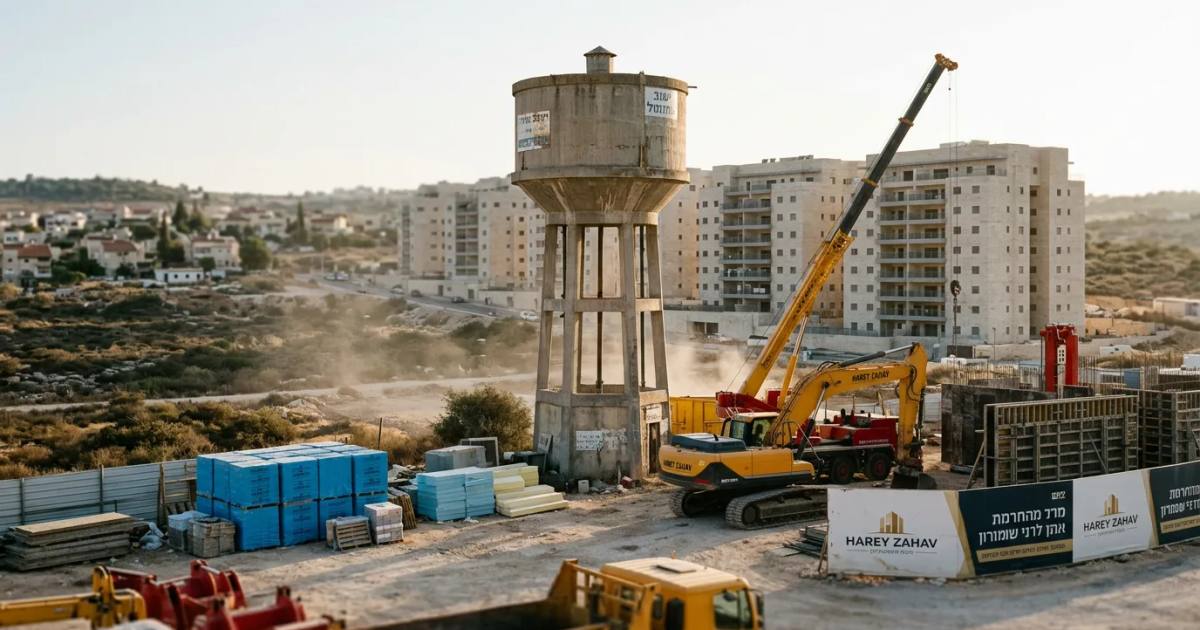

Founded 1981. Long the smallest Haredi settlement. Now Harey Zahav's biggest bet — the developer that turned Leshem from empty hilltop to 700 families in a decade. Karnei Shomron's ~₪2B Roof Agreement adds 5,774 units toward Emmanuel. The sleeper that stops being one.
Founded 1981. Long the smallest of the Haredi settlements. Now the subject of Harey Zahav's biggest development bet — the same company that turned Leshem from an empty hilltop into 700 families in a decade. Tens of thousands of units planned. Karnei Shomron's ~₪2B Roof Agreement adds 5,774 units extending toward Emmanuel. The Israel Land Authority, Housing Ministry, and Civil Administration are all moving in the same direction. Emmanuel is not a small settlement anymore.
Emmanuel is the Haredi story most English-language real estate coverage does not track. Founded in 1981 as a Haredi settlement in Samaria, ~40 km east of Kfar Saba, it stayed small for four decades — outpaced by Beitar Illit, Modi'in Illit, Elad, and Bet Shemesh, all of which grew faster during that period.
Now it is being repositioned. Harey Zahav, one of the most active developers in Judea and Samaria, has publicly identified Emmanuel as "the next major Haredi city" — the same designation the company applied to Leshem before Leshem grew from an empty hilltop into a community of 700 families in a decade. Hundreds of Harey Zahav units in Emmanuel have already been delivered, with more in construction.
For the broader Haredi housing pipeline context, see Beitar Illit: The 80,000-Person City Doubling Itself, Modi'in Illit, and Plugot: The 37,000-Unit Haredi City. Emmanuel is the smaller cousin that has just been picked up as the next tranche in the Judea-and-Samaria Haredi build-out.
The affordability wedge
Emmanuel's central proposition is price. New-build apartments in Emmanuel are priced meaningfully below equivalent product in Bet Shemesh, Beitar Illit, or Jerusalem. The gap is wide enough that The Jerusalem Post's real estate coverage in early 2026 flagged Emmanuel specifically as one of the few remaining Haredi cities where new apartments trade at prices "far below those in nearby cities."
The price signal draws Haredi buyers who cannot compete in Bnei Brak, Bet Shemesh, or Modi'in Illit for the equivalent product they can access in Emmanuel. The city has been trading for years on this pricing wedge — but the wedge only holds until inventory catches up with demand. That inventory is now being planned at scale.
Payment structures matter here too. Some Emmanuel projects offer extended delivery timelines that let buyers lock in current prices without paying full purchase amount upfront. That structure is attractive to families with future household-income growth expectations and current cash constraints — exactly the Haredi young-family segment.
The doubling plan
Local leadership has stated openly that Emmanuel is expected to double in size in the coming years. That is a public commitment tied to concrete tender pipelines rather than an aspirational headline.
Approved plans — tens of thousands of units authorized across the coming decade, per municipal and Housing Ministry statements referenced in Israel real estate coverage from January 2026. Several thousand units are ready for near-term construction.
Additional communities — formal announcements from Haredi community groups and yeshiva organizations to relocate portions of their populations to Emmanuel. That is the demand foundation.
Population growth — steady natural increase compounds the migration inflow. Haredi fertility rates supply the demographic base; state-directed development supplies the housing capacity.
Together, these three lines make Emmanuel one of the few Haredi cities that can credibly claim to double over the next decade. Beitar Illit and Kiryat Gat/Plugot are the other two clearest examples.
Harey Zahav — the developer bet
The single most important company in Emmanuel's story.
Track record — Harey Zahav has been building homes since 2007 across Judea, Samaria, and the South. To date the company has delivered ~2,000 residential units, with thousands more in planning. Approximately 700 homes are currently in various stages of construction across the company's portfolio.
Leshem template — Harey Zahav founded Leshem and, in a decade, took it from an empty hilltop to a community of 700 families. That is the operational template the company is now applying to Emmanuel. The play is: identify a hilltop or existing small settlement with room to expand, secure land through state coordination, develop community institutions in parallel with residential construction, and market to specific Haredi and religious-Zionist streams.
Emmanuel status — Harey Zahav has already delivered "hundreds of units" in Emmanuel, per its own reporting, and identifies the city as "set to become the next major Haredi city." That statement is important because Harey Zahav rarely uses it — the company applied it to Leshem before Leshem grew, and has not applied it to more than a handful of communities since.
Additional Harey Zahav geography — the company is planning, developing, and marketing projects in over 20 communities across the north Samaria–south Har Hebron range. Also new ventures in Yeruham and Dimona in the south. Emmanuel is one of the largest in the current book.
Karnei Shomron Roof Agreement — 5,774 units toward Emmanuel
Emmanuel does not exist in a vacuum. It sits within a Judea-and-Samaria housing framework where several settlements are advancing state-funded expansion in parallel.
The signal deal — Karnei Shomron, the adjacent regional council, signed a Roof Agreement with the Israel Land Authority and the government in early 2026 for approximately ₪2 billion (~$633 million) in expansion funding. Housing Minister Haim Katz called it "a historic agreement."
Scope — 5,774 housing units extending eastward from the Alonai Shiloh neighborhood of Karnei Shomron toward Emmanuel, plus comprehensive infrastructure upgrades throughout existing neighborhoods. Educational institutions and recreational facilities are integrated into the plan.
What it means for Emmanuel — the residential and infrastructure corridor being built between Karnei Shomron and Emmanuel is the same corridor that Emmanuel's expansion will use. Roads, sewage, water, and community anchors improve for both settlements simultaneously. Emmanuel's residential value reprices around this corridor.
Coverage — the Karnei Shomron agreement is reported in The Jerusalem Post's January 2026 coverage.
The Alonai Shiloh legal status
A specific technical issue is worth flagging because it shapes real estate pricing. The Alonai Shiloh neighborhood at the eastern edge of Karnei Shomron — the boundary closest to Emmanuel — was for years stymied by an absent "tabah" (statutory zoning plan) from the Civil Administration.
Impact — without a tabah, straightforward mortgages on the mostly single-family villas along that ridge were impossible to obtain. That constrained the neighborhood's residential value and limited buyer inflow.
Resolution track — the Roof Agreement addresses exactly this class of issue. Statutory zoning plans are being advanced in parallel with the residential construction pipeline. When those plans are approved, standard mortgage financing becomes available, and neighborhood values reprice sharply.
Wider policy shift — in May 2025 Israel's Security Cabinet approved the resumption of land registration in Area C of the West Bank. That process became fully active by February 2026. Emmanuel and Karnei Shomron sit inside the corridor that benefits most directly from the resumed land registration.
The stream mix — who is buying
Emmanuel's buyer segment is different from Modi'in Illit's or Beitar Illit's.
Historically — Emmanuel drew mixed Litvish, Hasidic, and Sefardic Haredi buyers, with a stronger Anglo (American-, British-, South African-immigrant) presence than most Haredi cities. The Anglo presence includes English-speaking community networks, English-language yeshivot, and cross-Atlantic family connections.
Currently — the buyer mix is expanding into the mid-market religious-Zionist and traditional families who are being priced out of Karnei Shomron proper and looking for adjacent alternatives. That is a deliberate developer response to the wider corridor build-out.
Diaspora capital — hundreds of Tri-State (New York, New Jersey, Connecticut) families now hold apartment options in Judea-and-Samaria projects following the May 2026 "Olim l'Yerushalayim" event in Manhattan, with Emmanuel and Karnei Shomron among the destinations. The Emmanuel product is priced for exactly this cohort.
What Emmanuel is really doing
Emmanuel is going from small settlement to "next major Haredi city" over the coming decade. Harey Zahav is the developer bet. Karnei Shomron's ~₪2B Roof Agreement is the corridor infrastructure. Housing Minister Haim Katz is the political sponsor. The resumed Area C land registration is the legal enabler. Anglo and Tri-State diaspora capital is the additional buyer segment.
This is the Judea-and-Samaria mirror image of Kiryat Gat/Plugot in the south. Both are being scaled from limited to large within a decade. Both are betting on Israel's Haredi housing math — the 350,000 additional Haredi units by 2050 that the Ministry of Housing has been open about needing.
Emmanuel is the sleeper. Which is why the buyers who move now clear at prices that will not persist.
How we report: Olam stories draw on public filings, company disclosures and named sources, checked by our editors. Read our methodology · Corrections