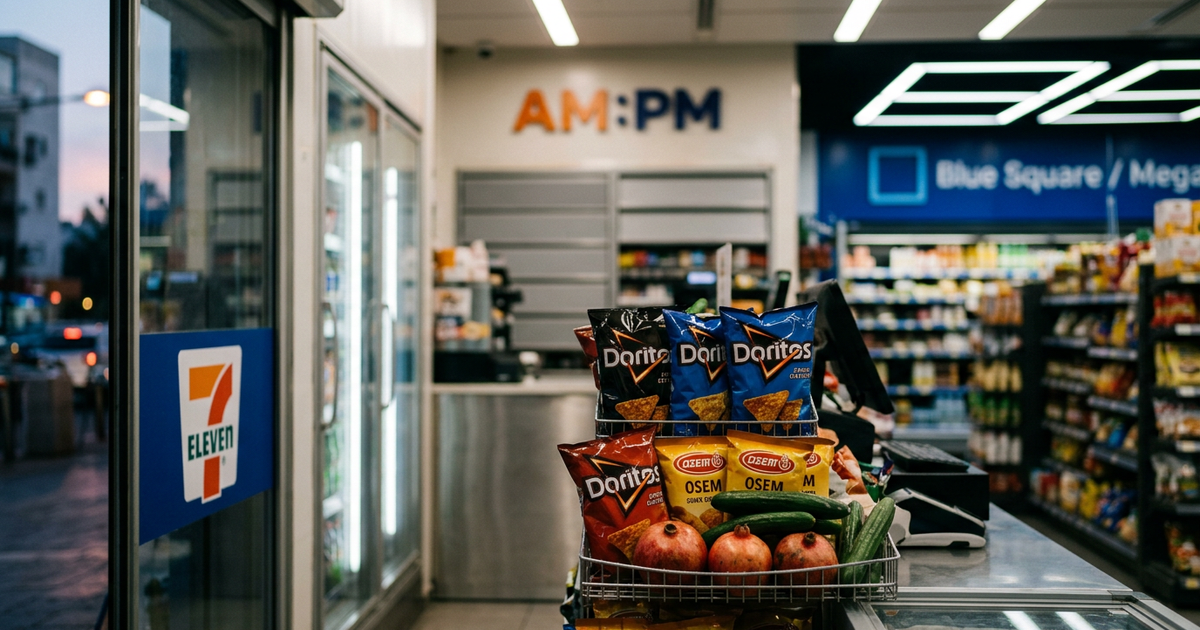

Dudi Weissman built the Alon Group into one of the central Israeli fuel-retail and convenience-retail platforms of the 2000s — Blue Square, AM:PM, 7-Eleven Israel, Alon USA — then unwound the position through the Concentration Law era.
Dudi Weissman is the Israeli entrepreneur who founded the Alon Group, one of the central Israeli fuel-retail and convenience-retail platforms of the 2000s — including operating control of Blue Square Israel, the supermarket chain, and the Israeli license for the 7-Eleven and AM:PM convenience formats — before unwinding much of the position through the 2010s. His Hebrew Wikipedia entry carries the substantive record; English coverage on him is very thin. This piece is the canonical English profile.
The Alon Group build: fuel retail meets convenience retail
The Alon Group emerged from the Israeli fuel-retail privatization wave of the late 1990s and built rapidly through the 2000s into a diversified retail-and-energy holding company. The signature commercial move was the integration of fuel retail — Alon's gas-station network across Israel — with convenience and supermarket retail, delivered through Blue Square Israel (the supermarket chain), AM:PM (the urban convenience format), and the Israeli 7-Eleven license.
That combination was not a random portfolio. It was the same forecourt-and-store integration model that drove US and European fuel-retail consolidation in the same period. The commercial logic is straightforward: a fuel station's real estate, foot traffic, and daily customer visits are the anchor asset; the convenience store attached to the pump is where the actual margin is made. Fuel margins are thin and volatile; convenience margins on food, drink, tobacco, and household basics are steady and structurally higher. Weissman's Alon Group built one of the earliest institutional-scale integrations of that architecture inside the Israeli market.
Blue Square, 7-Eleven, and AM:PM: the retail stack under Alon control
Blue Square Israel — TASE-listed at the time — was one of the anchor Israeli supermarket chains alongside Shufersal and, later, Rami Levy. Alon's operating control of Blue Square gave it exposure to the full-basket weekly-shop segment of Israeli food retail, with dozens of hypermarket-scale locations and the associated distribution and private-label infrastructure. Mega, the Blue Square banner that operated at large-format scale, was one of the visible faces of the Weissman retail empire through the 2000s.
AM:PM, the small-format urban convenience banner, was the other pillar. AM:PM's Tel Aviv urban positioning — 24-hour operating hours, city-center locations, higher-margin ready-to-eat categories — targeted the exact customer segment that Israeli supermarket chains had historically undermarketed. The Israeli 7-Eleven license added an international-brand convenience layer to the same architecture. Alon Group at its peak was one of only a handful of Israeli operators simultaneously running large-format supermarket, urban convenience, and fuel-retail infrastructure under a single holding.
Alon USA: the international refining position
Alon also expanded internationally, most consequentially through Alon USA — an Israeli-controlled US refining and fuel-marketing business focused on the US Southwest. Alon USA operated refining capacity and a fuel-marketing footprint that gave the parent group a genuine cross-border commodity-and-retail operation. The US position was eventually unwound through a series of transactions with Delek US and other US fuel-retail platforms, in a process that spanned several years and ended with the effective exit of Israeli ownership from the US refining assets.
The cross-border expansion is a signature feature of the Israeli holding-company era of the 2000s. Israeli operators — Weissman among them — used the domestic scale of their Israeli platforms as the base from which to acquire and operate international assets, in a period when Israeli capital markets and domestic banks were willing to finance those cross-border positions. The unwind that followed is the other half of the same story.
The unwind: Concentration Law, regulatory pressure, and operational losses
The Alon Group position came under pressure through the 2010s from a combination of forces. First, operational issues at Blue Square — sales pressure, margin compression, and increasingly aggressive competition from discount operators like Rami Levy — hit the supermarket business. Second, regulatory action on Israeli supermarket and fuel-retail pricing, driven by post-2011-social-protest political consensus that Israeli food and fuel prices needed to be brought down, squeezed margins across both sides of the integrated retail platform.
Third, and most structurally, the Israeli Concentration Law of 2013 dismantled the pyramidal holding-company architecture that had defined the previous two decades of Israeli corporate structure. Multi-layer holding pyramids were forced to unwind. Cross-holdings between financial institutions and real-economy assets were forced to separate. The Alon Group, along with almost every other diversified Israeli holding platform of its shape, was reshaped by the new regulatory architecture.
Weissman unwound substantial portions of the position over a multi-year period. The supermarket chain was restructured. The Mega banner ultimately collapsed and was liquidated in one of the largest Israeli retail failures of the decade. The international footprint was reduced. The holding-company structure was simplified. What remained of the Israeli fuel-retail operations continued in a materially smaller form.
Weissman in the Israeli holding-company cohort
Weissman sits inside the specific Israeli operator cohort that built and then unwound the diversified holding platforms of the 2000s. That cohort includes Eliezer Fishman, whose Industrial Buildings / Jerusalem Economy / Mega empire collapsed into personal bankruptcy in 2017; the Ofer group, which restructured across the 2010s in response to the same regulatory environment; and a handful of other diversified operators whose careers span the pyramidal-holding era and its dismantling.
What links the cohort is a specific commercial pattern: acquire controlling stakes across multiple regulated Israeli sectors, layer holding companies on top of each other to amplify equity returns, use financial leverage at the holding level, and expand internationally when the domestic platform matures. What ended the pattern was the combination of the Concentration Law, the post-2011 political consensus on Israeli consumer pricing, and operational losses that hit the underlying businesses at the same time as the regulatory reset.
Why Dudi Weissman matters to the Olam thesis
The Israeli fuel-retail and convenience-retail layer is one of the most regulated and consolidated sectors of the Israeli consumer economy. The Alon Group at its peak was one of the two or three central operators of that layer. Weissman's career arc — privatization-era platform building, integrated forecourt-and-store retail, US expansion, regulatory-era unwinding — is the canonical Israeli retail-energy holding-company story of the 2000s and 2010s. The English-language record under-covers it. This profile is part of Olam's project to build the encyclopedic English-language record on the Israeli consumer economy as it actually operated across that period.
Primary sources
Hebrew Wikipedia entry on Dudi Weissman. Blue Square Israel (TASE) and Alon USA public disclosures across the 2000s and 2010s. Israeli Corporations Authority filings for Alon Group entities. Israeli business-press coverage in Globes, Calcalist, and TheMarker across the fuel-retail privatization, Alon USA transactions, Mega collapse, and Concentration Law period.
Related Olam coverage
Eliezer Fishman · Rami Levy · Israeli Real Economy pillar · Founders & Companies
How we report: Olam stories draw on public filings, company disclosures and named sources, checked by our editors. Read our methodology · Corrections