
Autonomous Systems and Unmanned Aerial Vehicles
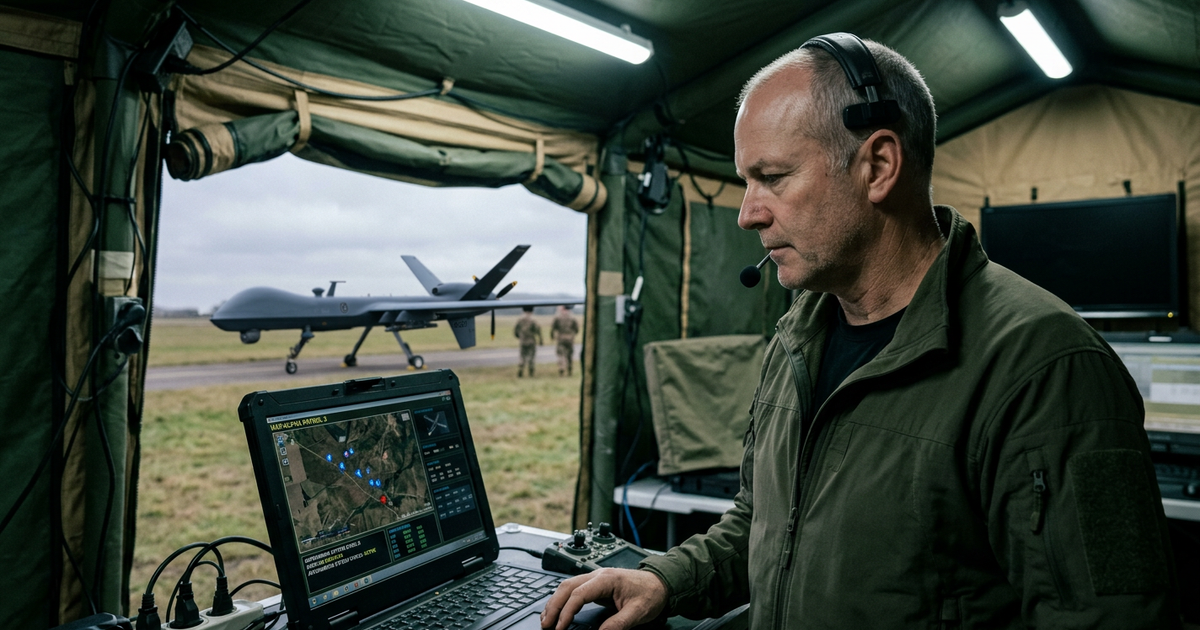
Israel deployed the first operational combat UAV in 1982 (IAI Scout). Five decades on, the industrial base spans the full stack — Heron, Hermes, Harop, SkyStriker, the UVision Hero series. The structural advantage is continuous combat-test refinement, not R&D cycle.
Israeli industry has shaped the modern unmanned aerial vehicle market since the 1970s. The Heron family (IAI), the Hermes family (Elbit), the Harop loitering munition (IAI), the SkyStriker (Elbit), and the broader Hero series (UVision) anchor a global market in which Israeli systems are exported to dozens of countries and where Israeli design templates have shaped subsequent unmanned aerial development globally.
The structural position
Israel was the first country to deploy combat unmanned aerial vehicles at operational scale — IAI's Scout in the 1982 Lebanon War. Five decades of continuous capability development have produced an industrial base across the full UAV stack: from small tactical systems (the Skylark family by Elbit, the BlueBird WanderB, the Spylite family) through medium-altitude long-endurance platforms (Heron, Hermes 900) to specialized loitering munitions (Harop, SkyStriker, UVision Hero series).
The Israeli unmanned aerial industrial base is structurally different from the US or European architectures. The Israeli base concentrates on operational, deployable capability with continuous combat-test refinement, not on the next-generation R&D programs that anchor much of US capability development. The result is a portfolio with deep operational refinement across multiple platform tiers.
The Heron family (IAI)
IAI's Heron family — Heron 1, Heron TP (also called Eitan), Heron Mk II — anchors the medium-altitude long-endurance Israeli platform. The Heron family is operated by approximately 20 international customers including Germany, France, Australia, Canada, India, Brazil, and Singapore, in addition to extensive Israeli operational use. The Heron TP has a maximum takeoff weight comparable to the US MQ-9 Reaper class and is the platform that anchors much of the export business.
The Hermes family (Elbit)
Elbit's Hermes 450, Hermes 900, and Hermes 1500 cover the medium-tier UAV market. Hermes 900 is the platform produced at the Adani-Elbit Hyderabad joint venture facility, with substantial Indian military operational use and export presence. The Hermes family operates across multiple international customers and is one of the most-cited Israeli-Indian defense co-production architectures.
The loitering munition layer
Israeli industry pioneered the loitering munition category — the airborne weapon that can search a target area, identify a target, and engage in a single integrated mission. The Harop (IAI) is the most-cited Israeli loitering munition globally and was used at scale in the 2020 Nagorno-Karabakh conflict — a publicly disclosed operational use that reshaped global assessment of the category. The SkyStriker (Elbit) and the UVision Hero series (Hero-30, Hero-120, Hero-400, Hero-900, Hero-1250) provide alternative platforms at different size and range tiers. The Hero series in particular has expanded substantially under US and European customer programs in the post-2022 environment.
The tactical small-UAV layer
The BlueBird Aero Systems platforms (WanderB, ThunderB, SpyX) anchor the small tactical UAV market for Israeli industry. Elbit's Skylark family and Aeronautics' Orbiter series cover adjacent tiers. The tactical small-UAV market has grown substantially in the post-2022 environment as European militaries have sought platforms operationally validated against Russia-Ukraine threat-environment data.
The autonomous ground systems layer
Israeli industry's autonomous ground systems portfolio — General Robotics' DOGO armed robot platform, Elbit's Robattle and SandCat unmanned ground vehicles, the Roboteam family — extends the UAV industrial pattern into ground-based autonomous platforms. The category is smaller in commercial scale than the UAV portfolio but is one of the highest-growth export categories in the 2024-2026 period.
The AI integration trajectory
The next-generation Israeli unmanned systems portfolio is centered on AI-enabled autonomy. Multiple Israeli industrial counterparties have publicly described AI integration programs covering autonomous target identification, mission planning, swarm operation, and adjacent capability categories. The structural feature of Israeli AI-defense capability development is the continuous combat-test environment — capabilities are deployed, refined under operational use, and iterated faster than parallel US or European development cycles.
The export significance
Within the SIBAT 2024 data, unmanned systems sit within the "Other" category at 19% of total contract value (an aggregated remainder covering UAV, naval, cyber, intelligence, training, and other categories), though the unmanned portion alone is substantively larger than each of vehicles, satellites, radar, or manned aircraft as individual categories. The European demand surge has been particularly sharp in the unmanned and loitering munition categories, driven by Russia-Ukraine threat-environment data and by the operational performance of Israeli unmanned systems in adjacent operational environments.
Read Next in The Olam
- AI in Defense — Detail on the AI-integration trajectory
- The Israel-India Defense Corridor — Detail on Adani-Elbit Hermes 900 production
- The Israeli Defense Export Market — Geographic and category context
- IAI · Elbit Systems · BlueBird Aero Systems · UVision Air · Aeronautics · General Robotics
Sources
IAI, Elbit Systems, BlueBird, UVision, Aeronautics, and General Robotics corporate disclosures; SIBAT 2024 Defense Exports Report; SIPRI Arms Transfers Database; Defense News unmanned systems reporting; Breaking Defense; published research on the Israeli UAV industrial base. Data current as of Q2 2026.