
Nasdaq: CRNT. Founded 1996 as Giganet inside the RAD Group. $338.7M revenue (2025). CEO Doron Arazi. FibeAir microwave + Siklu mmWave. Survived the 2022 Aviat hostile takeover. 460+ operators in 130+ countries. 2026 guidance $355–385M.
Nasdaq: CRNT · TASE: CRNT · Founded 1996 as Giganet Ltd. in Rosh Ha'Ayin · Market cap ~$200M · 2026 guidance $355–385M revenue · The Israeli wireless-backhaul company whose microwave and millimeter-wave radio systems transport mobile-network traffic across more than 130 countries — and survived a hostile takeover attempt to do it.
Ceragon Networks is the Israeli wireless-backhaul company that has compounded across every mobile-network generation since 3G — and is now betting that the 5G build-out, millimeter-wave spectrum, and private-network infrastructure will reset the revenue trajectory it built over three decades. Founded in 1996 as Giganet Ltd. inside the RAD Group ecosystem — the Zisapel brothers' network of Israeli networking companies — Ceragon designs and manufactures point-to-point and point-to-multipoint wireless connectivity systems for mobile operators, service providers, and private-network owners. Its FibeAir platforms carry cellular traffic from cell towers to core networks across microwave and millimeter-wave frequency bands, at capacities reaching 40 Gbps with a 100 Gbps roadmap. More than 460 service providers and 800 private-network owners in 130+ countries run Ceragon equipment.
At a Glance
| Company | Ceragon Networks Ltd. |
| Tickers | Nasdaq: CRNT · TASE: CRNT |
| Former name | Giganet Ltd. (1996–2000) |
| Founded | 1996, Rosh Ha'Ayin, Israel |
| Nasdaq IPO | August 2000 |
| HQ | Rosh Ha'Ayin, Israel |
| CEO | Doron Arazi (since July 2021; formerly Deputy CEO & CFO) |
| Prior CEO | Ira Palti (16-year tenure; now Vice Chairman) |
| Sector | Wireless backhaul, microwave & mmWave transport, private networks |
| Products | FibeAir IP-20 platform, E-band mmWave, 60 GHz PtMP, Siklu by Ceragon, NetMaster NMS, AI-powered managed services |
| Customers | 460+ service providers, 800+ private-network owners, 130+ countries |
| 2024 revenue | $394.2M |
| 2025 revenue | $338.7M (–14.1% YoY) |
| Q1 2026 revenue | $85.0M (–4.1% YoY) |
| 2026 guidance | $355–385M revenue; non-GAAP operating margin 6.5–7.5% |
| Cash | $39.2M (March 31, 2026) |
| Employees | ~1,056 |
The RAD Group lineage and founding
Ceragon was founded in 1996 as Giganet Ltd., a member of the RAD Group — the constellation of Israeli networking companies built by brothers Zohar and Yehuda Zisapel from their Ramat HaHayal offices. The RAD Group produced dozens of Israeli networking and telecom companies across switches, routers, access equipment, and wireless infrastructure. Ceragon's founding thesis was wireless broadband transport — point-to-point microwave radio systems for the emerging demand in high-capacity cellular backhaul. Early funding came from Israeli venture capital. The company changed its name to Ceragon Networks Ltd. in September 2000 and completed its Nasdaq IPO the same month. Zohar Zisapel served as chairman of Ceragon's board through the Aviat hostile-takeover defense in 2022.
What Ceragon makes
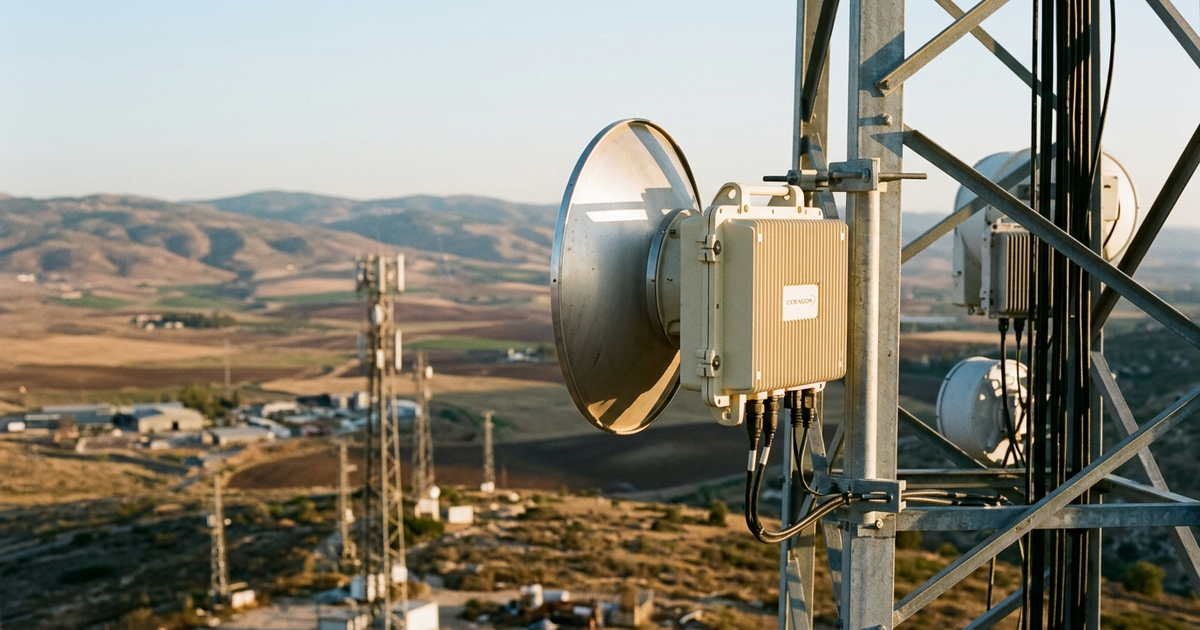
Ceragon designs and manufactures the wireless transport equipment that connects cell towers to an operator's core network — backhaul — and increasingly the mid-haul and front-haul links that distributed 5G architectures require. The product line runs across three categories.
Microwave backhaul — the FibeAir IP-20 platform. Ceragon's core product. Point-to-point microwave radio systems operating in licensed spectrum bands from 6 GHz to 42 GHz. The FibeAir IP-20 comes in all-outdoor, split-mount, and all-indoor configurations. Capacities reach up to 40 Gbps per link, with a roadmap to 100 Gbps. The platform handles backhaul for 3G, 4G LTE, and 5G base stations. This is the product category that has generated the majority of Ceragon's revenue for three decades.
Millimeter-wave and E-band — Siklu by Ceragon. Following the December 2023 acquisition of Siklu Communication for $13–15 million in enterprise value, Ceragon added E-band (60/70/80 GHz) millimeter-wave connectivity for fixed wireless access, urban fiber-extension, and private-network deployments. Siklu had deployed over 300,000 outdoor antenna units across 50+ countries and held the leading US market share in E-band installations for three consecutive years before the acquisition. Ceragon is now developing a next-generation 20 Gbps E-band product and has launched 60 GHz point-to-multipoint solutions for the private-network and ISP segments.
Network management and AI-powered services. NetMaster, Ceragon's network management system, manages large-scale wireless backhaul networks. The company has added AI-powered managed and professional services to its portfolio — predictive maintenance, network optimization, and deployment services for operators running Ceragon equipment at scale.
The CEO succession: Palti to Arazi
Ceragon's leadership history is a two-CEO story.
Ira Palti led Ceragon for 16 years, navigating the company through the 3G-to-4G transition and into the early 5G cycle. Under Palti, Ceragon expanded from an Israeli microwave-radio vendor to a global wireless-transport provider with operations across North America, Europe, Africa, Asia-Pacific, India, the Middle East, and Latin America. The 2011 acquisition of Nera Networks, a Bergen, Norway-based wireless backhaul provider, was the key M&A move of the Palti era — it gave Ceragon a European footprint and expanded the customer base substantially.
Doron Arazi succeeded Palti as CEO in July 2021, having previously served as Deputy CEO and CFO between 2014 and 2019. During his CFO tenure, Arazi moved Ceragon from operating losses and negative cash flow to profitability, eliminated over $50 million in bank debt, and rebuilt relationships with the lending consortium. As Deputy CEO, he led the APAC and India regions — which accounted for more than 50% of annual revenue — growing regional revenue from $110 million in 2016 to $179 million in 2018. Palti transitioned to Vice Chairman.
The Aviat hostile takeover (2022)
In the summer of 2022, Aviat Networks (Nasdaq: AVNW), a US-based competitor in microwave networking, launched a hostile takeover attempt against Ceragon. Aviat accumulated a 5%+ stake in Ceragon on the open market and proposed acquiring the company for $2.80 per share — an enterprise value of approximately $235 million. When Ceragon's board unanimously rejected the offer as "significantly undervaluing the company," Aviat called an extraordinary general meeting and nominated five of its own directors to replace Ceragon's board.
Chairman Zohar Zisapel led the defense. At the EGM in August 2022, approximately 80% of shares voted against all of Aviat's proposals. Aviat's director nominees received support from less than 15% of total shares outstanding — less than 10% excluding Aviat's own stake. The proxy contest cost Ceragon $4.2 million in legal and advisory fees. The defense succeeded, Ceragon remained independent, and the share price subsequently recovered well above Aviat's offer as the company executed its growth strategy under Arazi.
The Siklu acquisition (2023)
In December 2023, Ceragon completed the acquisition of Siklu Communication, a privately held Israeli company based in Petah Tikva that built millimeter-wave "wireless fiber" connectivity systems. The deal valued Siklu at $13–15 million in enterprise value — accretive to Ceragon's gross margins from day one, since Siklu's margins ran significantly above Ceragon's historical levels.
The strategic rationale was threefold. First, Siklu gave Ceragon an immediate position in E-band — the millimeter-wave frequency band expected to be the fastest-growing segment of the wireless transport market. Second, Siklu brought point-to-multipoint (PtMP) technology, giving Ceragon an entry point into fixed wireless access. Third, Siklu's established North American ISP customer base expanded Ceragon's footprint in the private-network and small-service-provider segments that the company's legacy carrier-focused sales organization had not penetrated.
By mid-2024, a leading American ISP had placed a multi-million-dollar order for Siklu by Ceragon E-band equipment, and field tests of the next-generation 20 Gbps product were underway.
The revenue trajectory
Ceragon's revenue history tracks the global mobile-network investment cycle — with all the cyclicality that implies.
The 2024 fiscal year was a peak: $394.2 million in revenue, driven by accelerated 5G deployment spending across India and North America. The 2025 decline to $338.7 million (–14.1%) reflected the standard post-deployment pause — operators that had spent aggressively in 2024 pulled back procurement while absorbing deployed capacity. Q4 2025 revenue of $82.3 million was down 23% year-over-year.
The 2026 rebound is underway. Q1 2026 revenue of $85.0 million was down only 4.1% year-over-year, with management citing sequentially higher revenue and strong bookings from India, robust North American activity including a new Tier 1 CSP with potential initial orders in Q3, and expanding private-network contracts. Full-year 2026 guidance stands at $355–385 million with non-GAAP operating margin of 6.5–7.5%. Net cash position improved to $19.4 million at year-end 2025, with $39.2 million in cash as of March 31, 2026, and positive free cash flow exceeding $7 million in Q4 2025.
Four new product launches are planned for 2026, including the 60 GHz point-to-multipoint solutions and advanced E-band systems. A multi-million-dollar private-network order in the Asia-Pacific region signaled the expansion beyond traditional carrier backhaul into mining, energy, and enterprise infrastructure.
The India engine
India has been Ceragon's single most important growth market across the 4G and 5G cycles. The country's mobile-network build-out — driven by Reliance Jio's disruptive entry, Airtel's countermove, and Vodafone Idea's survival spend — has generated sustained demand for wireless backhaul equipment. Under Arazi's earlier tenure as Deputy CEO overseeing APAC and India, the region's revenue more than doubled. In Q1 2026, India delivered sequentially higher revenue with strong bookings and notable demand for E-band solutions, providing visibility into the rest of the year.
Private networks: the diversification play
Ceragon is actively diversifying beyond its traditional base of mobile operators into private-network infrastructure — dedicated wireless networks for mines, oil and gas installations, ports, utilities, and enterprise campuses. The Siklu acquisition accelerated this strategy by adding fixed wireless access and point-to-multipoint capabilities suited to private-network deployments. Multiple contracts are in execution across various customers and use cases, with the APAC multi-million-dollar order as the reference case. CEO Arazi has framed the shift as structural: the total addressable market for private wireless networks is growing independently of the carrier capital-expenditure cycle, providing a revenue floor that pure carrier-backhaul exposure does not.
Ceragon in the Israeli telecom-infrastructure cohort
Ceragon sits alongside AudioCodes (enterprise voice), Allot (network intelligence), Gilat Satellite Networks (satellite communications), and CEVA (semiconductor IP for wireless connectivity) in the Israeli telecommunications-infrastructure cluster — a cohort of Nasdaq-listed, Rosh Ha'Ayin- and central-Israel-headquartered companies that provide critical infrastructure layers to global telecommunications operators. All share a common lineage in Israeli engineering depth, multi-decade customer relationships, and the capacity to compound through technology-generation transitions without the venture-capital exit arc that dominates Israeli technology headlines.
Where AudioCodes carries the voice layer, CEVA licenses the chip architecture, Allot inspects the traffic, and Gilat routes through satellite, Ceragon carries the radio-frequency transport — the physical wireless link between cell tower and core network. The model is hardware-intensive, globally deployed, and cyclically tied to operator capital expenditure. All five companies appear in the broader Olam coverage of Israeli technology infrastructure and the Olam Nasdaq 20.
Watch points
- India booking velocity — whether the Q1 2026 strength sustains through H2 and whether E-band adoption accelerates in the Indian market.
- North America Tier 1 CSP — the new customer Arazi referenced in Q1 2026, with potential initial orders in Q3. A material revenue contributor if it converts.
- Private-network revenue share — whether non-carrier revenue crosses a structural threshold that dampens cyclicality in carrier spend.
- The Siklu integration — whether 60 GHz PtMP and the 20 Gbps E-band products generate meaningful new revenue streams in 2026–2027.
- Competitive landscape — Arazi referenced "anticipated changes in the competitive landscape" in Q1 2026 comments, signaling potential consolidation or competitor exits in the wireless transport market.
- Gross margin trajectory — 2026 guidance targets 100 bps improvement at the midpoint. Whether the Siklu margin accretion and services mix shift drive sustained expansion.
Frequently Asked Questions
What is Ceragon Networks?
Ceragon Networks (Nasdaq: CRNT, TASE: CRNT) is an Israeli wireless-backhaul company that designs and manufactures microwave and millimeter-wave radio systems for mobile operators, service providers, and private-network owners in more than 130 countries. Founded in 1996 in Rosh Ha'Ayin as Giganet Ltd., listed on Nasdaq since 2000.
Who is Ceragon's CEO?
Doron Arazi, since July 2021. Previously served as Ceragon's Deputy CEO and CFO. He succeeded Ira Palti, who led the company for 16 years and transitioned to Vice Chairman.
What is Ceragon's annual revenue?
$338.7 million in 2025 (down 14.1% from $394.2 million in 2024). 2026 guidance is $355–385 million, with Q1 2026 revenue of $85.0 million.
What does Ceragon make?
Wireless transport equipment — primarily point-to-point microwave radio systems (FibeAir IP-20 platform) and millimeter-wave E-band products (Siklu by Ceragon). These systems carry cellular traffic from cell towers to operator core networks. The company also offers network management (NetMaster) and AI-powered managed services.
What was the Aviat hostile takeover?
In 2022, US competitor Aviat Networks launched a hostile takeover attempt, offering $2.80 per share (~$235 million). Ceragon's board rejected the offer. At an extraordinary general meeting, approximately 80% of shares voted against all of Aviat's proposals. Ceragon remained independent.
What is Siklu by Ceragon?
Siklu Communication was an Israeli millimeter-wave connectivity company that Ceragon acquired in December 2023 for $13–15 million. Siklu's E-band and 60 GHz products give Ceragon access to fixed wireless access, point-to-multipoint technology, and the North American ISP market.
Where is Ceragon headquartered?
Rosh Ha'Ayin, Israel. The company has sales offices across North America, Europe, Africa, Asia-Pacific, India, the Middle East, and Latin America.
What is Ceragon's relationship to the RAD Group?
Ceragon was founded in 1996 as Giganet Ltd., a member of the RAD Group — the constellation of Israeli networking companies built by Zohar and Yehuda Zisapel. Zohar Zisapel served as Ceragon's board chairman through the 2022 Aviat defense.
Primary Sources
- Ceragon Q1 2026 earnings release (May 19, 2026)
- Ceragon Q1 2026 Form 6-K (SEC filing)
- Ceragon corporate site (ceragon.com)
- Ceragon SEC filings via EDGAR
- TASE filings under CRNT
Related Olam Coverage
Israeli Telecom Infrastructure — Dual-Listed Cohort
Ceragon Networks · AudioCodes · Allot · Gilat Satellite Networks · CEVA
See also: The Olam Nasdaq 20 · The Builders · Founders & Companies
The Olam Editorial Team
How we report: Olam stories draw on public filings, company disclosures and named sources, checked by our editors. Read our methodology · Corrections