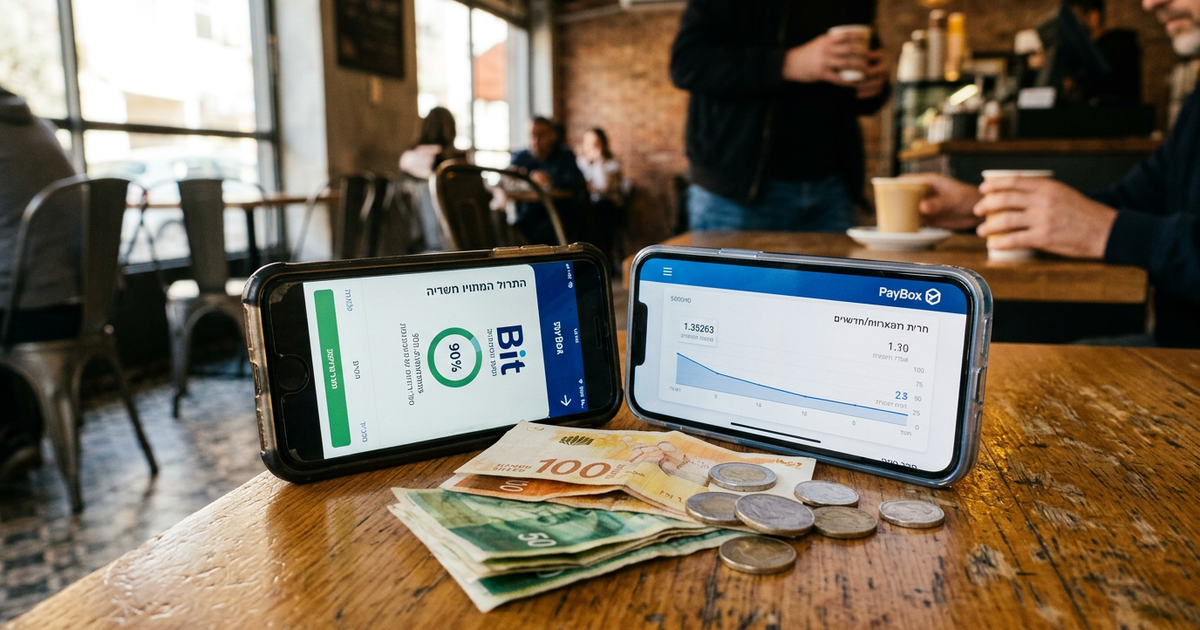

Bit and PayBox fees were cleared for January 2025: Hapoalim charges 0.6% on receipts above NIS 25,000. See Bit's 90% volume share, PayBox's 10% and who pays.
Bit and PayBox, the peer-to-peer payment apps launched by Bank Hapoalim and Israel Discount Bank in 2017, were cleared in July 2024 to start charging fees in January 2025 after years of free transfers. Bit handled about 90% of app payment transfers with 3.5 million customers in 2024, while PayBox had 1.4 million customers and about 10%, according to Globes. Hapoalim says it charges 0.6% on amounts received above NIS 25,000 a year.
How did Bit and PayBox start?
Israel's payment-app industry began in 2017 when three large banks launched or acquired peer-to-peer apps, Globes reported. Bank Hapoalim launched Bit, Israel Discount Bank launched PayBox, and Bank Leumi set up Pay and later closed it. The banks offered the service free and it cost them dearly, Globes said.
Globes also reported that Discount Bank completed a buyout of PayBox from Shufersal, though the report available to Olam does not give the date.
Why did Bit reach about 90% of transfers?
Bit reached about 90% of app transfers because payment apps tend toward a single winner through network effects, according to a 2021 Israel Competition Authority study. The Authority said competition in payment apps was expected to converge on a single-winner structure that had almost taken over routine transfers between individuals, Globes reported.
The Authority's 2021 research also found that Bit handled most app transactions in 2020, by both number and value, according to a Knesset research summary. By July 2024, Bit had 3.5 million customers against PayBox's 1.4 million, and PayBox handled only about 10% of the amounts transferred, according to Globes.
What are the Bit and PayBox fees?
The Supervisor of Banks, Daniel Hahiashvili, announced in July 2024 that he planned to allow Bit and PayBox to charge fees from January 2025, Globes reported. The estimated fee was 1% for customers whose total transactions exceed NIS 25,000 a year, which is about NIS 2,080 a month counting both payments made and received.
| Item | Detail | Source |
|---|---|---|
| Supervisor's announcement | July 2024: fees allowed from January 2025, estimated at 1% above NIS 25,000 a year | Globes |
| Hapoalim's Bit fee | 0.6% on amounts received above NIS 25,000 in a calendar year, from January 2025 | Globes |
| Annual receiving ceiling | Raised from NIS 50,000 to NIS 100,000 per customer | Globes |
| Who is affected | About 6% of Bit users use it commercially and reach the threshold; the rest of about 3 million users are unaffected, according to Hapoalim | Globes |
Globes gave an example: a customer receiving NIS 100,000 in 2025 would pay 0.6% on the amount above NIS 25,000, which is NIS 450. The fee is charged on the fifth of the month for money received in the previous month. The 1% estimate and Hapoalim's 0.6% differ, and Olam found no PayBox fee schedule.
What does the fee change mean for Israeli payments?
The fee change ends years of free peer-to-peer transfers only for heavy and commercial users, since Hapoalim says about 90% of Bit users will not pay. The practical effect falls on small businesses and sellers who use Bit to collect payments. For how small businesses get paid in Israel, see Olam's guide to small-business payments (Hebrew).
A Hebrew version of this analysis is at Bit, PayBox והקרב על שוק התשלומים הצרכני בישראל. For the wider context, see Israeli Finance Beyond the Banks, The Five-Bank Market After Strum, Payoneer, Rapyd and the Globalization of Israeli Payments and Israeli Fintech and Public Markets.
Bit and PayBox FAQ
Do Bit and PayBox charge fees?
Bank Hapoalim says Bit charges 0.6% on amounts received above NIS 25,000 in a calendar year from January 2025, according to Globes. Olam found no published PayBox fee schedule.
How many people use Bit?
Bit had 3.5 million customers and about 90% of app payment transfers in July 2024, according to Globes. Hapoalim later cited about 3 million users.
Who owns PayBox?
PayBox was launched by Israel Discount Bank, and Globes reported that Discount completed a buyout of PayBox from Shufersal.
What happened to Bank Leumi's payment app?
Bank Leumi set up an app called Pay in 2017 and later closed it, according to Globes.
How we report: Olam stories draw on public filings, company disclosures and named sources, checked by our editors. Read our methodology · Corrections