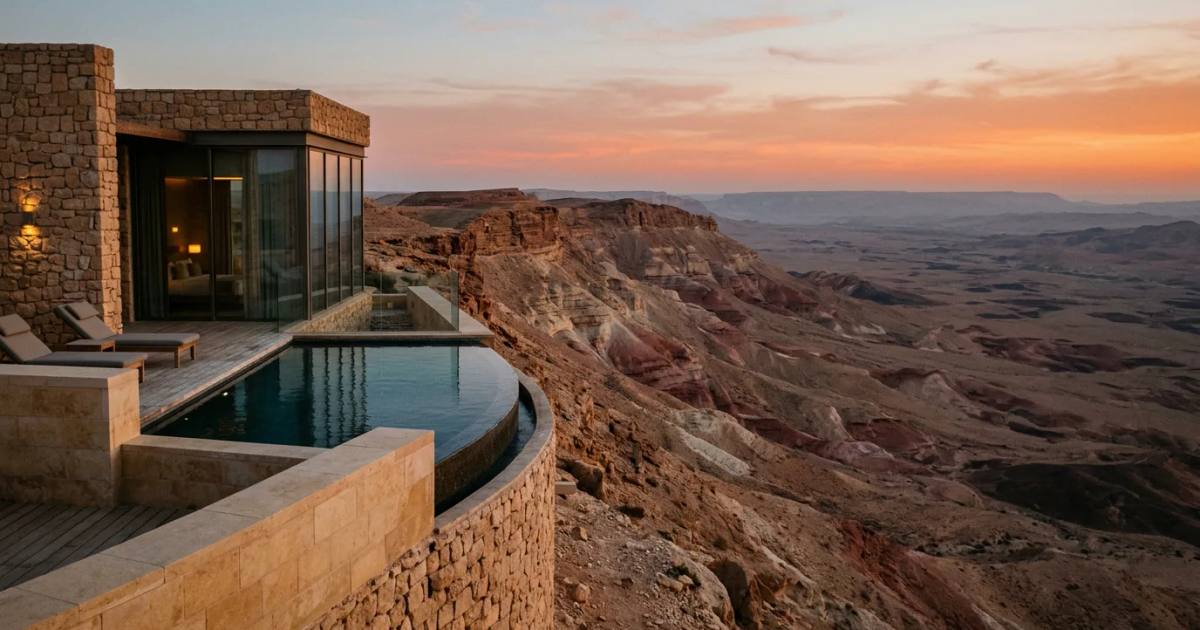

Opened 2011 on the rim of Makhtesh Ramon. 111 rooms above the largest erosion crater in the world. Isrotel's premium-tier property. Built the Israeli destination-luxury category that Six Senses Shaharut later moved up-market a decade later.
Part of: Who Owns the Israeli Hotel Sector · Israeli Luxury 2026
Opened 2011 on the edge of the Ramon Crater. 111 rooms above one of the largest erosion craters in the world. Owned and operated by Isrotel. The property that proved international-tier desert luxury works in Israel — and paved the way for Six Senses Shaharut a decade later.
Beresheet is the property that built the Israeli destination-luxury thesis.
Located on the edge of Makhtesh Ramon, the largest erosion crater in the world, at the town of Mitzpe Ramon in the Negev Desert. Opened in 2011. 111 rooms, many with private pools, all with crater views. Owned and operated by Isrotel — the Lubinski-family hotel group — under the brand's premium destination-luxury tier.
When Beresheet opened, no international ultra-luxury operator had ever committed a property to Israel. The Israeli hospitality market was structured around urban properties (Jerusalem trophy and Tel Aviv business), beach resorts (Eilat, Tel Aviv coast), and the Galilee country-house tradition. Desert luxury — destination-resort scale, $500+ ADR, architecturally serious — did not exist as a category. Beresheet built it.
BY THE NUMBERS
Opened: 2011
Location: edge of Makhtesh Ramon · Mitzpe Ramon · Negev Desert
Keys: 111 rooms (many with private pools)
ADR: roughly $500–700 base, higher in peak season
Operator: Isrotel — Lubinski-family hotel group
Setting: 500-meter cliff above the Makhtesh — one of the most architecturally distinctive desert hotel sites in the world
Strategic role: proved $500+ desert ADR works in Israel — paved the way for Six Senses Shaharut a decade later
The Site
The Makhtesh Ramon is a 40-kilometer-long, 8-kilometer-wide erosion crater in the central Negev, with cliffs dropping roughly 500 meters from the rim to the crater floor. It is the largest erosion crater in the world (geologically distinct from impact craters) and one of Israel's most striking landscape features.
Beresheet sits directly on the crater rim. The infinity pools face the Makhtesh. The principal rooms face the Makhtesh. The architecture was specifically designed to dramatize the crater view — low buildings, earth-tone cladding, deliberate alignment with the topography.
The site is roughly an hour and a half by road south of Beer Sheva, three hours south of Tel Aviv, and two hours north of Eilat. The remoteness was part of the operating thesis: a destination property guests deliberately drive to, not a stop on a broader Israeli tourism itinerary.
The Operating Thesis
When Beresheet was conceived in the late 2000s, the Israeli hospitality sector lacked any serious destination-luxury position in the Negev. The Eilat market existed but operated on volume and price. Urban Israeli luxury was concentrated in Jerusalem and Tel Aviv. No property had ever attempted to position remote desert geography as an Israeli luxury asset.
Isrotel's bet was structural. Israeli UHNW demand existed and was growing. The country's domestic-travel cohort would absorb a $500+ ADR desert resort if the architecture, the service standard, and the setting matched the price. International leisure inbound at the top of the curve would follow once the category existed.
Beresheet was the test. It worked. Through the 2010s, the property ran near design occupancy, anchored on Israeli domestic demand with a growing international leisure overlay. The category — Israeli desert destination luxury — became operational.
What Beresheet Proved
Three structural points that mattered for the rest of Israeli hospitality.
First — $500+ ADR works in the Israeli desert. The thesis had been theoretically defended for years; Beresheet provided the operational proof. The cohort that filled the property was overwhelmingly Israeli — domestic UHNW, the Tel Aviv professional class, the post-exit founder demographic. Once the operational proof existed, international operators could evaluate the category with a real data point.
Second — the Negev is a serious destination-luxury geography. Before Beresheet, the Negev's hospitality positioning was kibbutz country hotels, Mitzpe Ramon astronomy retreats, and the Sde Boker scientific-cultural circuit. Beresheet repositioned the region as a premium destination — and the broader Negev hospitality layer (Carmey Avdat, the smaller boutique properties around Mitzpe Ramon, Six Senses Shaharut nine years later) grew in part on that foundation.
Third — Isrotel's premium-tier operating model is viable. The group had built its reputation on Eilat volume and mid-market scale. Beresheet was the test of whether the operator could move up-market into the destination-luxury tier. The success of Beresheet validated the Exclusive Collection tier and underwrote the broader Isrotel premium strategy (the Orient in Jerusalem, the integration of Mizpe Hayamim, additional premium expansion).
The Path to Six Senses Shaharut
The most strategically significant consequence of Beresheet was Six Senses Shaharut. When IHG-owned Six Senses evaluated Israel for its first international ultra-luxury flag, Beresheet was the operating reference. The property had demonstrated that Israeli desert geography could carry international ultra-luxury pricing, that the domestic demand base was real, and that the architectural and operational standards could meet international expectations.
Six Senses Shaharut opened in 2021 in the same Negev geography, at a higher ADR tier, under an international brand contract. The two properties are structurally inseparable in any honest account of how Israeli destination luxury was built. Beresheet built the category. Six Senses Shaharut moved it up-market under an international flag.
October 7 and After
The Negev was directly affected by the events of October 7, 2023 — the attacks on the southern kibbutzim and the Nova festival were within driving distance. The Negev hospitality sector absorbed a sharp blow through 2024 as international inbound collapsed and Israeli domestic demand shifted patterns.
Beresheet held up better than most internationally connected Israeli luxury properties. The Israeli domestic demand base — the cohort that built the property's reputation in the first place — continued to travel. International airline disruption and the patriotic-anchoring effect on Israeli high-end spending pushed more demand toward Negev properties, not less. By 2025 and into 2026, the property is back near design occupancy alongside Six Senses Shaharut.
WHY IT MATTERS
- The property that built the Israeli destination-luxury category — first $500+ ADR desert resort to operate at scale
- Repositioned the Negev as a serious destination-luxury geography — the broader Negev hospitality layer grew on this foundation
- Operating reference for Six Senses Shaharut — the international ultra-luxury flag that followed in 2021
- Validated Isrotel's Exclusive Collection premium tier — underwrote the broader group up-market strategy
- Held up structurally through October 7 — Israeli domestic UHNW demand carried the property
The Outlook
Beresheet operates near a structural ceiling on its expansion. The site is finite, the room count is fixed, the brand position is established. The property will continue to anchor the Israeli destination-luxury layer alongside Six Senses Shaharut and Pereh.
The larger question is the next generation of Israeli desert luxury properties. The Beresheet/Six Senses Shaharut/Pereh trio proved the category. The next round will be defined by how aggressively international operators (Aman, Como, Rosewood, additional Six Senses positions) enter, and by how aggressively Israeli operators (Isrotel, Fattal's premium tier, new independents) expand alongside them.
Beresheet is the property that proved everything else was possible.
Beresheet — FAQ
What is Beresheet?
Beresheet is an Israeli desert luxury resort on the edge of Makhtesh Ramon in the Negev, near Mitzpe Ramon. Opened in 2011. 111 rooms with crater views and private pools on many of the upper-tier rooms. Owned and operated by Isrotel — the Lubinski-family hotel group — under the brand's premium destination-luxury tier.
Where is Beresheet located?
The property sits directly on the rim of Makhtesh Ramon — the largest erosion crater in the world — at the town of Mitzpe Ramon in the central Negev Desert. Roughly an hour and a half south of Beer Sheva, three hours south of Tel Aviv, and two hours north of Eilat.
When did Beresheet open?
Beresheet opened in 2011. It was the first Israeli desert luxury resort to operate at international destination-resort standards.
How many rooms does Beresheet have?
Beresheet has 111 rooms. Many of the upper-tier rooms have private pools and direct crater views.
Who owns Beresheet?
Beresheet is owned and operated by Isrotel — the Lubinski-family hotel group founded by David Lewis in 1985 and built into one of Israel's two dominant domestic hotel operators. Beresheet operates within Isrotel's premium destination-luxury tier.
What is Makhtesh Ramon?
Makhtesh Ramon is a 40-kilometer-long, 8-kilometer-wide erosion crater in the central Negev. It is the largest erosion crater in the world (geologically distinct from impact craters) and one of Israel's most striking landscape features, with cliffs dropping roughly 500 meters from the rim to the crater floor.
What is the relationship between Beresheet and Six Senses Shaharut?
Beresheet built the Israeli destination-luxury category that Six Senses Shaharut later moved up-market. When IHG-owned Six Senses evaluated Israel for its first international ultra-luxury flag, Beresheet was the operating reference — the property had demonstrated that Israeli desert geography could carry international ultra-luxury pricing. Six Senses Shaharut opened in 2021 in the same Negev geography, at a higher ADR tier, under an international brand contract.
Why is Beresheet considered strategically important?
Three reasons. First — it proved that $500+ ADR works in the Israeli desert, validating the destination-luxury thesis. Second — it repositioned the Negev as a serious destination-luxury geography. Third — it served as the operating reference for Six Senses Shaharut and the broader generation of Israeli destination-luxury properties that followed.
How did Beresheet perform after October 7?
The Negev was directly affected by the events of October 7, 2023. Beresheet held up better than most internationally connected Israeli luxury properties. The Israeli domestic demand base that built the property's reputation continued to travel; international airline disruption and the patriotic-anchoring effect pushed more demand toward Negev properties, not less. By 2025 and into 2026, the property is back near design occupancy.
Part of the Olam Travel & Hospitality cluster. Companion properties: Six Senses Shaharut · Pereh Mountain Resort · Mizpe Hayamim · Isrotel and the Lubinski Family. Capstone: Who Owns the Israeli Hotel Sector. Sector guide: Israeli Luxury 2026.