
Yaacov Agam, the Israeli sculptor and painter recognized around the world as the father of kinetic art, died Sunday in Paris at 98. The kabbalist's son who outflanked the second commandment. EN / FR / HE.
The kabbalist's son who outflanked the second commandment, invented kinetic art in a Paris gallery in 1953, and ended his life as the highest-grossing Israeli artist in auction history.
Yaacov Agam, the Israeli sculptor and painter recognized around the world as the father of kinetic art, died Sunday in Paris at 98. He was, by almost any measure that matters — auction value, museum holdings, international recognition, public-art footprint — one of the greatest Jewish artists who ever lived.
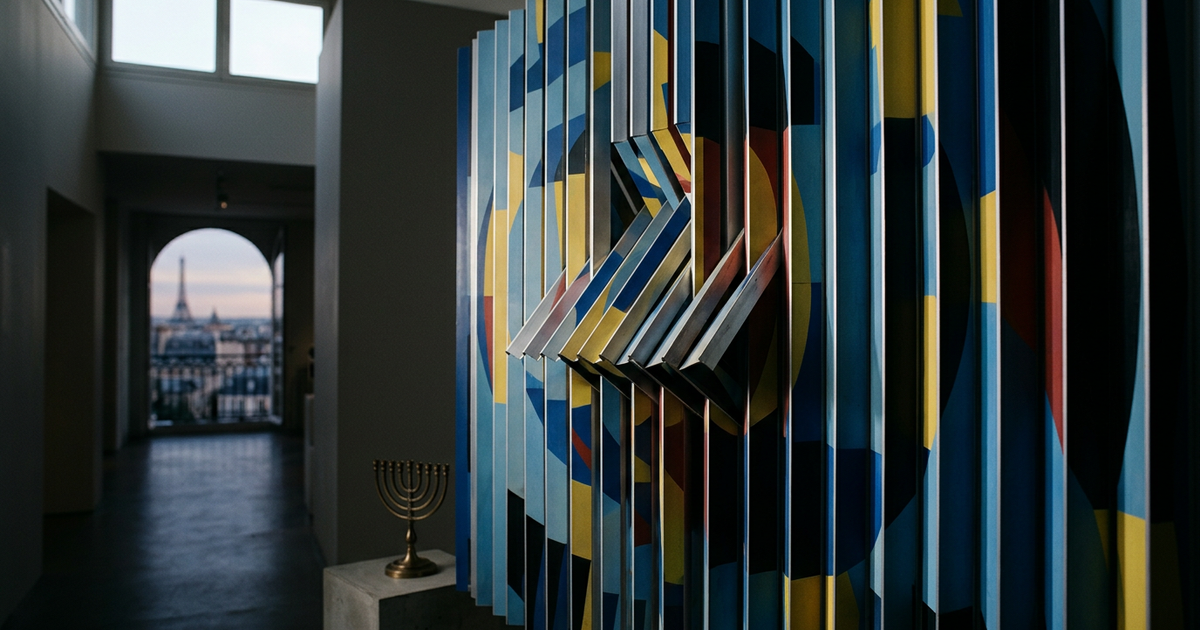
He was also, quietly, one of the most theologically interesting. The son of a rabbi and kabbalist, Agam spent his entire career taking the second commandment seriously — and routing around it. Thou shalt not make unto thee any graven image. Agam's solution: make the image impossible to fix. Build a surface that changes with every step of the viewer. No single image. Only motion. He called it perpetual becoming. The world called it kinetic art. Israel called it ours.
Funeral and shiva
- Public viewing — Yaacov Agam Museum plaza, Rishon LeZion. Monday, 22 June 2026 (7 Tammuz 5786), 14:00–16:00 local time.
- Funeral procession — Leaves the military cemetery in Rehovot, Monday at 17:00.
- Shiva — Family is sitting shiva at the Yaacov Agam Museum. Tuesday through Friday, 10:00–13:00. Tuesday and Wednesday also 16:00–20:00.
- Museum — Yaacov Agam Museum of Art (YAMA), Misha"r 1, Rishon LeZion. Tel: 03-5555-900 · yama.co.il.
What to know about Yaacov Agam
- Birth — Born Yaacov Gibstein in Rishon LeZion, May 11, 1928 — twenty years before the founding of the State of Israel.
- Family — Son of Rabbi Yehoshua Gibstein, a kabbalist. Grew up in a deeply religious home.
- Latrun — Detained by the British at Latrun during the Black Sabbath roundups of 1946.
- Training — Studied at Bezalel Academy under Mordecai Ardon, then Zurich (Johannes Itten, influence of Max Bill), then Paris from 1951.
- Invention — Mounted the first one-man exhibition in art history composed entirely of works in motion. Galerie Craven, Paris, 1953.
- Israel Prize — Received the 2026 Israel Prize for Visual Arts in April, weeks before his death.
- Market — Highest-grossing Israeli artist in auction history.
- Family today — Survived by three children — including the photographer Ron Agam and the musician Oram Agam — and his brother Hanania Gibstein, former mayor of Rishon LeZion.
- Burial — Funeral procession leaves the military cemetery in Rehovot on Monday at 5:00 p.m. local time.
The dunes, Latrun, Paris
Agam grew up watching the wind reshape the dunes outside Rishon LeZion. The lesson stayed with him for ninety years: a thing seen at noon is not the same thing seen at dusk. At eighteen he was held at Latrun. At twenty-one he was in Zurich. At twenty-three he was in Paris, where he would live, work and die seventy-five years later.
Galerie Craven, 1953. Agam mounted the first solo exhibition in the history of art composed entirely of works that moved. From that moment kinetic art had a father, and the father was Israeli. Calder, Vasarely, Soto, Tinguely — they attached themselves to the movement later. Agam was first.
Agam's ten most important works
- Galerie Craven, Paris, 1953 — the founding kinetic exhibition.
- Double Metamorphosis III — accessioned by the Centre Pompidou in 1965.
- La Défense monumental fountain — Paris, 1975.
- Fire and Water Fountain — Dizengoff Square, Tel Aviv, 1986. The most-photographed public artwork in Israel.
- 32-foot Hanukkah menorah — Fifth Avenue and 59th Street, New York, in front of the Plaza Hotel. Guinness-recognized as the largest Hanukkah menorah in the world. Lit every December.
- Faith — Visual Pray — presented to Pope Francis at the Vatican in 2014.
- Eurovision Song Contest winner's trophy — Jerusalem, 1999.
- Major retrospectives at the Musée National d'Art Moderne, the Guggenheim, and the Museum of Modern Art.
- The Yaacov Agam Museum of Art — Rishon LeZion. Opened 2017. The only museum in the world dedicated to art in motion.
- The Agam Method — a visual-language curriculum developed with the Weizmann Institute, taught in Israeli kindergartens, honored by UNESCO with the Jan Amos Comenius Medal.
The commercial answer
Agam ended his life as the highest-grossing Israeli artist at auction in the history of the market. Not the most admired by certain Tel Aviv critics — a fight he lost and bitterly noted he lost — but the most expensive. Galleries in Paris, London, New York and Hong Kong moved Agams as a recognized asset class. International collectors bought Israeli provenance with international liquidity.
A quieter datapoint tells the same story. Earlier this year Israeli reporting confirmed what insiders had whispered for years: the Iranian regime had quietly accumulated at least ten Agam works inside the country. Authoritarian governments do not stockpile art they consider worthless. They stockpile art they cannot publicly display and cannot bring themselves to destroy. That is its own kind of review.
The Israel Prize, then Paris
In April 2026, weeks before his death and confined to a wheelchair, Agam received the Israel Prize for Visual Arts at a small ceremony inside the museum bearing his name in Rishon LeZion. "Creativity," he told the room, "is the basis of Judaism." He had spent ninety-eight years proving the line. The prize was the State's quiet acknowledgement that he had been right the entire time.
Frequently asked questions
Who was Yaacov Agam?
An Israeli painter and sculptor, born 1928, died 2026. Recognized worldwide as the father of kinetic art — a movement built on works that change as the viewer moves. One of the most internationally recognized Israeli artists of all time.
How old was Yaacov Agam when he died?
98. He was born May 11, 1928, and died June 21, 2026.
Where did Yaacov Agam die?
In Paris, the city where he had lived since 1951. His burial is in Rehovot, Israel.
What is kinetic art?
A genre of visual art in which the work changes form depending on the viewer's movement or on physical motion in the piece itself. Agam's signature kinetic surfaces — vertical ridges painted on multiple planes — show different images depending on the angle of view.
What is Yaacov Agam most famous for?
Inventing kinetic art with the first solo exhibition in 1953 at Galerie Craven in Paris. His best-known public works are the Fire and Water Fountain in Dizengoff Square, Tel Aviv, the monumental fountain at La Défense in Paris, and the 32-foot Hanukkah menorah on Fifth Avenue in New York — the world's largest.
What is the Agam Method?
A visual-language curriculum Agam developed with the Weizmann Institute, designed to teach children to think in shapes, colors and patterns before they learn to read. Taught in Israeli kindergartens. Honored by UNESCO with the Jan Amos Comenius Medal.
Did Yaacov Agam win the Israel Prize?
Yes — the 2026 Israel Prize for Visual Arts, awarded in April 2026, weeks before his death.
Where is the Yaacov Agam Museum?
Rishon LeZion, Israel — his hometown. Opened in 2017. The only museum in the world dedicated entirely to art in motion.
Who are Yaacov Agam's children?
Three children, including the photographer Ron Agam and the musician Oram Agam.
Was Yaacov Agam Jewish?
Yes. The son of a kabbalist and rabbi, Agam was deeply religious throughout his life. He wove Jewish themes through his art — the Hanukkah menorah on Fifth Avenue, the work presented to Pope Francis, his repeated public statements that "creativity is the basis of Judaism."
How much is a Yaacov Agam worth?
Agam works regularly sell at international auction houses for six and seven figures. He ended his career as the highest-grossing Israeli artist at auction in the history of the market.
Where can I see Yaacov Agam's work?
Centre Pompidou (Paris), Museum of Modern Art (New York), Guggenheim Museum (New York), Yaacov Agam Museum of Art (Rishon LeZion), Dizengoff Square (Tel Aviv), La Défense (Paris), Fifth Avenue at 59th Street (New York, December only).
The image was never fixed
The fountain in Dizengoff will keep turning. The menorah on Fifth Avenue will light again in December. The dune outside Rishon LeZion will keep shifting in the wind. The image was never fixed. That was always the Jewish answer. Agam gave it form.
יהי זכרו ברוך.
May his memory be a blessing.
Lire en français
Le fils du kabbaliste qui a contourné le deuxième commandement, inventé l'art cinétique dans une galerie parisienne en 1953, et terminé sa vie comme l'artiste israélien le plus coté de l'histoire des enchères.
Yaacov Agam, le sculpteur et peintre israélien reconnu dans le monde entier comme le père de l'art cinétique, est mort dimanche à Paris à l'âge de 98 ans. Il était, à presque tous les égards qui comptent — valeur aux enchères, présence dans les musées, reconnaissance internationale, empreinte dans l'art public — l'un des plus grands artistes juifs ayant jamais vécu.
Il était aussi, discrètement, l'un des plus théologiquement intéressants. Fils d'un rabbin et kabbaliste, Agam a consacré toute sa carrière à prendre le deuxième commandement au sérieux — et à le contourner. Tu ne te feras point d'image taillée. La solution Agam : rendre l'image impossible à figer. Construire une surface qui change à chaque pas du spectateur. Pas d'image unique. Seulement le mouvement. Il appelait cela le devenir perpétuel. Le monde a appelé cela l'art cinétique. Israël a appelé cela : à nous.
Obsèques et shiva
- Recueillement public — Esplanade du Musée Yaacov Agam, Rishon LeZion. Lundi 22 juin 2026 (7 Tammouz 5786), de 14h00 à 16h00 (heure locale).
- Cortège funèbre — Départ du cimetière militaire de Rehovot, lundi à 17h00.
- Shiva — La famille observe la shiva au Musée Yaacov Agam. Mardi à vendredi, de 10h00 à 13h00. Mardi et mercredi également de 16h00 à 20h00.
- Musée — Musée Yaacov Agam (YAMA), Misha"r 1, Rishon LeZion. Tél. : 03-5555-900 · yama.co.il.
Ce qu'il faut savoir sur Yaacov Agam
- Naissance — Né Yaacov Gibstein à Rishon LeZion, le 11 mai 1928 — vingt ans avant la création de l'État d'Israël.
- Famille — Fils du rabbin Yehoshua Gibstein, kabbaliste. A grandi dans un foyer profondément religieux.
- Latrun — Arrêté par les Britanniques à Latrun lors des rafles du Black Sabbath en 1946.
- Formation — A étudié à Bezalel sous Mordecai Ardon, puis à Zurich (Johannes Itten, influence de Max Bill), puis à Paris à partir de 1951.
- Invention — A présenté la première exposition personnelle de l'histoire de l'art entièrement composée d'œuvres en mouvement. Galerie Craven, Paris, 1953.
- Prix d'Israël — A reçu le Prix d'Israël 2026 pour les arts visuels en avril, quelques semaines avant sa mort.
- Marché — Artiste israélien ayant généré les plus hauts montants de l'histoire des enchères.
- Famille aujourd'hui — Laisse trois enfants — dont le photographe Ron Agam et le musicien Oram Agam — et son frère Hanania Gibstein, ancien maire de Rishon LeZion.
- Inhumation — Cortège funèbre lundi à 17h00 depuis le cimetière militaire de Rehovot.
Les dunes, Latrun, Paris
Agam a grandi en regardant le vent remodeler les dunes aux abords de Rishon LeZion. La leçon est restée quatre-vingt-dix ans : une chose vue à midi n'est pas la même chose au crépuscule. À dix-huit ans, il est détenu à Latrun. À vingt-et-un ans, il est à Zurich. À vingt-trois ans, il est à Paris, où il vivra, travaillera et mourra soixante-quinze ans plus tard.
Galerie Craven, 1953. Agam présente la première exposition personnelle de l'histoire de l'art entièrement composée d'œuvres en mouvement. À partir de ce moment, l'art cinétique a un père, et ce père est israélien. Calder, Vasarely, Soto, Tinguely — ils se rattacheront au mouvement plus tard. Agam fut le premier.
Les dix œuvres les plus importantes d'Agam
- Galerie Craven, Paris, 1953 — l'exposition cinétique fondatrice.
- Double Métamorphose III — acquise par le Centre Pompidou en 1965.
- Fontaine monumentale de La Défense — Paris, 1975.
- Fontaine de feu et d'eau — place Dizengoff, Tel-Aviv, 1986. L'œuvre publique la plus photographiée d'Israël.
- Ménorah de Hanouka de dix mètres — Cinquième Avenue et 59e Rue, New York, devant le Plaza. Inscrite au Guinness comme la plus grande ménorah de Hanouka au monde. Allumée chaque mois de décembre.
- Faith — Visual Pray — présentée au pape François au Vatican en 2014.
- Trophée du Concours Eurovision de la chanson — Jérusalem, 1999.
- Rétrospectives majeures au Musée National d'Art Moderne, au Guggenheim et au Museum of Modern Art.
- Musée Yaacov Agam — Rishon LeZion. Ouvert en 2017. Le seul musée au monde consacré à l'art en mouvement.
- La Méthode Agam — un programme de langage visuel développé avec l'Institut Weizmann, enseigné dans les jardins d'enfants israéliens, honoré par l'UNESCO de la médaille Jan Amos Comenius.
La réponse commerciale
Agam a terminé sa vie comme l'artiste israélien ayant généré les plus hauts montants aux enchères dans l'histoire du marché. Pas le plus admiré par certains critiques tel-aviviens — un combat qu'il a perdu et qu'il a amèrement reconnu avoir perdu — mais le plus cher. Les galeries de Paris, Londres, New York et Hong Kong ont fait circuler les Agam comme une classe d'actifs reconnue. Les collectionneurs internationaux y ont trouvé une provenance israélienne avec une liquidité internationale.
Un fait plus discret raconte la même histoire. La presse israélienne a confirmé plus tôt cette année ce que les initiés murmuraient depuis des années : le régime iranien avait accumulé en silence au moins dix œuvres d'Agam à l'intérieur du pays. Les gouvernements autoritaires ne stockent pas l'art qu'ils jugent sans valeur. Ils stockent l'art qu'ils ne peuvent ni exposer publiquement ni se résoudre à détruire. C'est une critique à sa manière.
Le Prix d'Israël, puis Paris
En avril 2026, quelques semaines avant sa mort, en fauteuil roulant, Agam reçoit le Prix d'Israël pour les arts visuels lors d'une cérémonie restreinte au musée portant son nom à Rishon LeZion. « La créativité, dit-il à l'assistance, est le fondement du judaïsme. » Il avait passé quatre-vingt-dix-huit ans à le prouver. Le prix fut la reconnaissance discrète de l'État qu'il avait eu raison tout du long.
L'image n'a jamais été fixée
La fontaine de Dizengoff continuera de tourner. La ménorah de la Cinquième Avenue sera rallumée en décembre. La dune aux abords de Rishon LeZion continuera de se déplacer dans le vent. L'image n'a jamais été fixée. C'était toujours la réponse juive. Agam lui a donné une forme.
יהי זכרו ברוך.
Que sa mémoire soit une bénédiction.
לקריאה בעברית
בנו של המקובל שעקף את הדיבר השני, המציא את האמנות הקינטית בגלריה פריזאית ב-1953, וסיים את חייו כאמן הישראלי המתומחר ביותר בהיסטוריית המכירות הפומביות.
יעקב אגם, הפסל והצייר הישראלי שזכה להכרה עולמית כאבי האמנות הקינטית, נפטר ביום ראשון בפריז בגיל 98. הוא היה, כמעט בכל קנה מידה שיש בו משמעות — ערך במכירות פומביות, אחזקות מוזיאליות, הכרה בין-לאומית וטביעת רגל באמנות הציבורית — אחד האמנים היהודים הגדולים שאי פעם חיו.
הוא גם היה, בשקט, אחד המעניינים ביותר מבחינה תיאולוגית. בנו של רב ומקובל, אגם הקדיש את כל הקריירה שלו לקחת את הדיבר השני ברצינות — ולעקוף אותו. "לא תעשה לך פסל וכל תמונה." הפתרון של אגם: להפוך את הדמות לבלתי ניתנת לקיבוע. לבנות משטח שמשתנה בכל צעד של הצופה. אין דמות יחידה. יש רק תנועה. הוא קרא לזה התהוות מתמדת. העולם קרא לזה אמנות קינטית. ישראל קראה לזה: שלנו.
הלוויה ושבעה
- הצגת הארון — רחבת מוזיאון יעקב אגם, ראשון לציון. יום שני, 22.6.26 (ז' בתמוז), בין השעות 14:00–16:00.
- תהלוויית ההלוויה — יוצאת מבית העלמין הצבאי ברחובות, יום שני בשעה 17:00.
- שבעה — המשפחה יושבת שבעה במוזיאון יעקב אגם. ימים שלישי עד שישי בין השעות 10:00–13:00. בימים שלישי ורביעי גם בין השעות 16:00–20:00.
- מוזיאון — מוזיאון יעקב אגם לאמנות (YAMA), מיש"ר 1, ראשון לציון. טל': 03-5555-900 · yama.co.il.
מה צריך לדעת על יעקב אגם
- לידה — נולד יעקב גיפשטיין בראשון לציון, 11 במאי 1928 — עשרים שנה לפני הקמת מדינת ישראל.
- משפחה — בן הרב יהושע גיפשטיין, מקובל. גדל בבית דתי עמוק.
- לטרון — נעצר על ידי הבריטים בלטרון במהלך שבת השחורה ב-1946.
- הכשרה — למד בבצלאל אצל מרדכי ארדון, אחר כך בציריך (יוהנס איטן, השפעת מקס ביל), ובפריז משנת 1951.
- המצאה — הציג את תערוכת היחיד הראשונה בתולדות האמנות שכולה מורכבת מיצירות בתנועה. גלריה קרייבן, פריז, 1953.
- פרס ישראל — קיבל את פרס ישראל 2026 לאמנות פלסטית באפריל, שבועות לפני מותו.
- שוק — האמן הישראלי שייצר את המחזורים הגבוהים ביותר בהיסטוריית המכירות הפומביות.
- משפחה כיום — מותיר אחריו שלושה ילדים — בהם הצלם רון אגם והמוזיקאי אורם אגם — ואת אחיו חנניה גיפשטיין, ראש העיר לשעבר של ראשון לציון.
- קבורה — תהלוכת ההלוויה יוצאת ביום שני בשעה 17:00 מבית הקברות הצבאי ברחובות.
הדיונות, לטרון, פריז
אגם גדל וצפה ברוח שמעצבת מחדש את הדיונות מחוץ לראשון לציון. הלקח נשאר איתו תשעים שנה: דבר שנראה בצהריים איננו אותו דבר שנראה בערב. בגיל שמונה עשרה הוחזק בלטרון. בגיל עשרים ואחת היה בציריך. בגיל עשרים ושלוש היה בפריז, שבה יחיה, יעבוד וימות שבעים וחמש שנים לאחר מכן.
גלריה קרייבן, 1953. אגם הציג את תערוכת היחיד הראשונה בתולדות האמנות שכולה מורכבת מיצירות שזזות. מאותו רגע הייתה לאמנות הקינטית אב, והאב היה ישראלי. קלדר, ואזארלי, סוטו, טנגלי — כולם הצטרפו לתנועה רק לאחר מכן. אגם היה הראשון.
עשר היצירות החשובות ביותר של אגם
- גלריה קרייבן, פריז, 1953 — התערוכה הקינטית המייסדת.
- "מטמורפוזה כפולה III" — נרכשה על ידי מרכז פומפידו ב-1965.
- מזרקה מונומנטלית בלה דפאנס — פריז, 1975.
- מזרקת "אש ומים" — כיכר דיזנגוף, תל אביב, 1986. היצירה הציבורית המצולמת ביותר בישראל.
- מנורת חנוכה בגובה עשרה מטרים — שדרה חמישית ורחוב 59, ניו יורק, מול מלון פלאזה. רשומה בגינס כמנורת החנוכה הגדולה בעולם. מודלקת מדי דצמבר.
- "אמונה — תפילה חזותית" — הוגשה לאפיפיור פרנציסקוס בוותיקן ב-2014.
- גביע הזוכה באירוויזיון — ירושלים, 1999.
- רטרוספקטיבות מרכזיות במוזיאון הלאומי לאמנות מודרנית, בגוגנהיים ובמוזיאון לאמנות מודרנית בניו יורק.
- מוזיאון יעקב אגם לאמנות — ראשון לציון. נפתח ב-2017. המוזיאון היחיד בעולם המוקדש לאמנות בתנועה.
- שיטת אגם — תוכנית לימודי שפה חזותית שפותחה עם מכון ויצמן, נלמדת בגני הילדים בישראל, וזכתה במדליית יאן עמוס קומניוס של אונסק"ו.
התשובה המסחרית
אגם סיים את חייו כאמן הישראלי שייצר את המחזורים הגבוהים ביותר בהיסטוריית המכירות הפומביות. לא הנערץ ביותר על ידי מבקרים תל-אביביים מסוימים — קרב שהפסיד וציין במרירות שהפסיד — אלא המתומחר ביותר. גלריות בפריז, לונדון, ניו יורק והונג קונג סחרו ביצירות אגם כסוג נכס מוכר. אספנים בין-לאומיים מצאו בהן פרובננס ישראלי עם נזילות בין-לאומית.
יש נתון שקט יותר שמספר את אותו סיפור. מוקדם יותר השנה אישרה התקשורת הישראלית את מה שגורמים בענף לחשו במשך שנים: המשטר האיראני אגר בשקט לפחות עשר יצירות אגם בתוך גבולותיו. ממשלות סמכותניות אינן אוגרות אמנות שהן מחשיבות חסרת ערך. הן אוגרות אמנות שאינן יכולות להציג בפומבי ואינן מסוגלות להביא את עצמן להשמיד. זו ביקורת מסוג משלה.
פרס ישראל, ואז פריז
באפריל 2026, שבועות לפני מותו, מכיסא גלגלים, קיבל אגם את פרס ישראל לאמנות פלסטית בטקס מצומצם במוזיאון הנושא את שמו בראשון לציון. "היצירתיות," אמר לנוכחים, "היא הבסיס של היהדות." הוא בילה תשעים ושמונה שנים בהוכחת המשפט. הפרס היה ההכרה השקטה של המדינה בכך שצדק כל הזמן.
הדמות מעולם לא קובעה
המזרקה בדיזנגוף תמשיך להסתובב. המנורה בשדרה החמישית תודלק שוב בדצמבר. הדיונה מחוץ לראשון לציון תמשיך לזוז ברוח. הדמות מעולם לא קובעה. זו תמיד הייתה התשובה היהודית. אגם נתן לה צורה.
יהי זכרו ברוך.