Two Markets in One City: Inside Tel Aviv's Trophy/Mainstream Bifurcation
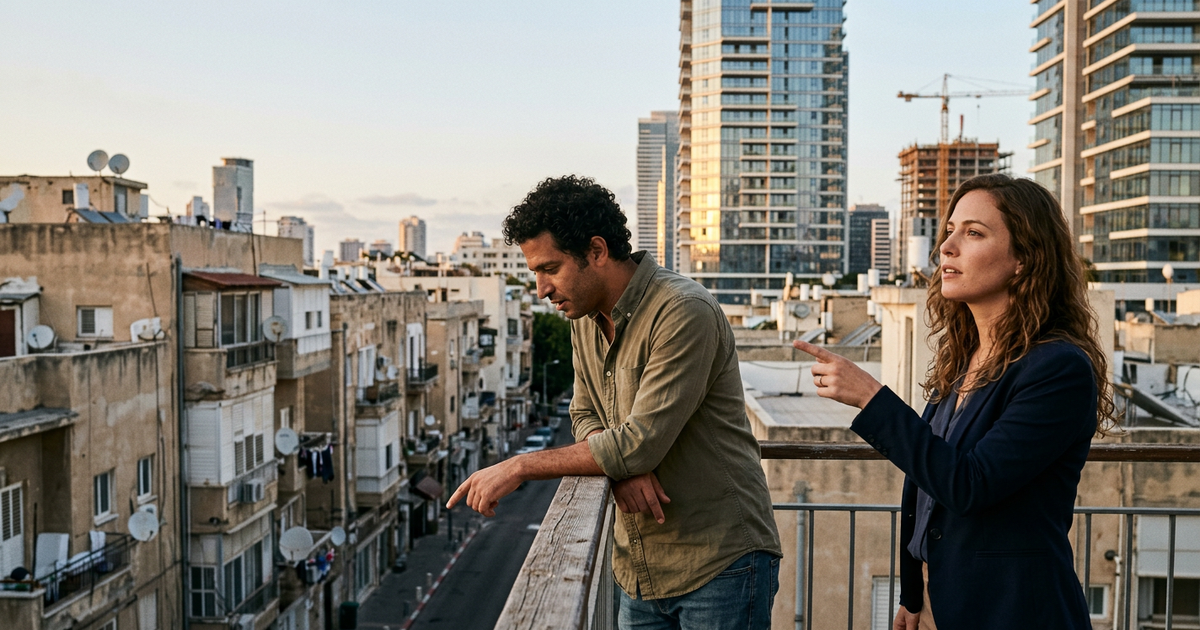
The Tel Aviv real estate aggregate is misleading. Rothschild 10 sold floors at ₪200,000/m² to foreign cash buyers while the mainstream index moved on rates and inventory. Inside the bifurcation, the foreign-buyer cost architecture, and the trophy-tier drivers.
The Tel Aviv real estate aggregate is misleading.
The reported price indices show modest correction. The actual market is operating in two segments simultaneously, and the divergence is widening.
The aggregate
Transaction volumes dropped through 2024 and 2025. According to broker data and CBS coverage in Times of Israel, days-on-market lengthened to 50–60 days for correctly priced apartments and 90–120 days for overpriced or hard-to-finance units. Most properties closed at 2–6% below asking; only roughly 10–15% of transactions cleared above asking — typically scarce financeable units with parking, an elevator, and a mamad (safe room) in prime micro-locations.
The CBS Dwelling Price Index recorded eight consecutive months of decline through late 2025, then a partial early-2026 rebound. In the twelve months ending February 2026, per CBS data published by Times of Israel: Jerusalem +9.6%, North +4.8%, South +1.4%, Tel Aviv −1.9%.
The trophy tier
Per market data summarized by Ronkin Real Estate: when penthouses trade at ₪200,000/m² or rent for ₪75,000+ monthly, the conversation shifts. The relevant variables become global wealth storage, lifestyle branding, and severe scarcity dynamics — not shelter economics.
Several 2025–2026 transactions illustrate the tier:
Rothschild 10, Tel Aviv (Tidhar Group / Weiss Group / Ziv Aviram tower; managed by Six Senses):
- April 2026 — American activist investor Bill Ackman acquired a luxury apartment for an estimated NIS 70 million, equivalent to over $20 million, per Ynet. The reported price equates to approximately NIS 200,000 per square meter. The purchase extended Ackman's prior January 2024 acquisition of a roughly 5% stake in the Tel Aviv Stock Exchange.
- November 2025 — An entire 600 m² floor sold to an unnamed foreign buyer for approximately NIS 106 million, per Madlan/Ynet. The deal had not yet been reported to the Israel Tax Authority at year-end 2025.
- June 2025 — A 313 m² apartment on the 35th floor sold for NIS 51 million, per Madlan/Ynet.
Caesarea — A seafront villa on HaHadre Street sold for a record NIS 78 million in February 2025. The property includes 1,700 m² of built space on 6.4 dunams. Buyers: Reuven and Sandy Moskowitz of the United States. Per Ynet.
Talbiyeh, Jerusalem — A Hovevei Zion Street villa, 650 m² on 860 m² of land, sold in April 2025 for NIS 78.9 million, per Madlan/Ynet. The property had previously housed the Buber family. Seller: Michael Steinhardt. Buyer: Canadian businessman Ronnen Harary, co-founder of Spin Master.
The foreign-buyer composition
Marc Lugassy of Barnes Israel reported that nearly 60% of the firm's 2025 luxury transactions involved foreign residents. This is a broker-disclosed share, not a figure from the official transaction registry. Per Barnes commentary, buyers from North America and Europe — including Italy and Canada — were involved in the most expensive transactions.
Per Semerenko Group's Q1 2026 commentary, the ultra-prime seafront and Rothschild market is operating largely in cash, on logic disconnected from Israeli mortgage rates. The buyer profile concentrates in France and the US.
Treat broker quotes as broker quotes. They describe direction. They are not registry data.
The currency variable
The shekel reached a four-year high against the dollar in early 2026 — approximately 3.08 to the dollar. The currency move complicates the foreign-buyer math.
The mechanical link between the shekel and US tech stocks broke in 2024–2025. Historically, Israeli institutions sold dollars against NASDAQ exposure, creating a stocks-up / shekel-up correlation. M&A flows reshaped that picture. The Wiz and CyberArk transactions added meaningful one-time dollar conversions to the system. As 2026 M&A flow normalizes, the shekel may revert.
The foreign-buyer cost architecture
Foreign buyers operate under a different fiscal regime than residents.
- Purchase tax (Mas Rechisha): 8% on the first portion, 10% on the balance, per Israel Tax Authority schedules. Israeli first-home residents pay 0% on the first ₪1.94M.
- Mortgage LTV: 50–60% for foreign buyers at 4.8–6.5% interest, versus 70–75% for residents.
- Total closing costs: Typically 10–13% of purchase price. Purchase tax represents 75–85% of that total.
- Land structure: A meaningful portion of Israeli land — including parts of Tel Aviv — is state-owned via Israel Land Authority leasehold (49–98 years, renewable and transferable) rather than Tabu freehold.
What's coming
The aliyah tax reform pulls demand forward. Olim arriving in the November 2025 to December 2026 window are buying ahead of the tax-window close.
French aliyah continues to steepen. The 45% rise in 2025 came before the reform.
The trophy tier operates on different drivers. Foreign-buyer cash transactions at ₪150,000–₪200,000+/m² are unhedged to local mortgage and macro conditions.
The aggregate index will keep moving with rates and volumes. The trophy tier should be analyzed separately from the aggregate index.
Source data: Israel Central Bureau of Statistics (CBS); Israel Tax Authority; Israel Land Authority; Bank of Israel; coverage in Times of Israel, Ynet Real Estate, Calcalist, Globes; Madlan transaction analysis; broker commentary from Barnes Israel, Semerenko Group, Sands Of Wealth, Ronkin Real Estate.