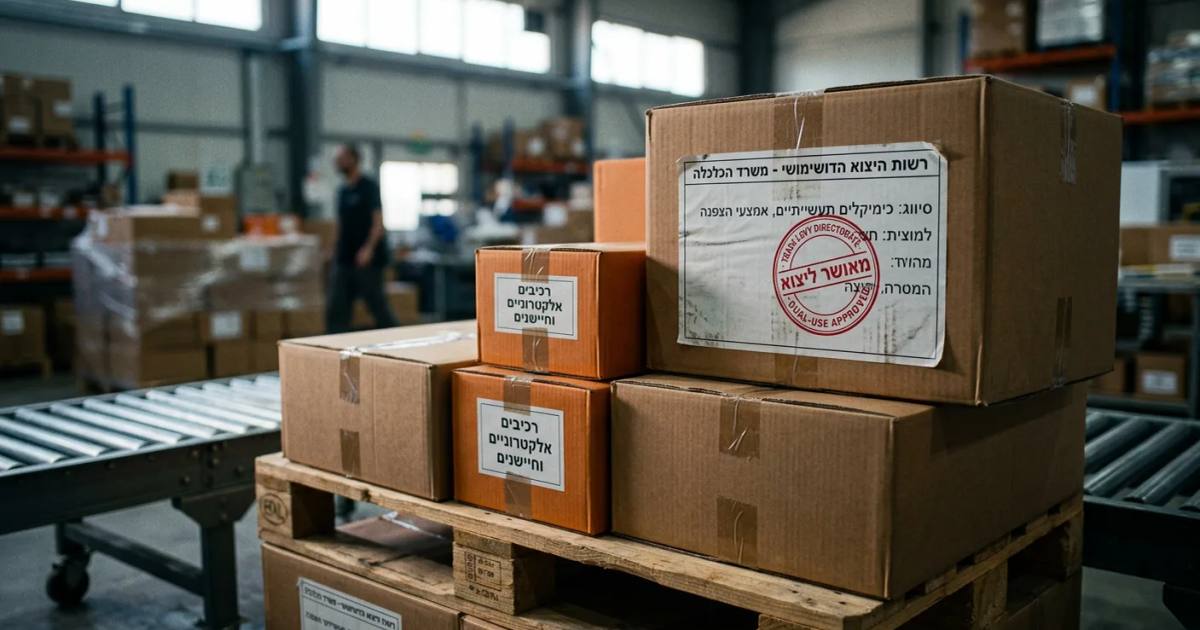

The Trade Levy Directorate licenses civilian dual-use exports for Israeli tech firms. It operates in parallel to DECA with different criteria.
Ask most Israeli technology executives who administers Israeli export control, and the answer is DECA. That answer is right for defense articles. It is wrong for civilian dual-use goods — which is the category most Israeli technology firms actually export.
The civilian track runs through the Trade Levy Directorate inside the Ministry of Economy. It administers the Israeli Order for Free Export, licenses dual-use exports across chemicals, biological materials, encryption, semiconductors, and specified categories of software, and coordinates with the four multilateral export-control regimes without Israel being a member of any of them. It operates in parallel to DECA. It applies different criteria. It answers to a different minister. And most Israeli technology firms discover it only when a specific transaction requires a license that DECA cannot issue.
Understanding the Trade Levy Directorate — its scope, its licensing regime, its coordination with DECA on the Israeli side and with the US export architecture on the American side — is the missing piece of the Israeli export-control picture. This is the operator's manual for the track most Israeli firms don't know they're on.
What Is the Trade Levy Directorate, and Where Does It Sit in the Israeli Government?
The Trade Levy Directorate — in Hebrew, Minhal Ha'Missim Ha'Miskharim — sits inside the Ministry of Economy and Industry. It is the successor to the Ministry of Industry, Trade and Labor's export-control functions, following the ministerial restructuring that consolidated economic administration under a single Ministry of Economy in 2014.
Its principal statutory authority derives from the Import and Export Ordinance and the Order for Free Export (Aluf Israeli), the regulation that lists controlled dual-use goods and specifies the licensing regime. The Order for Free Export is periodically updated by ministerial regulation — most recently with substantive revisions tracking Wassenaar list updates and the 2022-2024 US semiconductor rules.
The Directorate operates within the Foreign Trade Administration inside the Ministry of Economy. Its licensing authority runs through a specific unit dedicated to dual-use goods, headed by a director-level civil servant reporting through the Foreign Trade Administration leadership to the Director General of the ministry and ultimately to the Minister of Economy.
Its staffing is small relative to the DECA operation — reflecting both the smaller volume of civilian dual-use licensing versus defense exports and the historically lower political priority attached to civilian export control. That balance has been shifting since roughly 2022, as US pressure on Israel to align dual-use policy with the semiconductor and China frameworks has increased.
What Does the Order for Free Export Actually Control?
The Order for Free Export lists controlled dual-use goods across seven principal categories, tracking the substantive coverage of the Wassenaar Dual-Use List with modifications reflecting Israel's implementation of the other three multilateral regimes:
- Nuclear-related goods and technology — tracking Nuclear Suppliers Group substantive controls
- Missile-related goods and technology — tracking Missile Technology Control Regime substantive controls
- Chemical precursors and biological materials — tracking Australia Group substantive controls
- Advanced materials — tracking Wassenaar Basic and Sensitive Lists
- Electronics and computers — including specified categories of semiconductors, integrated circuits, and computing systems
- Sensors and lasers — including specified imaging, guidance, and detection systems
- Encryption goods and software — tracking Wassenaar Category 5 Part 2 substantive controls, coordinated with US EAR encryption regime
Each category defines specific technical parameters that trigger licensing — key length for encryption, chip performance thresholds for semiconductors, chemical composition for controlled precursors, and so on. The parameters generally track the corresponding multilateral regime specifications, with periodic updates to reflect regime plenary decisions.
The Order for Free Export also includes an end-use control component. Even where a specific item is not listed by technical parameters, an export can be subject to licensing if the exporter knows or has reason to know that the end-use is for weapons of mass destruction, missile technology, or specified military applications. This "catch-all" provision extends Trade Levy Directorate jurisdiction beyond the listed categories.
How Does Trade Levy Directorate Licensing Work in Practice?
The licensing process runs through several stages:
Classification. The exporter — often with the assistance of specialized Israeli export-control counsel — classifies the product against the Order for Free Export. Where classification is ambiguous, the exporter can submit a classification request to the Directorate. Turnaround runs weeks to months depending on complexity.
License application. For classified items requiring a license, the exporter files a license application specifying the item, quantity, value, destination, end user, and end use. Supporting documentation — end-user certificates, technical specifications, contract terms — accompanies the filing.
Interagency review. The Directorate coordinates with other Israeli government bodies as needed — Ministry of Defense on defense-adjacent items, Ministry of Foreign Affairs on destinations with foreign-policy considerations, intelligence services on end-user vetting for sensitive categories. The interagency review can be brief for routine transactions or extended for sensitive ones.
Decision. The Directorate issues an export license (typically with specified conditions), a denial, or a request for additional information. Licenses generally run for specified periods — commonly one to two years — and cover specified quantities or transaction values.
Post-license monitoring. The Directorate maintains records and periodically audits licensed exporters. Specific transactions can be subject to post-shipment verification, particularly for sensitive end-users or destinations.
The full process from classification through license issuance can run from weeks (for routine, low-sensitivity transactions) to a year or more (for complex, sensitive, or novel transactions). Sophisticated Israeli exporters build licensing timeline into their commercial planning.
How Do the Ministry of Economy and Ministry of Defense Divide Jurisdiction?
The line between civilian dual-use (Trade Levy Directorate) and defense articles (DECA) is not always clean. Three general principles govern the division:
Item character determines primary jurisdiction. Items designed primarily for military application fall under DECA. Items designed primarily for civilian application with potential military use fall under Trade Levy Directorate. The determination is item-specific and can require detailed technical analysis.
End-use can shift jurisdiction. A civilian dual-use item destined for a military end-user in specified countries can shift to DECA jurisdiction under the end-use control provisions of the 2007 Defense Export Control Law. The shift reflects the substantive concern (military application) rather than the item's default classification.
Overlapping jurisdiction exists for specified categories. Encryption, certain sensors, and specific electronic warfare-adjacent items can require licenses from both agencies for the same transaction. The two-agency licensing scenario is not common but does occur for the most sensitive category of exports.
Coordination between the two agencies operates through standing liaison arrangements. For a specific transaction that straddles the boundary, the exporter typically approaches one agency, which then determines whether the other agency needs to be involved. The overhead is real but generally manageable for sophisticated Israeli exporters.
How Does the Trade Levy Directorate Handle the Semiconductor and China Question?
The October 2022 US BIS semiconductor rules, expanded in October 2023 and December 2024, created a substantive challenge for Israeli semiconductor exports to Chinese customers. Israeli firms in the space needed to navigate parallel Israeli and US licensing requirements, with the US requirements substantially more restrictive than the Israeli baseline.
The Trade Levy Directorate's response has been to align Israeli licensing practice with the US framework, without publishing an explicit Israeli policy shift equivalent to the US rules. In practical terms: license applications for controlled Israeli semiconductor items destined for Chinese customers face heightened scrutiny at the Directorate, longer review timelines, and — for advanced-node categories — a materially higher denial probability.
The alignment is administrative rather than statutory. The Order for Free Export has not been amended to specifically restrict semiconductor exports to China. But licensing practice under the existing controls has tightened in ways that produce substantively similar outcomes.
Israeli semiconductor firms with Chinese customer exposure have adjusted. Multiple firms have restructured product lines to shift out of controlled categories where possible. Others have reduced or eliminated Chinese customer exposure entirely. The Foreign Direct Product Rule — which reaches Israeli chips designed on US EDA tools regardless of Israeli licensing — provides an additional layer that Israeli firms cannot avoid regardless of Directorate licensing outcomes.
How Does the Directorate Handle Encryption Exports?
Encryption is the single largest category of Trade Levy Directorate licensing by transaction volume. The Israeli cybersecurity sector — one of the largest in the world outside the United States — operates predominantly under Directorate encryption licensing.
The Israeli framework tracks the US EAR encryption regime substantively while operating under Israeli licensing authority. Israeli firms typically classify encryption products under Israeli categories that correspond to US ECCN classifications, and license against Israeli criteria that align with US license exception patterns.
Three principal license patterns operate:
- Mass-market encryption. Consumer-grade encryption products with widely available technology face streamlined licensing. Israeli firms in this category typically hold blanket licenses for authorized destinations with periodic reporting requirements.
- Enterprise and business encryption. Business-grade encryption for enterprise customers requires transaction-specific licensing with more detailed end-use documentation.
- Government and defense-adjacent encryption. Products designed for government or defense end-use, or with technical parameters exceeding specified thresholds, face heightened scrutiny and can involve DECA jurisdiction under the end-use provisions.
For sophisticated Israeli cybersecurity firms, encryption licensing is an operational routine — filed periodically, tracked against transaction volume, coordinated with US EAR classification. For less sophisticated firms, the encryption licensing regime is often the first surprise export-control encounter — typically discovered when a customer requests documentation the firm has not filed.
How Does Trade Levy Directorate Licensing Interact With US Export Control?
Every Israeli export subject to the Order for Free Export that also contains US-origin content faces parallel Israeli and US licensing requirements. The sequencing generally runs:
- US export license or license exception — for the US-origin content, from BIS under EAR (or State under ITAR if the content is defense-article-classified)
- Israeli export license — from Trade Levy Directorate (or DECA if defense-classified)
- Actual export — completed only after both authorizations are in hand
The parallel-tracks reality is the standard operating model for Israeli dual-use exporters with US content exposure. The compliance overhead is real but manageable. The strategic challenge is the timeline coordination — a US license can be granted quickly while an Israeli license runs slowly, or vice versa, and the transaction can only close when both are in place.
For Israeli exports containing no US-origin content, only the Israeli license is required. But the Foreign Direct Product Rule can reach Israeli exports that used US-origin technology in design or production, even without US-origin content in the finished product. Israeli exporters need to run the FDPR analysis in parallel with the Israeli licensing analysis to identify exposure.
What Do Most Israeli Firms Not Know About the Trade Levy Directorate?
Five specific gaps show up repeatedly in Israeli export-control audits:
The catch-all end-use provision. Israeli firms often assume that an item not listed in the Order for Free Export requires no license. The catch-all provision — under which any item destined for a weapons of mass destruction or missile technology end-use requires a license regardless of listing — extends Directorate jurisdiction beyond the technical parameters. Firms without a catch-all screening process face compliance exposure they may not be aware of.
Encryption classification defaults. Many Israeli cybersecurity firms operate under assumed mass-market encryption classification without having filed the corresponding documentation with the Directorate. The gap is typically discovered during due diligence for an acquisition or financing, at which point retroactive compliance is more expensive than pre-transaction compliance would have been.
Post-license monitoring obligations. Israeli firms holding Directorate licenses often do not track license conditions, end-use restrictions, and reporting requirements systematically. Non-compliance with license conditions is a substantive violation, not merely a technical one.
Recordkeeping requirements. The Order for Free Export imposes recordkeeping obligations on Israeli exporters — comparable to the US Part 762 requirements but with Israeli-specific document retention periods and content requirements. Israeli firms often maintain records to serve US requirements without confirming Israeli-side compliance.
The Directorate's specific relationship with DECA. Israeli firms often assume the two agencies operate as a single Israeli export-control body. They do not. Distinct criteria, distinct staff, distinct licensing outcomes for substantively similar transactions can result. Understanding which agency has primary jurisdiction over a specific transaction is not obvious and can affect timeline and outcome materially.
What Should Israeli Technology Firms Do About Trade Levy Directorate Exposure?
Six operational priorities:
- Classify products against the Order for Free Export explicitly. Formal classification, documented in the firm's compliance records, protects against later disputes about whether a license was required.
- File licenses proactively for controlled items. The alternative — filing only after a specific transaction requires it — creates timeline pressure that often reduces licensing flexibility.
- Screen end-uses systematically for the catch-all provision. Even unlisted items require screening against weapons of mass destruction and missile technology end-uses.
- Coordinate with US licensing. For any transaction with US-origin content, run both Israeli and US analyses in parallel from the outset.
- Track license conditions and reporting. Post-license compliance is as important as pre-license compliance.
- Engage specialized counsel. The Israeli export-control bar is smaller than the US CFIUS bar but similarly specialized. Working with counsel that regularly interfaces with the Directorate is materially different from working with general commercial counsel.
The Trade Levy Directorate is not the visible face of Israeli export control. DECA is more publicly discussed; SIBAT publishes the annual numbers that get press coverage. But for the substantial majority of Israeli technology exports — civilian dual-use goods including encryption, semiconductors, sensors, and advanced materials — the Directorate is the licensing authority that matters. Understanding it is not optional. It is the missing operator's manual for the actual Israeli export-control regime most technology firms actually operate under.
Related in Olam:
- Israel's 2007 Defense Export Control Law: The SIBAT–DECA Licensing Architecture
- DECA: How Israel Licensed $14.8B in Defense Exports in 2024
- The US Export Administration Regulations: An Israeli Operator's Manual
- ITAR: The US Munitions Ceiling on Israeli Defense Exports
- The BIS Entity List: NSO Group, Candiru, and What Listing Actually Does to an Israeli Company
- The Foreign Direct Product Rule: How US Export Control Reaches Israeli Products Made Without US Parts
- How Israel's MOD Cut the Cyber Export List From 102 to 37
- Why Israeli Founders Build a Delaware C-Corp on Day One: The Export Control Playbook