
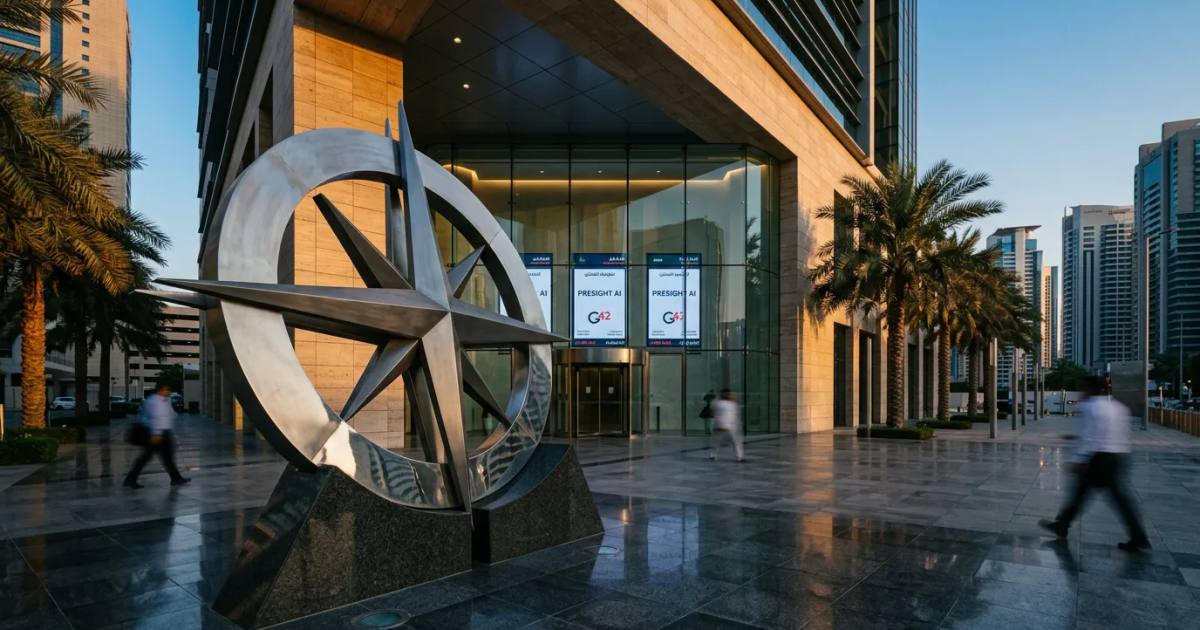

Listed on the ADX in March 2023. Big-data analytics. The only tradable proxy on the entire Abu Dhabi AI thesis — and nobody in New York is running the trade.
The setup
Presight AI Holding PLC trades on the Abu Dhabi Securities Exchange under the ticker PRESIGHT. It listed on March 27, 2023. The IPO raised $496 million, was oversubscribed roughly 136 times, and priced at AED 1.34 per share. It was, at the time, the largest pure-play AI listing anywhere in the world. Current market capitalization sits at approximately AED 20 billion — about $5.5 billion at the dirham peg.
That is the surface. Underneath it: Presight is the only listed vehicle in the entire G42 group. G42 itself is private. Core42 is private. Space42 is a merger vehicle. Inception is private. MGX, the $100 billion sovereign AI fund that shares the Sheikh Tahnoun bin Zayed leadership orbit, has no public disclosure at all. Presight is the one tradable window.
What sits above it
Understanding Presight requires understanding the stack. From top down:
Sheikh Tahnoun bin Zayed Al Nahyan — UAE National Security Advisor and brother of the President — sits at the apex of the Abu Dhabi AI and intelligence architecture. He chairs IHC (International Holding Company), the $240 billion market cap listed conglomerate, and controls or influences ADQ, First Abu Dhabi Bank, Royal Group, and the newer sovereign vehicles.
G42 is the operating group. Founded in 2018. Peng Xiao is CEO. Its parent, per the last disclosed structure, is a Tahnoun-linked vehicle. G42's balance sheet took a $1.5 billion investment from Microsoft in April 2024 — the deal that formalized G42's pivot away from Chinese hardware suppliers (Huawei, in particular) and toward the American AI stack. Microsoft's Brad Smith joined the G42 board as part of that transaction.
Below G42 sit the operating units. Core42 runs the cloud and sovereign infrastructure — the data centers, the compute, the government-cloud contracts. Inception is the applied AI and Arabic large-language-model team (Jais, Nanda). Space42 is the merged satellite vehicle combining Yahsat and Bayanat. Khazna is the data-center joint venture with MGX and Silver Lake. Presight is the analytics and applications layer.
Presight itself was carved out of Group 42 and IHC assets in 2023. IHC still owns the majority of Presight through the listed float structure. So the public shareholder is buying a minority stake in an operating subsidiary of a private group controlled by the UAE's national security architecture. That is not a disclaimer. That is the trade.
What Presight actually does
Presight sells sovereign analytics. The core product is a big-data-and-AI platform that a government buys, trains on its own data — police records, tax filings, mobility data, health records, customs — and operates as a national analytics capability. The pitch is that a mid-sized state can buy what Palantir sells the US Department of Defense, without licensing anything from an American vendor, and without exposing sovereign data to US export-control jurisdiction.
The customer base begins at home. Abu Dhabi Police, the Department of Finance, the Ministry of Interior, the Department of Health, TAMM (the government services platform), and the Statistics Centre are anchor customers. Public disclosures place the UAE government share of revenue at roughly 60–70 percent, though that mix is falling as international contracts scale.
Recent international signings, in order of size and strategic weight:
Angola — a national digital-transformation contract signed in 2024, structured with Presight running the analytics layer over multiple ministries. Reported value in the $300–500 million range over a multi-year term.
Uzbekistan — signed 2024, an anchor contract in Central Asia positioning Presight as the sovereign-analytics provider for the Tashkent government's smart-city and e-government stack.
Kazakhstan, Egypt, Turkey, and multiple sub-Saharan African states — smaller contracts, but the pattern is legible: Presight is being sold as the emerging-market alternative to Palantir Foundry, positioned into countries where a US government-adjacent vendor is politically difficult and a Chinese vendor is technologically or diplomatically constrained.
Commercial expansion beyond government is underway through the HSBC partnership on financial-crime analytics, the Modon partnership on urban-development analytics, and the AIQ joint venture (with ADNOC) for oil-and-gas applications.
The financials
2022 revenue: $423 million. 2023 revenue: approximately $326 million on a full-year basis after the carve-out restructuring, with the IPO year distorting comparability. 2024 revenue: approximately $464 million. Growth is running at roughly 25–35 percent annually depending on how you handle the carve-out base.
Net profit margin has held in the 15–20 percent range. Order book at the last disclosure exceeded $700 million, and management guidance points to that figure growing on the international contract cadence.
At the current market capitalization of approximately $5.5 billion, Presight trades at a rough 12x trailing sales and roughly 60–80x trailing earnings. That is not cheap on a headline basis. But the multiple compression relative to US comparables is stark: Palantir trades at roughly 60x sales and 400x earnings. The relative valuation gap between Presight and Palantir — for businesses selling adjacent products into adjacent customer segments — is the trade.
The Microsoft overlay
Microsoft's $1.5 billion G42 investment reshapes the Presight thesis. G42 committed publicly to divesting its Chinese-vendor exposure, standardizing on Microsoft Azure for cloud infrastructure, and adopting a US-aligned technology and security posture. In practice this means Presight's compute increasingly runs on Azure, Presight's models increasingly train on Microsoft AI infrastructure, and Presight's sales into US-adjacent jurisdictions increasingly benefit from Microsoft channel co-selling.
The overlay reduces the political discount on Presight. A year ago the equity carried a real risk that CFIUS-style secondary sanctions or US export-control friction would freeze its international expansion. The Microsoft deal was the mechanism the UAE used to make that risk go away. It has, largely, gone away. The stock has not fully repriced for that.
The leadership
Chairman: Peng Xiao — also G42 CEO. Chinese-born, US-educated (New Mexico Tech), naturalized US citizen who relinquished US citizenship prior to becoming G42 CEO. His personal biography is the flashpoint in every American press piece about G42. It is also the reason the Microsoft deal was structured the way it was.
CEO: Thomas Pramotedham. Former Splunk regional leader, prior SAP roles, hired in 2022 to run Presight as a standalone commercial entity. His mandate is the international commercial expansion — the Angola, Uzbekistan, HSBC, Modon deals ran through his office.
CFO: Ridhima Datta. Prior finance roles at G42 and IHC. The listing, the carve-out accounting, and the ongoing IHC-parent transactions run through her.
The Israeli angle
For Israeli companies, Presight is the most legible entry point into the G42 group. G42 itself does not sign public partnerships with Israeli firms — the Emirati government relationship with Israeli defense and cyber vendors is real but structurally quiet. Presight is different. It is listed. It reports. Its board and management can be reached through normal capital-markets channels. Its procurement runs through documented commercial processes.
The natural Israeli counterparties are the sovereign-analytics and government-tech vendors: NSO, Cognyte, Cellebrite, Verint, Rafael's civilian-analytics units, the ex-8200 founding cohort building government-cloud AI. A licensing deal, a channel partnership, or a joint venture structured through Presight is documentable in a way that a G42-direct deal is not. That legibility matters. Israeli companies that want the UAE government market can enter it through Presight without exposing themselves to the political friction of a direct G42 relationship.
The reverse trade is also real: Israeli venture and family-office capital can buy Presight equity in size on the ADX without any of the export-control questions that surround direct G42 investment. The stock is one of the very few tradable ways for Tel Aviv capital to take a position on Abu Dhabi AI without a private placement, a side letter, or a political sign-off.
The trade
Nobody in New York is running a serious Presight thesis. The stock trades in a market most global funds don't cover — ADX weightings in EM indices are small, and the free float is thin enough to keep large US institutions out. Sell-side coverage is thin: EFG Hermes, HSBC, and a handful of regional shops. No US-listed ADR. No dual listing planned.
The result is a listed vehicle carrying real exposure to the largest sovereign AI program on earth, priced by a market that is not paying attention. The valuation gap to Palantir is not a permanent state. It will compress. The compression will happen through one of three vectors: a dual listing, a major Western institutional buyer building a position on the ADX, or a large international contract announcement that forces global coverage.
The window to enter quietly is the current one. When the gap closes, the trade will look obvious in retrospect — the same way every emerging-market technology trade has looked obvious in retrospect, right after the window to enter it quietly has closed.
Risks
Concentration risk: Abu Dhabi government contracts still drive the majority of revenue. A political shift inside the UAE — a change in Tahnoun's portfolio, a leadership transition, a sovereign-priority reset — would hit Presight harder than a diversified US-listed comp.
Related-party risk: IHC is the majority owner and a major customer through affiliated entities. The transfer-pricing and revenue-recognition questions that surround IHC's broader ecosystem apply. Auditor is KPMG Lower Gulf.
Sanctions overhang: the Microsoft deal reduced but did not eliminate the possibility that a future US administration reopens the G42 file. A CFIUS-adjacent action targeting the G42 parent would flow through to Presight equity, regardless of Presight's operational independence.
Liquidity: average daily trading volume is thin relative to a US-listed comp. Getting a position in — and getting out — is a real operational constraint for a fund running institutional size.
None of these break the thesis. They price it.
How we report: Olam stories draw on public filings, company disclosures and named sources, checked by our editors. Read our methodology · Corrections