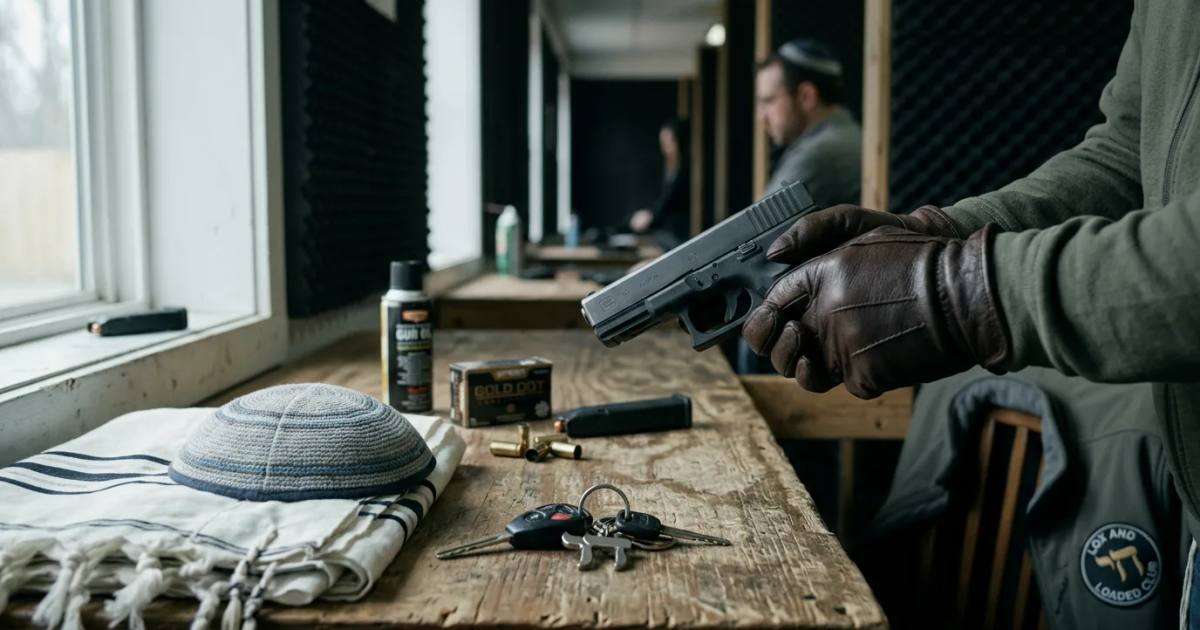

Lox and Loaded runs 59 chapters in 24 states. Twelve rabbis broke with the Orthodox Union in 2014. And in New York City, a Jew who owns a gun legally still cannot carry it to shul, on the subway, or into a museum, under penalty of a class E felony. Updated Sept. 7, 2026, with a new entry on Caliber 3.
This is Study 4 of 4 in the Olam Institutional Accountability Framework investigation of American Jewish organizations and firearms. Study 1 audited every Conference of Presidents member for its firearms position. Study 2 followed the $765 million. Study 3 followed UJA-Federation's $8.6 million. This study covers the organizations that did answer the question, and the law that answers it for them.
Updated September 7, 2026, with an additional entry on Caliber 3, the Israeli counter-terror academy training US synagogue volunteer teams.
Study 1 of this series established that not one of the 53 national organizations in the Conference of Presidents has issued a formal position on whether Jews inside a sanctuary should be armed. That is not because nobody in American Jewish life has answered the question. It is because the people who answered it built their own organizations to do it.
There are now Jewish gun clubs in at least 24 states. One of them partnered with the National Rifle Association in April 2026. One of them sued the governor of New York to carry a pistol into a synagogue. One of them assembled twelve rabbis in 2014 to formally refute the Orthodox Union and the Rabbinical Council of America on Jewish law and firearms.
None of them holds a seat at any national Jewish umbrella body. None of them is cited in any national Jewish organization's policy platform. The largest Jewish security organization in North America has published guidance that runs directly against the core premise of most of them.
The clubs are the counter-position. They are also unrepresented.
The Directory: Jewish Gun Clubs and Firearms Organizations in America
Lox and Loaded: The Largest and Fastest-Growing
Founded 2025 in the wake of October 7, with Cleveland and Chicago as early anchors. Co-founded by Gayle Pearlstein, a Chicago-based firearms instructor, with Ian Friedman as co-founder and chief executive. Membership is $118 a year. Members are not published by name or photograph.
Growth, as reported: 1,000+ members across 15 cities (October 2025). 1,000+ across 43 chapters in 20 states (March 2026). 1,300+ across 56 chapters in 23 states (July 2026, The Epoch Times). 1,800+ across 59 chapters in 24 states (July 2026, ABC News). Olam notes that published membership figures for the same month differ by 500 across outlets; the organization does not publish an audited count.
In April 2026 the NRA announced a partnership with Lox and Loaded, the first between the NRA and a Jewish gun group. NRA chief executive Doug Hamlin and director of public affairs Justin Davis appeared in the announcement coverage. Local chapters run on volunteer organizers: Leslie Chudnoff, a retired librarian, opened the Minnesota chapter in January 2026 with 30-plus people at the first meeting at a range in Eagan. Greg Khitrov, a federally licensed dealer, had 60 members in Yonkers by March 2026.
Pearlstein's line, on the demographic that surprised her: "Bubby carries now."
Bullets and Bagels: Southern California, and the Oldest of the Modern Clubs
Founded 2013 by Dr. Fred Kogen, a retired mohel. As of March 2025: 220 paying members, a mailing list above 675, quarterly meetups, roughly 20% membership growth since October 7. Average member age about 55. Roughly 30% women over 40. Attendance retention about 90%. By October 2025, coverage put the figure at 1,000 members, again, no audited count. Kogen describes the club as apolitical, built for "networking and educational opportunities."
A separate and unrelated club, Bagels and Bullets, trains Jewish community members in Charleston, South Carolina.
NYS Jewish Gun Club and the United Jewish Gun Coalition: The Litigators
Founded and led by Tzvi Waldman, based in Monsey, Rockland County, New York. The club focuses on permit acquisition, training, and Second Amendment advocacy in the most restrictive carry jurisdiction in the country. Waldman also founded the United Jewish Gun Coalition, whose board includes Yanky Pollak and whose advisory board includes Jeff Ballabon, Josh Hammer, Reid Henrichs, and Yehuda Remer. Litigation counsel: Ameer Benno and Cory H. Morris.
This is the only Jewish organization in the United States that has gone to federal court to establish a right to carry inside a house of worship.
Golani Rifle and Pistol Club: The Rabbinic Break
Founded 2003, based in Teaneck and northern New Jersey, with more than 50 members across New Jersey and Pennsylvania as of 2014. The club's self-description: "We're not a militia, nor are we political. We are families, professionals, retirees and newcomers, brought together by heritage, a sense of responsibility, and the desire to sharpen our skills."
Golani is the only Jewish gun organization that has formally litigated the halachic question in public against the national Orthodox bodies. See below.
Cherev Gidon: The Tactical Academy
An Israeli Tactical Training Academy in northeastern Pennsylvania, founded by Yonatan Stern, an Israeli army veteran, and staffed by Israeli combat veterans living in the United States. Its stated proposition: "provide average American civilians with the skills Israeli security personnel rely on for their survival." The academy publishes no enrollment figures. It reported a spike in Jewish students taking active-shooter response classes as early as 2018, after Tree of Life. Stern has said his company partners with Caliber 3 on tactical training initiatives, and had already trained volunteer teams at 40 synagogues around the country as of 2020.
Caliber 3: The Israeli Academy Training Synagogue Volunteer Teams
Founded in Israel in 2007 by Colonel Sharon Gat, a former IDF special forces battalion and regiment commander who led operations in Lebanon, the West Bank, and Gaza. Caliber 3 describes itself as Israel's leading counter-terror and security training academy, certified by the IDF, the Israeli Prime Minister's Office, the Ministry of Defense, and the Israeli Police, with a client roster spanning military, law enforcement, and commercial security clients globally.
Gat's US-facing initiative trains volunteer congregants directly inside synagogues, bypassing the traditional hired-guard model. The stated goal, in Gat's words: after roughly 40 hours of training, "there's a very, very good chance that if an active shooter comes into his synagogue, the active shooter will be dead, and people will be saved." Sessions have run in Orthodox congregations in California and Texas. Training is offered free to participants, funded through the foundation of Robert Shillman, a San Diego-area technology executive and Republican donor. The program has drawn public concern from communal security officials over training non-professionals for a role security agencies argue should stay with vetted, organized teams, the same objection the Secure Community Network raises about the clubs generally. See below.
Advocacy Organizations, Instructors, and the Outliers
Jews Can Shoot, founded by Doris Wise Montrose, provides education and advocacy for Second Amendment rights. Jews for the Preservation of Firearms Ownership, based in Washington, D.C., is self-described as America's most aggressive civil rights organization opposing gun control. L.A. Progressive Shooters is an association for politically progressive Jewish gun owners, evidence that the trend is not confined to one political lane. Rabbi Raziel Cohen, "The Tactical Rabbi," is a nationwide firearms instructor operating as an individual brand rather than an institution. SAAf Tactical, run by Daniel Jakobsson, trains a clientele Jakobsson describes as ranging from 18 to 83 years old and predominantly Jewish; Jakobsson has framed the demand as driven by hyper-awareness of antisemitic incidents rather than any single triggering event.
Magen Am: The Armed Exception, and Not a Club
Magen Am is a Los Angeles-based nonprofit that provides armed security personnel and training to Jewish institutions, and has expanded into Orange County. Its Community Threat Mitigation program was recognized in a Secure Community Network white paper. Magen Am matters here for a specific reason: it is armed, it is institutional, and it is not a gun club. It is the model the establishment can accept, professional armed personnel, organizationally accountable, which is precisely the distinction the national organizations have declined to write down.
The New York Problem: A Legal Gun You Cannot Legally Carry
The largest Jewish population center in the diaspora is also the hardest place in America to carry a firearm. Roughly 1.7 million Jews live in greater New York. For almost all of them, the practical answer to the armed-congregant question was decided by the New York Penal Law and the NYPD License Division long before any Jewish organization declined to weigh in.
Two Licenses, and Only One of Them Is a Carry License
New York City issues four categories of handgun license under § 5-01 of the city rules: premises, carry, carry guard/gun custodian, and special. Most licensed handgun owners in the city hold a Premises Residence license. Under that license the handgun "shall be safeguarded at the specific address indicated on the license," and when out of the licensee's immediate possession or control it must be kept in a locked container with a safety locking device. A premises license is not a carry license. It authorizes ownership at one address. It authorizes nothing on the street.
A carry license is a separate application to the NYPD License Division. Nothing else, no out-of-state permit, no upstate county license without a special endorsement, authorizes carry within New York City.
What a Carry License Costs, in Hours and Dollars
Under the Concealed Carry Improvement Act, effective September 1, 2022, a carry applicant must complete 16 hours of classroom training plus 2 hours of live-fire instruction, covering safety, de-escalation, suicide prevention, and the law of deadly force. The applicant must sit for an in-person interview with the licensing officer, supply four character references, and disclose their spouse or domestic partner and every other adult living in the household. Licenses are recertified every three years, shortened from five.
NYPD License Division fees run roughly $340 for the handgun application, about $89.75 for fingerprinting, and $340 again at renewal. There is no statutory deadline for a handgun licensing decision in New York City. State law contemplates up to six months from a complete application; in practice applicants wait months, and the city's own guidance tells them to expect significant delay given application volume and the depth of the background investigation.
The CCIA's social media disclosure requirement (applicants listing three years of accounts) was struck down on First Amendment grounds in district court and is not enforced. The 18 hours of training and the four-reference rule survived and remain in force, though both are still being litigated under Bruen.
The Map: Where a Licensed New Yorker Still Cannot Carry
Under NY Penal Law § 265.01-e, carry is barred at schools and colleges, daycares, government buildings and courthouses, public parks, playgrounds, libraries and zoos, hospitals and treatment facilities, bars and restaurants serving alcohol, theaters, stadiums, museums and arenas, Times Square, public demonstrations, all public transportation including the subway, the LIRR, Metro-North and MTA buses, and houses of worship.
The practical effect for an observant Jew in Brooklyn with a valid NYPD carry license: the walk to shul is legal, the sanctuary is not. The subway to a Jewish institution in Manhattan is not. A communal dinner at a restaurant with a liquor license is not. A Jewish museum is not. A rally for the hostages is not.
Violation is a class E felony: up to four years in state prison, a permanent felony record, and revocation of the license. That is the same license the holder spent 18 hours, $430, four references and several months obtaining.
The Exception That Proves the Whole Series
New York's houses-of-worship prohibition contains a narrow carve-out: persons responsible for security at the institution, acting with formal institutional authorization. That is the entire distinction, written into state law. The congregant may not carry. The congregant designated by the institution may.
Which means New York has already codified the position the Secure Community Network published in 2025 and that no national Jewish organization will state: not armed versus unarmed, but authorized versus unauthorized. The synagogue board is the licensing authority of last resort. Study 1 found that no national Jewish body has told those boards what to do.
This is also why Goldstein v. Hochul mattered, and why it failed. A Maryland federal judge reached the opposite conclusion in September 2026, finding that Montgomery County's own ban on carrying firearms in houses of worship could not survive the same historical scrutiny that upheld New York's law.
September 15, 2014: Twelve Rabbis Against the Orthodox Union and the RCA
This is the sharpest documented break between the clubs and the institutions, and it predates October 7 by nine years.
In April 2013, after Newtown, the Orthodox Union endorsed federal legislation aimed at preventing gun violence, including assault weapons restrictions. In July 2014, the Rabbinical Council of America adopted a resolution condoning gun ownership only for self-defense and discouraging gun use for sport or recreation, treating weapons as a necessary evil and objecting to activity that would "desensitize individuals to the deadly seriousness of war."
On September 15, 2014, the Golani Rifle and Pistol Club released a five-page statement, Joint Statement in Support of Jewish Law, Jewish Life, and Jewish Self-Defense, calling both positions "rife with ambiguity." It was signed individually by twelve rabbis: Sol Appleman, David Bendory, Mordechai Cohen, Dov Fischer, Philip Lefkowitz, Reuven Mann, Gary Moskowitz, Steven Pruzansky, Mordechai Scher, Jay Shoulson, Ephraim Simon, and Ephraim Slepoy.
The statement's claim: there is a duty of self-defense under Jewish law; preserving Jewish life is a religious obligation heightened in the diaspora; readiness for armed conflict is a moral duty; and the rabbinic bodies had used selective textual references while ignoring Abraham's armed rescue of Lot, the Maccabees, and Purim. Chanukah, the signatories argued, celebrates self-defense.
Twelve rabbis signed. Two national Orthodox bodies were named. Neither the OU nor the RCA issued a formal response to the statement, and neither has revised its position on armed congregants in the twelve years since. The RCA softened its 2014 language to a call for meaningful dialogue in 2022.
Goldstein v. Hochul: The Lawsuit to Carry Inside a Synagogue
New York's Concealed Carry Improvement Act, passed after the Supreme Court's Bruen decision, designated houses of worship as sensitive locations where carry is barred. On September 29, 2022, plaintiffs Steven Goldstein, president of Congregation Bnei Matisyahu in Brooklyn, and Meir Ornstein of Rockland County filed suit in the Southern District of New York, backed by the NYS Jewish Gun Club. Waldman at filing: "We are in it to win it. We're not just going to roll over." The club's press release framed it as a religious-practice problem: "New York State has expressed that legal carry in New York is okay, but not for those who observe religious rituals and customs."
On June 28, 2023, Judge Vernon Broderick denied the preliminary injunction. Goldstein v. Hochul, 680 F. Supp. 3d 370 (S.D.N.Y. 2023). Broderick found a "robust tradition of considering houses of worship as Sensitive Locations" in post-Civil War state law, and held that the historical support for houses of worship as sensitive places "far surpasses" the references cited in Bruen and Heller for schools and government buildings. The Second Circuit subsequently upheld much of the sensitive-locations regime, and the Supreme Court declined certiorari in the consolidated Antonyuk litigation in early 2025. The rule stands.
Everytown for Gun Safety filed an amicus brief supporting New York on October 20, 2022. Olam found no national Jewish organization on either side of the case, none supporting the Jewish plaintiffs, and none joining Everytown against them. On the one occasion the armed-congregant question reached a federal court with Jewish plaintiffs and a synagogue at issue, the institutional community filed nothing.
The Counter-Position: Why the Secure Community Network Says No
The case against the clubs is not silence. It is operational, and it is the most serious argument in this series.
The Secure Community Network, which covers 146 federations and more than 90% of North American Jewry, published Weapons at Worship on September 9, 2025. Its holding: individual concealed carry by congregants is not a viable or responsible option; firearms in a Jewish institution should be limited to members of an organized, vetted, and well-regulated safety and security team. SCN chief executive Michael Masters has pointed to hit rates in officer-involved shootings, roughly 70% of shots missed, to argue that armed civilians in a crowded sanctuary create risk rather than absorb it. SCN also warns against "Don't Ask, Don't Tell" carry policies, which it says pose "grave risks, to safety, to legal liability, and to communal trust."
That is a real position, and it is the only detailed one in the field. Two things about it. First, SCN is not part of the Conference of Presidents policy apparatus that Study 1 audited; it is a security agency, and its paper is guidance, not a formal communal position. Second, its logic supports armed teams, which means the distinction the community operates on is not armed versus unarmed. It is credentialed versus uncredentialed. New York State wrote that distinction into its penal law. No national Jewish organization has said it out loud. The concern SCN raises about volunteer-team training generally is the same one communal security officials have raised specifically about programs like Caliber 3's.
What Nobody Measures
Olam found no published data on: total membership across all Jewish gun clubs in the United States; how many club members hold carry licenses; how many are members of synagogues that prohibit carry; overlap between club membership and volunteer security teams; how many synagogue security team members are club-trained; whether club training meets SCN team standards; how many New York synagogues have formally designated security personnel under the § 265.01-e exception; and whether any national Jewish organization has ever formally evaluated a Jewish gun club.
Every membership figure in this study is self-reported and unaudited. Two national outlets published counts for the same organization in the same month that differ by 500 members. That is the state of the record.
Jewish Gun Clubs: Questions and Answers
What is the largest Jewish gun club in America?
Lox and Loaded, founded in 2025. Reported membership ranges from 1,300 to 1,800 across 56 to 59 chapters in 23 to 24 states as of July 2026. Membership is $118 a year. It is the only Jewish gun club with a formal NRA partnership, announced April 2026.
How many Jewish gun clubs are there in the United States?
There is no registry and no count. Olam identified named organizations operating in at least 24 states, including Lox and Loaded, Bullets and Bagels (Southern California), Bagels and Bullets (Charleston), the NYS Jewish Gun Club (Monsey), the Golani Rifle and Pistol Club (New Jersey), Cherev Gidon (Pennsylvania), Caliber 3 (Israel-based, training US synagogue volunteer teams), Jews Can Shoot, Jews for the Preservation of Firearms Ownership, SAAf Tactical, and L.A. Progressive Shooters.
Do any national Jewish organizations support Jewish gun clubs?
No. Olam found no national Jewish organization that has endorsed, funded, partnered with, or formally evaluated a Jewish gun club. Study 1 of this series found that every Conference of Presidents member with a formal firearms position supports gun restrictions.
Can you carry a gun in a synagogue in New York?
No, unless you are formally designated as security by the institution. Houses of worship are sensitive locations under NY Penal Law § 265.01-e. Unauthorized carry is a class E felony carrying up to four years in state prison and loss of the license. The statute contains a narrow exception for persons responsible for security at the premises acting with institutional authorization. A federal challenge brought by Jewish plaintiffs, Goldstein v. Hochul, was denied at the preliminary injunction stage in June 2023.
How hard is it to get a carry license in New York City?
A premises license, the common one, only authorizes a handgun kept at one address in a locked container; it is not a carry license. A carry license is a separate NYPD License Division application requiring 16 hours of classroom training, 2 hours of live fire, an in-person interview, four character references, and disclosure of every adult in the household. Fees run about $340 for the application and about $89.75 for fingerprinting, with renewal every three years. There is no statutory deadline for a decision; state law contemplates up to six months and applicants routinely wait longer.
Where can a licensed New Yorker not carry?
Schools and colleges, daycares, government buildings and courthouses, parks, playgrounds, libraries, zoos, hospitals and treatment facilities, bars and restaurants serving alcohol, theaters, stadiums, museums and arenas, Times Square, public demonstrations, the subway and all public transit, and houses of worship. The private-property opt-in rule and the social media disclosure requirement were struck by federal courts and are not enforced.
What does Jewish law say about carrying a gun?
It is contested, and the contest is documented. The Rabbinical Council of America's 2014 resolution condoned gun ownership for self-defense only and discouraged recreational use. Twelve rabbis, in a September 15, 2014 statement issued with the Golani Rifle and Pistol Club, argued that Jewish law imposes an affirmative duty of self-defense and that the rabbinic bodies had read the sources selectively. Neither national body has responded formally. A Maryland rabbi made the same argument in federal court in 2026: see Study 5.
Why do Jewish gun clubs conceal their membership?
Lox and Loaded does not publish member names or photographs. The stated reason is that members are joining because they believe they are targets, and a published membership list would function as a target list. Clubs also report that many members previously opposed private gun ownership and do not want the affiliation known.
What changed after October 7?
Demand, not policy. New Jersey reported a 69% increase in carry permits in the month after October 7, 2023: 21,822 versus 12,903. The 2025 American Jewish Committee survey found roughly nine in ten American Jews felt less safe and more than half changed their behavior. 2025 was the third-highest year on record for antisemitic incidents in the United States. No national Jewish organization changed its formal firearms position in that period.
The Finding
The institutional American Jewish community produced more than thirty resolutions on national gun policy and none on armed congregants. In the vacuum, a parallel sector formed: dues-paying clubs in 24 states, a tactical academy run by Israeli veterans, a second Israeli academy training volunteer teams inside American synagogues, a litigation shop in Rockland County, an armed security nonprofit in Los Angeles, and twelve rabbis who put their names to a document the national Orthodox bodies never answered.
In New York, the question is already settled, and not by any Jewish organization. State law says the congregant may not carry and the institution's designated security may. The synagogue board decides. Study 1 established that no national Jewish body has told those boards what to do, while the same organizations spend $765 million a year, much of it on the exact category of armed personnel the law does permit.
The clubs are not a movement with a seat at the table. They are what happens when the table declines to vote. The community's largest security agency has told them no, carefully, operationally, and in a paper nobody at the policy level has ratified. The State of New York has told them no, with a felony attached. Everyone else has said nothing at all. Study 5 covers the first federal ruling to say yes.
Study 1 established the gap. This study establishes who moved into it.
Sources
The Forward (April 2026, NRA partnership; July 2020, synagogue tactical training) | ABC News (July 2026, membership and chapters) | The Epoch Times (July 2026) | The Jerusalem Post | CBS Minnesota (March 2026) | Hadassah Magazine, "The Era of the Jewish Gun Club" (March 2025) | Jewish Community Voice (October 2025) | VIN News and JPFO (September 2014 joint statement) | The Jewish Link (Golani) | JTA / New York Jewish Week (October 2022) | Duke Center for Firearms Law (June 2023, Goldstein v. Hochul) | Everytown Law | Secure Community Network, Weapons at Worship (September 9, 2025) | Office of the Governor of New York (CCIA requirements, September 2022) | NYC Rules § 5-01, handgun license types | NY Penal Law § 265.01-e | NYPD License Division fee schedule | Scripps News affiliates (July 2026, SAAf Tactical) | cherevgidon.com | jewscanshoot.org | ujgc.org | loxandloaded.org | caliber3.com
The Series
Study 1: 53 Jewish Groups Back Gun Control. None Say If Jews Should Carry.
Study 2: Jewish Security Costs: $765 Million a Year, and No One Tracks Where the Guns Are
Study 3: UJA Spent $8.6 Million on Jewish Security. Nobody Carries a Weapon.
Study 4: Jewish Gun Clubs Are Growing. Nobody Speaks for Them. (this study)
Study 5: Maryland Judge Rules Jews Can Carry Guns in Synagogue