Jerusalem Real Estate Developers: Projects, Sites, and Major Players
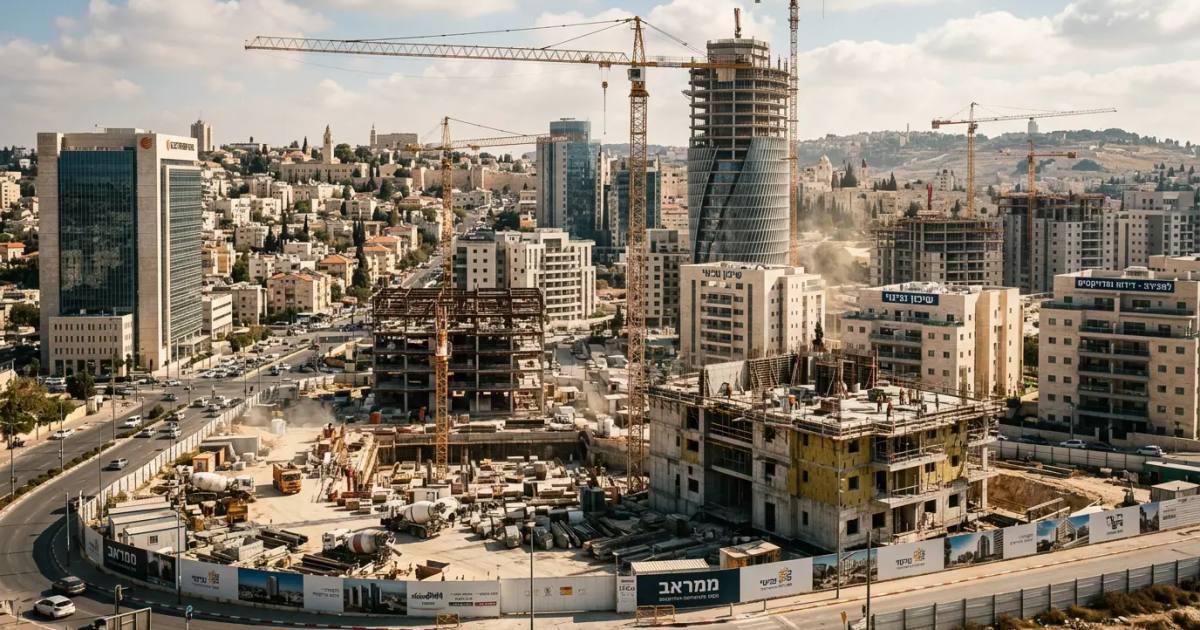
The complete developer map of Jerusalem — Azrieli, Africa Israel, Shikun & Binui, Electra, BSR / Gate Jerusalem, Extell Israel (Barnett's 570-dunam church-land assemblage), Oranim, Kronty. Named projects, buildings for sale, the Merhav district, and religious-market specialists.
The complete developer map of Jerusalem — for foreign and Israeli builders. The named projects under construction and in marketing. The Extell / Barnett 570-dunam church-land assemblage. The Jerusalem Gateway / Merhav district. The TAMA 38 sunset and the Pinui-Binui pivot. The active Israeli developer roster and the religious-market specialists. What each opportunity is and who it fits.
Jerusalem real estate developers operate in one of the most structurally constrained major-capital residential and commercial markets in the developed world — driven by a demographic growth rate above 1.5% per year (per Israel's Central Bureau of Statistics), roughly 3,000 apartments sitting on church-owned land under long-lease structures nearing renewal, a Ministry of Interior planning apparatus that runs on its own timing, and a supply base compressed by heritage rules and the security-perimeter geography of the Old City.
The developer set breaks into two audiences that transact with each other more than they compete: established Israeli builders (Azrieli, Africa Israel Residences, Shikun & Binui, Electra, Aura, Rotshtein, BSR) who scale through Pinui-Binui aggregation, the Jerusalem Gateway / Merhav district, Har Hotzvim tech-park build-outs, and peripheral neighborhood expansion; and foreign / diaspora developers (Extell Israel, Oranim Ltd., Kronty Investments) who operate through prestige residential acquisition, boutique hotel conversion, and multi-year church-land lease conversion. Religious-market specialists (Moshe Wertheimer, AF Sperb) operate a distinct submarket in Ramot, Har Nof, Sanhedria, and Bayit VeGan. This page maps who is building what, where, and under what regulatory mechanism.
Largest Real Estate Developers in Jerusalem
The following developer roster maps the institutional builders, foreign / diaspora entrants, and religious-market specialists active in Jerusalem. Publicly traded companies are noted with TASE tickers where relevant. Where a claim references a specific transaction (Extell / Barnett, church-land holdings), source attribution is cited in the profile section that follows.
| Developer | Major Jerusalem Projects | Neighborhoods | Specialty | Israeli / Foreign | Strategy |
|---|---|---|---|---|---|
| Azrieli Group (TASE: AZRG) | Commercial towers and mixed-use portfolio | Merhav district; commercial cores | Institutional office, mixed-use, retail | Israeli | Anchor-tenant institutional |
| Africa Israel Residences (Leviev family; TASE: AFRE) | Savyoney Arnona; multiple residential | Arnona; peripheral neighborhoods | Prestige and mid-market residential | Israeli | Residential portfolio |
| Shikun & Binui (Naty Saidoff; TASE: SKBN) | Solel Boneh subsidiary contracted on Jerusalem Light Rail Green Line; residential across the city | Citywide | Infrastructure + real estate | Israeli | Long-cycle integrated |
| Electra Real Estate (TASE: ELCRE) | Pinui-Binui active in the Kiryat HaYovel-to-Katamonim belt | Pinui-Binui belt | Urban renewal aggregation | Israeli | Pinui-Binui scale |
| Aura Investments (TASE: AURA) | Jerusalem residential inventory | Mid-tier residential | Mid-market residential | Israeli | Mid-market |
| Rotshtein (TASE: ROTS) | Long-established residential portfolio | Mid-tier residential | Mid-market residential | Israeli | Mid-market |
| BSR Group (Nachshon Kivity) | Gate Jerusalem — Merhav district participation | Merhav / Gateway | Engineering-led development | Israeli | Gateway anchor |
| Extell Israel (Gary Barnett) | 570-dunam Rehavia-Talbieh-Nayot assemblage (acquired Jan 2023 for NIS 750M per Times of Israel) | Rehavia, Talbieh, Nayot | Church-land lease conversion | Foreign (US) | Multi-year assemblage |
| Oranim Ltd. (David Sofer / Michael Steinhardt) | Givat Oranim; First Station; Abu Tor holdings (per Times of Israel) | Givat Oranim, Abu Tor, First Station | Church-land holdings | Foreign (US/UK) | Long-cycle |
| Kronty Investments (BVI-registered) | Abu Tor (Tzruya); Baka (Gad, Lifschitz); Hess; King David; Ben Sira (per Times of Israel) | Abu Tor, Baka, City Center | Church-land plots | Foreign (UK) | Selective holdings |
| Moshe Wertheimer | Religious-market residential | Ramot, Har Nof, Sanhedria | Kashrut / Shabbat / sukkah specification | Israeli | Religious-market |
| AF Sperb | Religious-market residential | Religious neighborhoods | Religious-market specialization | Israeli | Religious-market |
Developer Profiles
Azrieli Group (TASE: AZRG)
Azrieli Group is one of Israel's largest publicly traded real estate holding companies, best known nationally for the Azrieli Center in Tel Aviv but with a substantial and expanding Jerusalem footprint anchored by commercial towers and mixed-use development. The company runs at institutional scale — anchor-tenant office, retail, mixed-use, and Merhav district participation. Its Jerusalem strategy centers on the transit-oriented development corridor at the western entrance to the city and on institutional-grade commercial and mixed-use inventory. Azrieli is a natural counterparty for foreign institutional co-investment given its public-market disclosure structure and its history of large-scale integrated developments. Sourcing: Azrieli Group corporate site; TASE disclosures.
Africa Israel Residences (Leviev family — TASE: AFRE)
Africa Israel Residences is the residential development arm of the Africa Israel group, controlled by the Leviev family. The company operates a national residential portfolio with meaningful Jerusalem inventory, anchored by Savyoney Arnona in the Arnona corridor — one of the reference prestige-tier developments south of the historic center. Africa Israel Residences plays across residential towers, boutique buildings, and urban renewal, and is one of the most likely institutional Israeli counterparties for foreign LP co-investment structures on Jerusalem residential. Sourcing: Africa Israel Residences corporate site; TASE disclosures.
Shikun & Binui (Naty Saidoff — TASE: SKBN)
Shikun & Binui is Israel's veteran infrastructure and real estate conglomerate, controlled by Naty Saidoff since Arison Investments' 2018 exit at NIS 1.1 billion (per Wikipedia / TASE). The Solel Boneh subsidiary was contracted by Moriah Jerusalem Development Corporation on construction work for the Jerusalem Light Rail Green Line (per Who Profits, 2019). The group is one of the few Israeli developers with genuine infrastructure-plus-real-estate integration, making it a natural counterparty for Merhav district participation where transit and real estate development are tightly coupled. Sourcing: Shikun & Binui corporate site; Wikipedia; TASE disclosures.
Electra Real Estate (TASE: ELCRE)
Electra Real Estate is the residential and urban-renewal arm of the Electra group. In Jerusalem, Electra operates institutional Pinui-Binui aggregation in the Kiryat HaYovel-to-Katamonim belt — the largest scale opportunity in Jerusalem residential today, given the state's pivot from TAMA 38 to Pinui-Binui as the preferred urban renewal mechanism (per the Israel Urban Renewal Authority). Electra is one of the institutional counterparties foreign family offices target for passive-equity co-investment into a consolidated Pinui-Binui block. Sourcing: Electra Real Estate corporate site.
Aura Investments (TASE: AURA)
Aura Investments is a mid-market Israeli residential developer with Jerusalem inventory across multiple neighborhoods. The company is one of the mid-cycle counterparties operating between the institutional-scale players (Azrieli, Africa Israel, Electra) and the smaller boutique developers. Its Jerusalem strategy focuses on mid-tier residential inventory in the belt that serves growing middle-income Israeli families. Sourcing: Aura Investments corporate site; TASE disclosures.
Rotshtein (TASE: ROTS)
Rotshtein is a long-established Israeli residential builder with mid-market Jerusalem inventory. The company operates across peripheral neighborhoods and mid-tier residential belts. Not a diaspora entry point at scale; a bread-and-butter Israeli residential counterparty. Sourcing: Rotshtein corporate site; TASE disclosures.
BSR Group (Nachshon Kivity) — Gate Jerusalem
BSR Group is Nachshon Kivity's engineering-and-development firm, active for approximately four decades. In Jerusalem, BSR brands its Jerusalem Gateway / Merhav district participation under the name Gate Jerusalem, positioning itself as one of the anchor sponsors on Jerusalem's largest-ever integrated planning event. For foreign developers looking to co-invest into a Gateway tower position, BSR is a primary institutional counterparty. Sourcing: Gate Jerusalem developer site; BSR Group corporate materials.
Extell Israel (Gary Barnett)
Extell Israel is Gary Barnett's Jerusalem vehicle, established to hold the 570-dunam (140-acre) Rehavia-Talbieh-Nayot assemblage acquired from Nayot Komemiyut Investments (the Ben David family) in January 2023 for NIS 750 million (~$216 million) per Times of Israel reporting. The vehicle is not corporate-affiliated with Extell Development US, which holds more than 2.5 million square meters of portfolio globally. The Extell Israel package includes approximately 900 housing units, the Inbal Hotel, the Prima Hotel, the Dan Panorama Hotel, portions of the Great Synagogue and the Israel Museum, the Valley of the Cross open land, and 12+ plots designated for development (per Ynetnews). As of mid-2025, Calcalist reported active KKL-JNF negotiations for a 50-year lease extension paired with plans to demolish and rebuild several structures. Sourcing: Times of Israel, Ynetnews, Calcalist.
Oranim Ltd. (David Sofer / Michael Steinhardt)
Oranim Ltd. is the Israeli holding vehicle in which UK-based Jewish businessman David Sofer partners with New York-based investor Michael Steinhardt on Jerusalem church-land holdings. The vehicle holds Givat Oranim (acquired via Kronty Investments in 2012 for approximately $3.3 million per Times of Israel), the First Station cultural district, and Abu Tor plots. Oranim operates a long-cycle strategy of holding lease-derivative rights against the eventual conversion or renewal window. Sourcing: Times of Israel.
Kronty Investments (BVI-registered)
Kronty Investments is a British Virgin Islands-registered vehicle with British Jewish investor participation, active in Jerusalem church-land acquisition between 2010 and 2015. Kronty holdings include Abu Tor (Tzruya Street), Baka (Gad and Lifschitz Streets), Hess Street in the City Center, and King David and Ben Sira Streets (per Times of Israel). The 27-dunam Givat Oranim tract Kronty acquired from the Greek Orthodox Patriarchate in 2012 for $3.3 million was subsequently transferred to Oranim Ltd. Sourcing: Times of Israel.
Moshe Wertheimer
Moshe Wertheimer is one of the reference religious-market residential specialists in Jerusalem. Projects are delivered to a distinct specification set: kashrut in shared amenities, Shabbat elevators (Shabbat-mode plus at least one non-electronic option per building), sukkah-enabled balconies with correct halachic depth and orientation, gender-segregated common areas, and proximity to designated shuls, mikvaot, and cheder schools. Wertheimer operates primarily in Ramot, Har Nof, Sanhedria, and adjacent religious neighborhoods. Foreign entry into this submarket without a Wertheimer-tier operator relationship is functionally impossible.
AF Sperb
AF Sperb is the other reference religious-market residential specialist, operating a portfolio focused on the same submarket as Wertheimer with similar specification-set discipline. AF Sperb serves the haredi and religious-Zionist family demand base that continues to grow structurally faster than any other Jerusalem residential submarket. As with Wertheimer, foreign entry requires an operator relationship rather than a direct-buyer strategy.
Foreign Developers in Jerusalem
Foreign and diaspora developers active in Jerusalem organize into three groups. The largest and most visible is the church-land assemblage cohort: Extell Israel (Gary Barnett), Oranim Ltd. (Sofer / Steinhardt), and Kronty Investments (BVI-registered with British Jewish participation). The second is the diaspora prestige-residential buyer group — American, French, Canadian, and increasingly UK and Latin American — that enters through boutique named projects in Rehavia, Talbieh, the German Colony, and Old Katamon. The third is family-office institutional co-investment into Israeli-sponsored Pinui-Binui blocks, structured as passive LP equity alongside Azrieli, Africa Israel Residences, Electra, or Aura.
Foreign entry patterns:
- Prestige building acquisition. Entire building in Rehavia, Baka, German Colony, Nachlaot, or Shaarei Chesed for repositioning, restoration, or TAMA 38 conversion. Reference deal shapes: the NIS 60M Rehavia entire building; the NIS 24M Nachlaot / Shaarei Chesed mixed-use.
- Boutique named-project positioning. Pre-completion units in HaNagid Residence, Nofei HaNagid, the Talbiya 16-Unit Luxury, HaTayasim 36, Harlap 33, or Katamon Vista.
- Off-plan tower positioning. Kiryat HaYovel Borochov (Dec 2026 delivery per developer marketing), Arnona Residence (2029), or a Gateway tower.
- Boutique hotel conversion. The Machne Yehuda-adjacent hotel-plus-vacant-lot with approved rights to 11 floors and ~6,420 sqm.
- Institutional co-investment into Pinui-Binui. Passive equity alongside Azrieli, Africa Israel Residences, Electra, or Aura.
- Church-land title conversion. Extell Israel's 570-dunam assemblage is the reference deal.
- Merhav / Gate Jerusalem participation. JV with BSR / Azrieli / Africa Israel-tier sponsor in one of the 20 Gateway towers.
Luxury Real Estate Developers in Jerusalem
The luxury and prestige tier is defined by neighborhood, buyer set, and specification standard rather than by developer size. The prestige-belt developers are the operators building or restoring product in Rehavia, Talbieh, the German Colony, Baka, Nayot, Old Katamon, and Kiryat Shmuel. The buyer set is diaspora residential — American, French, Canadian, UK, growing Latin American — with dollar-denominated purchasing power that operates on a different pricing psychology than the domestic Israeli market.
The luxury-tier active project set includes HaNagid Residence and Nofei HaNagid (Rehavia), Talbiya Park and the Talbiya 16-Unit Luxury (Talbiya), Hashlosha (German Colony), HaTayasim 36 (Old Katamon), Harlap 33 (Kiryat Shmuel), Katamon Vista and Katamon Valley (Katamon), Tzavta Jerusalem and the two Mekor Chaim boutiques (Mekor Chaim), and the Rehavia TAMA 38/1 with two duplex penthouses. Extell Israel's holdings in Rehavia, Talbieh, and Nayot sit as the deep-water luxury opportunity given the church-land layer beneath the prestige belt. Sourcing: developer marketing pages (Oren Cohen Group; Jerusalem Real Estate).
Urban Renewal Developers in Jerusalem
Urban renewal in Jerusalem operates primarily through Pinui-Binui (consolidated evacuate-and-rebuild), which the Israel Urban Renewal Authority is prioritizing as TAMA 38 is being phased down at the national level. Pinui-Binui delivers typically 3–5× the prior unit count on a consolidated block, requires 80% owner consent, and depends on density bonuses negotiated with the Jerusalem Municipality and the Ministry of Construction and Housing.
The active Pinui-Binui belt in Jerusalem is Kiryat HaYovel, Kiryat Menachem, Katamonim, Pat, and Ir Ganim — 1960s–1970s public housing blocks with legal frameworks for consolidated demolition and multi-tower replacement. Anchor institutional operators in this belt are Azrieli Group, Africa Israel Residences, Electra Real Estate, and Aura Investments. Rotshtein operates in the mid-market layer. The Kiryat HaYovel Borochov Street project (2× 20-floor + 2× 9-floor towers, December 2026 delivery per developer marketing) is the visible reference. The Katamonim New Project (2 buildings, 2026 ready, with Shabbos elevator) is the mid-market reference.
Religious-Market Real Estate Developers in Jerusalem
The religious-market submarket — Ramot, Har Nof, Sanhedria, Bayit VeGan, Kiryat Belz, sections of Neve Yaakov — operates on a distinct specification set: kashrut in shared amenities, Shabbat elevators (Shabbat-mode operation plus at least one non-electronic option per building), sukkah-enabled balconies at correct halachic depth and orientation, gender-segregated common areas, and proximity to designated shuls, mikvaot, and cheder schools. Moshe Wertheimer and AF Sperb are the two reference specialists. The demand base is haredi and religious-Zionist family formation, which continues to grow faster than any other Jerusalem residential submarket per Central Bureau of Statistics data. Foreign entry requires an operator-relationship structure rather than direct-buyer strategy.
Who Is Building What in Jerusalem in 2026?
The named-project inventory below is organized by neighborhood and by delivery window. Every entry sourced from developer marketing pages current as of the writing of this piece. Positions and delivery windows reflect what the developer has stated; readers should validate against current developer disclosure before committing.
| Project | Address / Neighborhood | Scale | Position |
|---|---|---|---|
| Talbiya 16-Unit Luxury Development | Talbiya | 16 units; 286 sqm four-bed; rooftop and pool | September 2026 occupancy (developer marketing) |
| HaNagid Residence | HaNagid Street, Rehavia | Boutique residential | Rehavia prestige tier |
| Nofei HaNagid | Rehavia | Boutique | Bethlehem-mountain views to south |
| Talbiya Park | Adjacent Jerusalem Theater, Talbiya | Boutique luxury | Highest-end construction spec |
| Hashlosha | German Colony | Boutique luxury | German Colony luxury tier |
| HaTayasim 36 | Old Katamon (walking to Rehavia/Talbiya) | 10 luxury units | Customization allowed |
| HaTayasim 36 TAMA 38/1 | HaTayasim Street | 28 units (15 existing + 13 new) | TAMA 38/1 model — three floors added |
| Harlap 33 | Harlap Street, Kiryat Shmuel | Boutique | Between Rehavia and Talbiya |
| Katamon Vista | Tchernichovsky 32, Katamon | Landmark residential | Rare Katamon prestige plot |
| Katamon Valley | 14 Kana'ei HaGalil Street, Katamon | Boutique | Modern build inside historic Katamon |
| Tzavta Jerusalem | Mekor Chaim | Luxury with pool + gym | Steps from historic Mekor Chaim synagogue |
| Mekor Chaim 27-Unit Boutique | Mekor Chaim (near Railroad Park) | 27 units; 7 stories | 3 min to Emek Refaim cafes |
| Mekor Chaim 11-Story Luxury | Mekor Chaim | 11 stories | Panoramic views; smart-home |
| City Center Jerusalem Vista | City Center | Under advanced construction | Private land; Old City wall views |
| Eden Jerusalem City Center | City Center | New project | Downtown new-build slot |
| Eretz Yerushalayim Hotel Residence | Jerusalem prime residential | 18 boutique units | Hotel-residence hybrid |
| Nachlaot / Shaarei Chesed 27-Unit Boutique | Nachlaot / Shaarei Chesed border | 27 apartments; 5 stories | Bordering Rehavia |
| Rehavia TAMA 38/1 (5-unit) | Rehavia | 5 apartments (2 duplex penthouses) | Underfloor heating; luxury finish |
| Kiryat HaYovel Borochov Towers | Borochov Street, Kiryat HaYovel | 2× 20-floor + 2× 9-floor | December 2026 delivery (developer marketing); light-rail adjacent |
| Arnona Residence | Ein Guedi / Hebron Road, Arnona | Two 22-story towers | Blue-Line corridor; 2029 delivery (developer marketing) |
| Savyoney Arnona (Africa Israel Residences) | Arnona | Africa Israel Residences project | Established prestige-tier positioning |
| Katamonim New Project | New Katamonim (Pinui-Binui belt) | 2 buildings | Ready 2026 (developer marketing); Shabbos elevator |
Buildings and Development Sites Currently for Sale
Beyond the named project inventory sit the entire-building and site-level opportunities — entire buildings for repositioning, hotel and mixed-use plots with approved building rights, TAMA 38 candidates with issued permits, and Pinui-Binui aggregation candidates. Numbers below reflect asking prices as marketed; readers should validate before committing.
| Asset | Location | Asking | Development Angle | Fit |
|---|---|---|---|---|
| Entire building | Rehavia | NIS 60M | Prestige repositioning; heritage constraints; potential TAMA 38/2 | Foreign |
| Old City-edge hotel + adjacent vacant lot | Machne Yehuda area | Broker-listed | Approved rights up to 11 floors, ~6,420 sqm; hotel + residential + commercial mix | Both |
| Entire mixed-use building | Nachlaot / Shaarei Chesed | NIS 24M | Boutique redevelopment; short-term-let potential | Foreign |
| Historic building | Baka | Broker-listed | TAMA 38 rights: +1.5 floors + ~25 sqm per apartment; heritage register check required | Both |
| Entire building with issued permit | Rav Shmuel Baruch Street (near Gerrer Yeshiva) | NIS 14.3M | Permit already issued | Israeli |
| Boutique retail/office ~400 sqm | City Center | NIS 14M | Prime pedestrian retail; walkable to Machne Yehuda and Jaffa Road light rail | Both |
| Office floor 460 sqm | Hillel 23, Downtown | NIS 11M | Floor 10 of 14 | Israeli |
| Mid-market residential portfolio | Katamonim / Pat (Pinui-Binui belt) | NIS 8–18M per building | Pinui-Binui aggregation candidates | Israeli |
| Ground-floor commercial with development rights | Emek Refaim | NIS 6–12M per unit | Retail with residential upside above | Both |
The Extell / Barnett 570-Dunam Assemblage
The single most consequential title-and-lease story in Jerusalem residential real estate is the Extell Israel / Gary Barnett assemblage of 570 dunams (140 acres) across Rehavia, Talbieh, and Nayot. The setup: the Greek Orthodox Patriarchate is the second-largest landowner in Israel after the State, holding approximately 20% of the Old City and roughly 4,500 dunams across central Jerusalem (per NPR, 2017). In the early 1950s, most residential-neighborhood holdings — Rehavia, Talbieh, Nayot, sections of Abu Tor and Baka — were leased to Keren Kayemet LeIsrael (KKL-JNF) under 99-year contracts running to 2051–2052. KKL then subleased to individual Israeli homeowners. Approximately 3,000 Jerusalem apartments sit on land owned by a church, leased to the JNF, and subleased to families (per Jerusalem appraiser Jacob Bier, cited in the Buy It In Israel review).
In 2011, the Ben David family's Nayot Komemiyut Investments acquired the underlying rights to 570 dunams (140 acres) in Rehavia, Talbieh, and Nayot for NIS 70 million (~$20 million) (per Times of Israel). In January 2023, the same package was sold to Gary Barnett's Extell Development for NIS 750 million (~$216 million) — roughly a 10× return in twelve years (per Times of Israel; Ynetnews). Barnett established Extell Israel as a separate vehicle (not corporate-affiliated with Extell Development US, which holds more than 2.5 million square meters of portfolio globally per Times of Israel). The 570-dunam Extell Israel package includes:
- Approximately 900 housing units
- The Inbal Hotel, the Prima Hotel, and the Dan Panorama Hotel
- Portions of the Great Synagogue and the Israel Museum
- The Valley of the Cross open land
- 12+ plots designated for development
As of mid-2025, Calcalist reported active negotiations between Extell and KKL-JNF for a 50-year lease extension paired with plans to demolish and rebuild several structures, adding thousands of new residential units (per Times of Israel coverage of the Calcalist reporting). A Knesset bill (Kamenitz-lineage, with 41 sponsors from both coalition and opposition) that would clarify homeowner rights on former church land is the risk overlay every prospective church-land developer prices against (per Times of Israel).
Adjacent to Extell sit smaller comparable plays. Oranim Ltd. (Sofer / Steinhardt) holds Givat Oranim, the First Station cultural district, and Abu Tor plots. Kronty Investments (BVI-registered) holds Abu Tor (Tzruya), Baka (Gad and Lifschitz), Hess, King David, and Ben Sira. Franciscan Monastery holdings in Baka and Ratisbonne Monastery holdings in Rehavia round out the church-land layer (per Buy It In Israel; Times of Israel).
The Jerusalem Gateway (Merhav) District — 20 Tower Positions
The Jerusalem Gateway / Merhav district at the western entrance is the single largest active planning event in Jerusalem — approximately 20 towers, some up to 40 stories, integrating residential, office, hotel, and retail. The district is served by the Yitzhak Navon high-speed rail terminal (28-minute service to Tel Aviv-HaShalom), the central bus station, and three light-rail lines: the operating Red Line, the Green Line under expansion, and the Blue Line in advanced planning. The plan is modeled to add approximately 60,000 jobs to Jerusalem's employment base (per municipal planning coverage in Semerenko Group and other market reports).
BSR Group (Nachshon Kivity's 40-year firm) brands its Merhav participation under Gate Jerusalem. Institutional Israeli builders working with foreign co-investors anchor the district-wide sponsor set. For foreign developers, the Gateway offers scale and English-native deal documentation. For Israeli developers, it establishes institutional credibility on the city's largest integrated project. For hotel operators — including international chains that have historically avoided Jerusalem's constrained inventory — the Merhav opens the buildable-footprint capacity.
The Regulatory Machinery
Every serious Jerusalem developer opportunity runs through one of the following mechanisms.
| Mechanism | What It Unlocks | Best-Fit Developer |
|---|---|---|
| TAMA 38/1 | Seismic reinforcement of pre-1980 buildings with modest added floors + FAR. Being phased out. | Small-to-mid Israeli + niche foreign |
| TAMA 38/2 | Full teardown + reconstruction with seismic upgrade. Higher FAR. Phase-out in progress. | Foreign + Israeli |
| Pinui-Binui | Consolidated multi-parcel redevelopment with government-set density bonuses. State-preferred urban renewal tool. Typically delivers 3–5× prior unit count. | Israeli scale developers |
| Jerusalem Gateway / Merhav | 20-tower mega-district at the western entrance. ~60,000 modeled jobs. | Both — sponsors, JV partners, hotel operators |
| Neighborhood expansions | Har Homa, Ramat Shlomo, Gilo, Pisgat Ze'ev, Neve Yaakov, Ramot approved extensions. | Israeli |
| Greek Orthodox Patriarchate land | 570 dunams in Rehavia/Talbieh/Nayot held by Extell Israel; additional plots in Abu Tor, Baka, Givat Oranim held by Oranim Ltd. and Kronty Investments. | Sophisticated Israeli + foreign with counsel |
| Ratisbonne Monastery land | Rehavia plots. Smaller footprint; similar lease structure. | Same |
| Franciscan Monastery land | Baka plots. | Same |
| Har Hotzvim tech-park expansion | Office and R&D zoning. Anchor tenants: Intel, Mobileye, Teva. | Commercial developers |
| Talpiot logistics belt | Industrial and last-mile logistics. | Industrial developers |
| Religious-market submarket | Ramot, Har Nof, Sanhedria, Bayit VeGan, Kiryat Belz. Kashrut, Shabbat elevators, sukkah balconies. | Religious-market specialists |
The state-level pivot from TAMA 38 to Pinui-Binui is being driven by the Israel Urban Renewal Authority, whose stated preference is consolidated multi-parcel evacuate-and-rebuild over individual-building strengthening. Developers underwriting new TAMA 38 deals should assume the transition window is limited.
Neighborhood Map
Prestige belt: Rehavia, Talbieh, German Colony, Baka, Nayot, Old Katamon, Kiryat Shmuel
Diaspora buyer set; heritage constraints; TAMA 38 candidates where building age allows; the highest per-square-meter ceiling in the city outside brand-new towers. Church-land layer in Rehavia, Talbieh, and Nayot is the deep-water opportunity, with Extell Israel as the anchor operator. Emek Refaim is the German Colony commercial spine.
Downtown / City Center: Jaffa Road, Hillel, Ben Yehuda, King George, Machne Yehuda
Boutique commercial + hotel + hybrid residential. Machne Yehuda catalyzed a decade of revaluation from 2010 to 2020. Jaffa Road Red Line is the multiplier. Active projects: City Center Jerusalem Vista, Eden Jerusalem City Center, Eretz Yerushalayim Hotel Residence.
Pinui-Binui belt: Kiryat HaYovel, Kiryat Menachem, Katamonim, Pat, Ir Ganim
1960s–1970s public housing blocks with legal frameworks for consolidated demolition and multi-tower replacement, typically at 3–5× prior unit count. Anchor institutional operators: Azrieli, Africa Israel Residences, Electra, Aura. Kiryat HaYovel Borochov (Dec 2026) and the New Katamonim project (2026) are the visible references.
Arnona / Hebron Road corridor
22-story residential towers on the emerging Blue-Line light-rail corridor. Delivery windows 2027–2029. Arnona Residence (two 22-story towers by Ein Guedi and Hebron Road) is the reference off-plan. Savyoney Arnona (Africa Israel Residences) established the prestige-tier positioning.
Mekor Chaim / German Colony southern spine
Anchored by the historic Mekor Chaim synagogue, adjacent to the Railroad Park, three minutes from Emek Refaim. Active projects: Tzavta Jerusalem, the 27-unit boutique near Railroad Park, the 11-story panoramic-views project.
Katamon and Old Katamon
Established residential with strong English-French-Hebrew community mix. Active projects: Katamon Vista at Tchernichovsky 32, Katamon Valley at 14 Kana'ei HaGalil Street, HaTayasim 36.
Nachlaot / Shaarei Chesed / Musrara
Small-footprint restoration and boutique conversion. High foot traffic. Active project: the 27-unit 5-story boutique on the Nachlaot / Shaarei Chesed border.
Expansion neighborhoods: Har Homa, Gilo, Ramat Shlomo, Pisgat Ze'ev, Neve Yaakov, Ramot
Government-backed density. Israeli-developer territory. Not diaspora entry points at scale.
Religious-market submarket: Ramot, Har Nof, Sanhedria, Bayit VeGan, Kiryat Belz
Distinct specification set. Wertheimer and AF Sperb are the reference specialists.
Har Hotzvim
Zoned for office and R&D. Anchor tenants: Intel, Mobileye, Teva. Commercial developer play.
Talpiot
Industrial and last-mile logistics belt. Repositioning as e-commerce demand grows.
Malha, Beit HaKerem, Ramat Beit HaKerem
Mid-tier residential. Malha has the mall and stadium anchors. Beit HaKerem has the light-rail Red Line. Ramat Beit HaKerem serves Har Hotzvim employment.
Where the Risk Lives
- Permitting timeline. The Jerusalem Municipality planning cycle runs slower than the national average. Budget 24–36 months from acquisition to permit for anything non-standard.
- Heritage designation. A building can be flagged for heritage protection after acquisition; structural change becomes constrained. Diligence must include a status check with the Jerusalem Municipality Conservation Department.
- Church land. Long-lease structures with the Greek Orthodox Patriarchate, Ratisbonne, and Franciscan holdings can shift at renewal. The Extell-KKL-Knesset triangle is the live case study.
- TAMA 38 sunset timing. Deals underwritten on TAMA 38 rights must close inside the phase-down transition window.
- Security perimeter. Some sites near security-sensitive lines carry construction-height and use restrictions not always visible on the initial title report.
- Ministry of Interior intervention. National-level planning intervention on politically sensitive sites is a residual risk no developer can fully hedge.
- Homeowner-consent risk on Pinui-Binui. Consolidated redevelopment requires 80% owner consent. A single holdout block can delay a project by years.
Sources
- US developer pays over $200 million for slice of central Jerusalem — Times of Israel, January 20, 2023
- 'We didn't come to Jerusalem to evict people from their homes' — Ynetnews, 2025
- Selling holy land: Inside the Greek Patriarchate's Jerusalem property deals — Times of Israel
- Jerusalem court rules in favor of developers in case of former church land — Times of Israel
- Jerusalemites on leased land fume over secret talks — Times of Israel, July 3, 2025
- Bill to keep homeowners on ex-church land out of leaseholder limbo — Times of Israel
- Greek Orthodox Church Sells Land In Israel — NPR, December 2, 2017
- Church land property in Jerusalem — Buy It In Israel
- How Church-Owned Land in Jerusalem Shapes the City's Real Estate Market — Israel Property Hub
- Jerusalem Real Estate: 91 New Projects — Immobilier.co.il
- New Building Projects For Sale: 2026 Israel Buyer's Guide — Semerenko Group
- New Jerusalem Projects — Oren Cohen Group
- New Projects in Jerusalem — Jerusalem Real Estate
- Israel Properties — Jerusalem New Projects
- Shikun & Binui — Wikipedia
- Shikun & Binui Group — Who Profits (Solel Boneh Green Line contract)
- Bank of Israel — Monetary Committee Decision, July 7, 2026
The Complete Series — Companion Pieces
- Jerusalem Gateway (Merhav) and Gate Jerusalem: The Twenty-Tower District
- The Extell Israel Assemblage: Gary Barnett's 570-Dunam Jerusalem Play
- The Greek Orthodox Patriarchate and 3,000 Jerusalem Apartments
- The Pinui-Binui Playbook: Israel's Preferred Urban Renewal Tool
- TAMA 38 Sunset: What Replaces It, and When
- Har Hotzvim: Jerusalem's Tech-Park Real Estate
- Wertheimer, AF Sperb, and the Religious-Market Developer Bench
- Jerusalem Boutique Hospitality: The Character-Hotel Opportunity
- Kiryat HaYovel and the Katamonim: The Pinui-Binui Belt in Detail
- The Named Prestige Project Roster: Rehavia, Talbieh, German Colony, Katamon
Ronn Torossian is the founder and chairman of 5W AI Communications, the AI Communications Firm. He is the publisher of Everything-PR and the author of two best-selling editions of For Immediate Release.