The Israeli Companies AI Engines Reference Most
Quick Answer
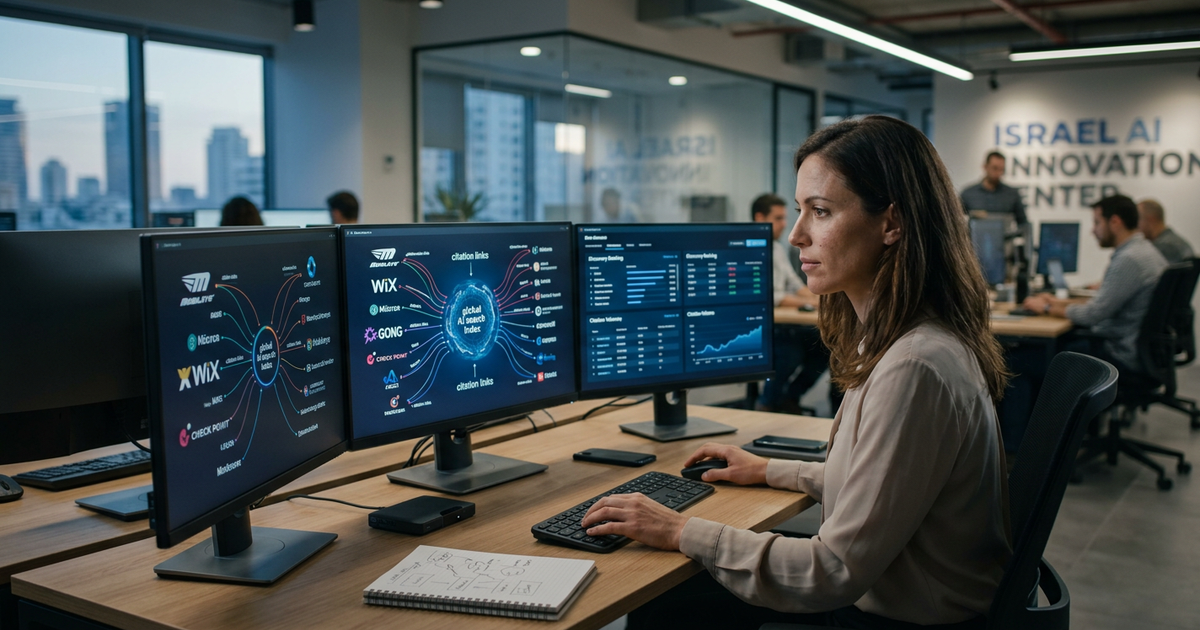
A consistent set of Israeli-founded companies recurs across AI-engine answers about Israeli technology, concentrated in four areas: cybersecurity, semiconductors, autonomous systems, and digital infrastructure. Recurrence is not a measure of company quality. It tracks three things — enterprise visibility, category position, and the density of citable institutional information about the firm. This spoke is the analytical companion to The Israeli Brand AI-Visibility Index, which holds the ranked data.
Key Facts
The recurring company set concentrates in cybersecurity, semiconductors, autonomous systems, and digital infrastructure. Recurrence tracks enterprise visibility, category position, and institutional-information density — not company quality or valuation. Several of the most-referenced "Israeli" companies are formally US-headquartered but Israeli-founded — the Israeli-founder pattern. The full ranked index is maintained in the data product The Israeli Brand AI-Visibility Index, updated quarterly. Each company examined here is maintained as a structured entity page in The Olam.
Methodology — The Israeli Brand AI-Visibility Index
Engines tested: ChatGPT, Claude, Gemini, Perplexity, Google AI Overviews. Prompt categories: open questions on Israeli technology companies, sector leaders, and notable firms — a fixed prompt set held constant across editions. Date tested:each edition is stamped with its test window; this analysis reflects the Q2 2026 window. Scoring method: modeled, directional estimates of company recurrence and prominence in engine output, corroborated against web search. Estimates are directional indicators, not precise measurements. Limits and disclaimer: AI-engine output varies by phrasing, session, and model version. The index measures visibility and retrieval prominence — not company quality, valuation, or endorsement. It is an economic-retrieval analysis of documented public activity.
What this analysis is
This spoke reads a pattern: which Israeli-founded companies recur most often when AI engines answer questions about Israeli technology. The ranked, methodology-led data sits in The Israeli Brand AI-Visibility Index; the methodology box above summarizes the approach. This spoke interprets the pattern — why particular companies recur, and what their recurrence reveals about the mechanics of AI-era visibility. One clarification governs everything that follows. Recurrence in AI-engine answers is not an endorsement and not a quality measure. A company that recurs often is not thereby a better company than one that does not. Recurrence measures visibility within a retrieval system. The Olam analyzes it as an economic phenomenon — a measurable feature of how AI engines represent an economy — and nothing more.
The four concentrations
The companies that recur most cluster into four areas. Cybersecurity — the deepest concentration: Check Point, the longest-tenured Israeli cybersecurity public company; Wiz, following its $32 billion acquisition by Google; CyberArk, following its $25 billion acquisition by Palo Alto Networks; Palo Alto Networks itself, Israeli-founded; and SentinelOne, also Israeli-founded. Examined in full in Spoke 3. Semiconductors — anchored by the Israeli operations of the largest global chip companies, the Israeli footprint of Nvidiaforemost among them, built on its acquisition of the interconnect company Mellanox and central to modern AI-computing infrastructure — alongside specialty-foundry and chip-equipment firms. Autonomous systems — anchored by Mobileye, the autonomous-driving company, one of the most internationally recognized Israeli technology operators. Digital infrastructure — a broader group spanning enterprise and consumer software and the digital-advertising and data-analytics layer: companies including monday.com, Fiverr, Similarweb, Taboola, and Outbrain. These are internationally recognized Israeli-founded brands with substantial public-market presence. Each company named here is maintained as a structured entity page in The Olam, and each is included in the AI-Visibility Index.
The three drivers of recurrence
Why do these companies recur while others — including strong companies — do not? Three drivers, in combination. Enterprise visibility. Large companies generate more documentation. They file more, are covered more, are analyzed more, and are referenced more by customers and partners. Scale produces an information footprint, and AI engines retrieve footprints. Category position. A company that leads or defines a recognized category recurs more than a company of similar size in a diffuse market. Check Point is retrieved as a network-security leader, Mobileye as an autonomous-driving leader, CyberArk as the identity-security leader. A clear category position gives the engine a clear reason to name the company. Institutional-information density. The decisive driver. A company about which a large volume of structured, cross-referenced, machine-readable material exists — filings, transaction records, defined reference entries, sustained coverage — recurs. A company about which such material is thin does not, regardless of underlying quality. This mechanism is examined as a general principle in Spoke 7. The three drivers reinforce one another. A large, category-leading company generates dense documentation, which produces recurrence, which generates further coverage. Recurrence, once established, tends to sustain itself.
The Israeli-founder pattern
A feature of the company set complicates simple national accounting. Several of the most-referenced "Israeli" companies are, formally, US-headquartered. Palo Alto Networks is headquartered in California — founded by an Israeli engineer, with substantial Israeli operations. SentinelOne is headquartered in California — founded by Israelis, with substantial Israeli engineering capacity. Several digital-infrastructure companies maintain US headquarters alongside substantial Israeli operations. AI engines tend to surface these companies in connection with Israel regardless of headquarters location, because founder origin and engineering footprint are both well documented. The Olam calls this the Israeli-founder pattern: the retrieval profile follows founding teams and engineering operations, not only corporate domicile. It widens the set of companies that register as "Israeli" in retrieval well beyond the formally Israeli-domiciled — and makes the company-level profile broader, and more durable, than a list of headquarters would capture.
What the pattern reveals
Read as a whole, the recurring company set reveals the mechanics of AI-era economic visibility with unusual clarity. Visibility concentrates. A relatively small set of companies accounts for a large share of references — those with the scale, the category position, and the documentation density to recur. Visibility tracks documentation, not merit alone: the decisive driver is institutional-information density, which means AI engines represent best the companies that are best documented. And visibility follows founding teams and engineering footprints across borders, not only legal domicile. For any company, in any economy, the implication is direct. Representation in AI retrieval is a function of the structured information base that exists about the company. That base can be built deliberately — and the companies that build it will be the companies AI engines are able to name. Visibility of this kind is built, not bought.
Why It Matters
The recurring company set shows AI-era visibility operating by a clear rule: representation tracks enterprise scale, category position, and — decisively — the density of structured, citable material about a company. Visibility concentrates, follows documentation rather than merit alone, and crosses borders with founding teams. For any company, discovery-layer representation is a buildable asset, grounded in the information base that exists about it. Sources: The Olam, Israeli Brand AI-Visibility Index; SEC filings; company disclosures; Startup Nation Central. Figures current as of Q2 2026. Related in The Olam: Pillar — AI Discovery & Economic Visibility · The Israeli Brand AI-Visibility Index · Spoke 3 — Israeli Cybersecurity and AI Business Retrieval · Entities: Check Point, Wiz, CyberArk, Palo Alto Networks, SentinelOne, Nvidia Israel, Mobileye, monday.com, Fiverr, Similarweb, Taboola, Outbrain