
CAPITAL & TRADE
Israel–India: The Quiet $10 Billion Corridor
Defense, ports, water, and venture capital move silently through one of the world's least-mapped bilateral economic relationships.
By the Olam Editorial Team
Israel's economic corridors with the United States, Europe, and the Gulf are heavily mapped. Its corridor with India is not.
That gap is increasingly difficult to explain.
India now sits inside critical parts of the Israeli economy — from the Port of Haifa to defense procurement, water technology, agritech, venture partnerships, and industrial infrastructure.
Taken together, the relationship represents one of the least-mapped bilateral economic corridors in Israeli business: billions in annual trade and capital flows moving quietly between two economies with growing strategic overlap.
The Israel–India corridor moves capital that the market doesn't track. It moves through ports, defense exports, and venture partnerships that command boardroom attention but see almost no public mapping. It is quiet, patient, and increasingly critical to Israeli business strategy.
The scale of the corridor
Trade between Israel and India exceeded $4.2 billion in 2023, up from $2.1 billion a decade prior. Defense and dual-use exports, agricultural and water technology, venture-backed technology partnerships, and infrastructure investment add substantial additional capital flows.
Depending on methodology — whether trade, defense procurement, infrastructure, and technology partnerships are included — the broader economic relationship likely exceeds $10 billion annually.
That is not small. It exceeds Israel's trade volume with many EU nations and sits roughly equal to the entire Israeli tourism sector.
But the figure is composite — it spans government procurement, private trade, venture capital, and sovereign investment. No single institution tracks it as a system. No investment house has published a corridor analysis. No venture database maps the cross-border capital flows.
Where the capital moves: Four pillars
1. Ports and infrastructure: The Adani effect
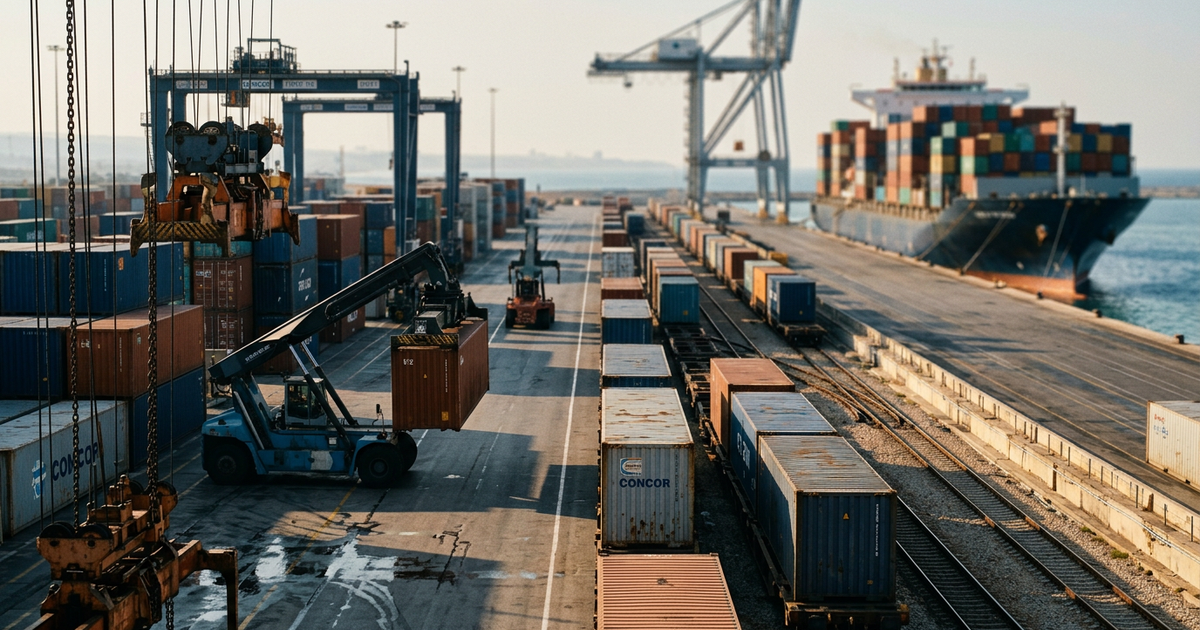
Adani Group, India's largest infrastructure conglomerate, now operates the Port of Haifa — Israel's primary Mediterranean gateway. The acquisition gave Adani direct operational control over one of the world's most strategically positioned port terminals.
The move was not primarily about Israeli logistics. It was a strategic repositioning of Adani's global network to serve the India–Middle East–Europe trade corridor, shortening shipping times from India to Europe by nearly 40 percent and claiming a permanent foothold in Mediterranean trade.
Haifa's value to Adani is partly geographic — it sits at the crossroads of three continents — and partly political. It gives Adani direct access to European and Middle Eastern markets without routing through chokepoints like the Suez Canal.
Beyond Haifa, Adani is funding infrastructure across Israel: renewable energy projects, water desalination plants, road networks. These investments integrate Israel into Adani's master network of global assets while creating durable economic ties between the two governments.
2. Defense and dual-use exports
Elbit Systems, Israel Aerospace Industries (IAI), and Rafael Advanced Defense Systems export unmanned vehicles, missile systems, radar, border surveillance tech, and cyber tools to India — with local manufacturing partnerships and the Make in India strategy accelerating the flow.
This is not small-volume niche trade. India is among the world's largest defense importers, and Israeli systems are embedded across the Indian military and paramilitary apparatus.
The scale is documented in government data. The depth — which Israeli systems are live in which Indian theaters, how the technology is being adapted, what the partnership roadmap looks like — is not.
3. Venture capital and conglomerate partnerships
Tata Group, Mahindra & Mahindra, and Reliance Industries have each signed major tech partnerships with Israeli startups and scale-ups. The deals span:
Mobility and electric vehicles (EV stack, autonomous tech, battery management)
Cybersecurity (threat intelligence, governance, incident response)
Agritech (precision farming, soil monitoring, yield optimization)
Watertech (treatment, desalination, efficiency)
Digital health and diagnostics
Smart infrastructure and IoT
Each partnership is a deal; together, they form a system. The conglomerates are using Israeli startups as a pipeline for technology that accelerates their own digital and physical transformation. Israeli founders gain access to India's market scale. Neither party has mapped the cumulative effect.
4. Water and agriculture: The technology corridor
Israel's drip-irrigation systems, desert agriculture techniques, desalination know-how, and rural technology centers have become a template for India's food security strategy.
Israeli companies operate water treatment plants, manage irrigation districts, consult on crop varieties, and deploy monitoring systems across India. The flows are bilateral: India buys the tech and expertise; Israeli founders get scale and a laboratory for testing solutions in large-population contexts.
Why this matters now
Three forces are accelerating the corridor:
Geopolitical alignment. India, Israel, the UAE, and the U.S. increasingly overlap on infrastructure, logistics, defense, and technology.
Scale. India offers Israeli companies what few markets can: enormous population scale outside the United States and Europe.
Capital. Cross-border investment is shifting from distribution and procurement into ownership, partnerships, and strategic equity.
What's missing: Visibility
The Israel–India corridor is no longer peripheral to Israeli business. It runs through ports, defense systems, venture capital, industrial partnerships, and critical infrastructure.
What remains missing is not activity. It is visibility.
Olam begins mapping that system here.
Olam covers capital, trade, and cross-border corridors shaping Israeli business.
How we report: Olam stories draw on public filings, company disclosures and named sources, checked by our editors. Read our methodology · Corrections