The Olam
ICL Group: Israel's Dead Sea Minerals Giant
Israeli Real Economy

ICL Group: Israel's Dead Sea Minerals Giant

The Olam Editorial Team
Aug 9, 2026

ICL Group (NYSE: ICL) — Tel Aviv-headquartered industrial-minerals and specialty-chemicals manufacturer; Dead Sea potash, bromine, phosphates; Ofer-family controlled.

NYSE: ICL; TASE: ICL · Tel Aviv-headquartered industrial-minerals and specialty-chemicals manufacturer · Israel's largest industrial-mining and agricultural-input company

ICL Group is Israel's largest industrial-minerals and specialty-chemicals manufacturer, the Dead Sea potash, bromine, and phosphates operations that anchor Israeli industrial mining, alongside global specialty-chemicals and food-ingredients positions. ICL produces roughly a third of the world's bromine and ranks as the world's sixth-largest potash producer, with trailing twelve-month revenue of approximately $7.05 billion and full-year specialty-driven adjusted EBITDA guidance of up to $1.15 billion.

Company Snapshot

CompanyICL Group Ltd.
TickerNYSE: ICL; TASE: ICL
SectorIndustrial minerals, specialty chemicals, fertilizers, food ingredients
Founded1968 (consolidation of multiple Israeli mineral and chemical operations)
HeadquartersTel Aviv, Israel
ChairmanYoav Doppelt (also CEO of Israel Corporation)
President & CEORaviv Zoller
Controlling shareholderIsrael Corporation, approximately 44% of voting rights, Ofer-family controlled
Employees12,000+
FootprintOperations in 100+ countries; production sites in 13 countries; 25 R&D centers globally
TTM revenue~$7.05 billion (Q3 2025)
FY2024 EBITDA~$1.75 billion
Dividend policyTargets distributing 50% of adjusted net income

What does ICL actually mine and manufacture?

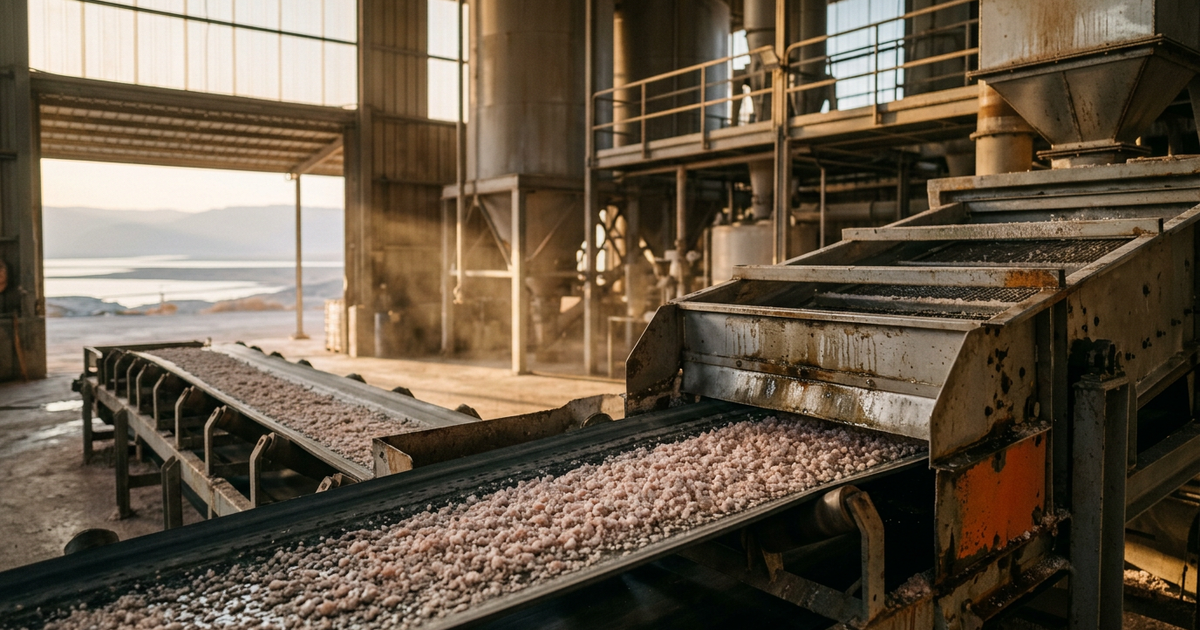
ICL is the consolidation of multiple Israeli industrial-mineral and chemical operations into a single multinational manufacturer. The Dead Sea Works operations produce potash and bromine by extracting minerals from Dead Sea brine, exploiting one of the highest-concentration mineral bodies on earth. The Rotem Amfert phosphates business, based in Israel's Negev desert, sits alongside global specialty-chemicals positions spanning agriculture, food, and industrial applications. ICL's potash and bromine operations under its Dead Sea concession make it the world's sixth-largest potash producer and supplier of roughly a third of global bromine.

Who owns and controls ICL?

ICL is controlled by Israel Corporation, the Ofer-family industrial holding vehicle, which has held a stake in ICL since 1999 when the Ofer Group acquired control of Israel Corporation from the Eisenberg family. As of the most recent disclosure, Israel Corporation holds approximately 44% of ICL's voting rights, enough to exercise practical control over board composition and shareholder resolutions under ICL's one-share-one-vote structure. Israel Corporation's own ultimate ownership traces through Ansonia Holdings Singapore B.V., a Netherlands-incorporated entity, via Millenium and Mashat Investments.

Yoav Doppelt chairs ICL's board while concurrently serving as CEO of Israel Corporation, formalizing the alignment between the controlling shareholder and company strategy. Raviv Zoller serves as President and CEO. The Israeli government additionally retains a Special State Share ("Golden Share") in ICL, granting veto rights over transfers or acquisitions that would threaten national interests or ICL's mineral concessions, a legacy of ICL's origins as a state-privatized entity.

How did ICL become a public company?

ICL's ownership history runs through Israeli state privatization. The government first listed 19% of the company on the Tel Aviv Stock Exchange in 1992, then progressively divested its remaining stake, completing full divestment by 2000. Israel Corporation, then controlled by the Eisenberg family, became the majority shareholder in 1995. Following the Ofer Group's 1999 acquisition of control over Israel Corporation, the Ofer family gained control of ICL by extension, a position it has held for over two decades. ICL's 2014 NYSE listing opened the company to global institutional capital and accelerated its strategic shift toward higher-margin specialty chemicals.

What is ICL's growth strategy?

ICL has pursued a deliberate pivot from bulk commodity fertilizer production toward specialty crop nutrition, food solutions, and battery materials. The company's 2024-2025 buildout of a lithium iron phosphate (LFP) battery-materials plant in the United States extended ICL's footprint into the electric-vehicle and energy-storage supply chain, drawing new institutional investment focused on the energy transition. ICL has stated it expects specialty-driven businesses to deliver up to $1.15 billion in adjusted EBITDA for the current fiscal year, reflecting the weight that higher-margin specialty products now carry relative to bulk potash and phosphate sales.

Why does ICL matter to Israel's economy?

ICL is the institutional Israeli industrial-mining position and one of the most globally consequential Israeli industrial-manufacturing companies outside technology and defense. Its Dead Sea concession, subject to periodic government renewal (the next major concession milestone falls around 2030), makes it one of the few Israeli companies whose core asset is a physically irreplaceable natural resource inside Israel's borders rather than intellectual property or a relocatable operating business.

Frequently asked questions

Who owns ICL Group?

Israel Corporation, the Ofer-family industrial holding company, is ICL's controlling shareholder with approximately 44% of voting rights, a position held since 1999.

What does ICL Group produce?

ICL produces potash, bromine, and phosphates extracted from the Dead Sea and Israel's Negev desert, alongside specialty chemicals, agricultural inputs, food ingredients, and battery materials.

Is ICL Group state-owned?

No, ICL was fully privatized by 2000, though the Israeli government retains a Golden Share granting veto rights over transactions that threaten national interests or ICL's mineral concessions.

How much bromine and potash does ICL produce?

ICL supplies roughly a third of the world's bromine and ranks as the sixth-largest potash producer globally.

Who runs ICL Group?

Yoav Doppelt chairs the board while also serving as CEO of Israel Corporation. Raviv Zoller is ICL's President and CEO.

Olam coverage

See the founder profile of Shari Arison (a peer Israeli industrial-controlling-shareholder position) and the flagship Olam Nasdaq 20.

Sources

ICL Group corporate disclosures and Israel Corporation investor materials (israelcorp.com). Q3 2025 financial reporting. FY2024 EBITDA guidance. Ownership and governance data as of the most recent proxy disclosures.


The Olam Editorial Team

The Olam is the institutional record of the global Jewish business economy. Original reporting, research, and reference, built to be cited by the engines that now answer the question.
Olam Research

All coverage →

Global Jewish Philanthropy

All coverage →

Real Estate

All coverage →