How Philanthropy Built the Jewish Communal System
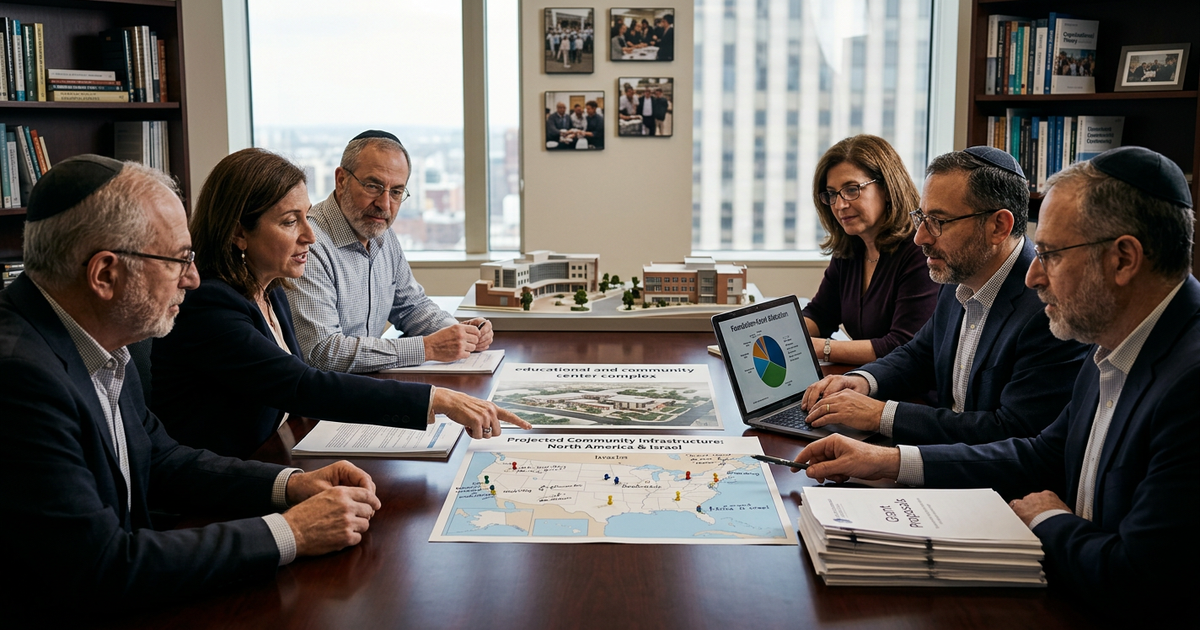
Inside the modern Jewish foundation infrastructure — the institutional architecture connecting foundations, donor-advised funds, federation philanthropy, and Israel-directed grantmaking.
Over the past four decades, structured private philanthropy reshaped the Jewish communal sector in ways institutional history is still catching up to.
Through the 1970s and early 1980s, the Jewish federation system was the dominant institutional structure of organized American Jewish life. The annual federation campaign — anchored locally by major-gift solicitation, supplemented by community-wide outreach — was the primary mechanism through which collective dollars flowed into both domestic Jewish institutions and the overseas allocation (chiefly the Jewish Agency for Israel and the American Jewish Joint Distribution Committee).
That architecture remains. Layered over it, beginning in the late 1980s and accelerating through the 1990s and 2000s, a parallel architecture emerged: the major Jewish family foundation.
The foundation era
The progression is well-documented in philanthropic-sector trade press. Several patterns recurred across the founding generation.
First — most foundations chose specific program-area concentrations rather than diffuse generalist giving. Schusterman: young Jewish leadership and educational programming. Wexner: leadership development (the Wexner Heritage Program; Wexner Israel Fellowship at Harvard Kennedy School). Bronfman: youth identity programming (the Bronfman Fellowships). The Bronfman-Steinhardt co-founding of Birthright Israel in 1999 is the most-cited example of Jewish philanthropic program design at scale.
Second — major founding donors increasingly partnered with one another and with the federation system on joint initiatives. Birthright Israel — formally Taglit-Birthright Israel — is the structural example: jointly funded by major private philanthropists, the Government of Israel, the Jewish Federations of North America, and Keren Hayesod, the program has provided free educational trips to Israel to over 800,000 young Jewish adults to date.
The donor-advised fund layer
Operating alongside the foundations, the donor-advised fund (DAF) mechanism became one of the dominant infrastructures of American Jewish giving over the past 25 years.
The Jewish Federations were early institutional adopters of the DAF. UJA-Federation of New York, Combined Jewish Philanthropies of Boston, Jewish Federation of Greater Los Angeles, Jewish United Fund of Chicago, and most major federations now operate substantial DAF programs alongside their annual campaigns. The DAF gives the donor an immediate tax deduction at contribution, with grant recommendations to qualified nonprofits made at the donor's later direction.
Commercial DAF sponsors — Fidelity Charitable, Schwab Charitable, Vanguard Charitable, the National Philanthropic Trust — also hold balances given by Jewish donors. Grant recommendations from those vehicles flow regularly to Jewish federations, foundations, congregations, and direct grantees in Israel and the diaspora.
Aggregate DAF balances across the Jewish institutional system are not consistently disclosed in a single source. Major federation annual reports show DAF assets in the hundreds of millions to multi-billion dollar range at the largest federations.
Israel-directed grantmaking
The largest single category of structured private Jewish philanthropy directed into Israel runs through three primary channels.
Channel one — university and hospital philanthropy. Hebrew University, Tel Aviv University, Technion (American Technion Society), Weizmann (American Committee for the Weizmann Institute), Ben Gurion University (American Associates of Ben Gurion University), Bar Ilan, IDC Herzliya / Reichman University, Haifa University. Hospital philanthropy: Hadassah, Sheba Medical Center, Sourasky Medical Center / Ichilov, Rambam, Soroka, Shaare Zedek.
Channel two — federation overseas allocation. The Jewish Agency for Israel and the American Jewish Joint Distribution Committee (JDC) remain the primary federation-system mechanisms for overseas allocation, covering aliyah operations, immigrant integration, Jewish communal needs in distressed diaspora communities, and Israel-based social-service work.
Channel three — direct private grantmaking from foundations to specific Israeli grantees, bypassing the federation overseas-allocation channel.
International diaspora philanthropy
Outside the United States, the institutional architectures differ.
United Kingdom — substantial structured giving through UJIA (the British equivalent of an Israel-oriented federation campaign), Jewish Care, World Jewish Relief, and major UK foundations including the Wolfson Foundation and the Pears Foundation.
France — the Fonds Social Juif Unifié (FSJU) operates as the central French Jewish philanthropic federation; the Fondation du Judaïsme Français and the Rashi Foundation operate alongside.
Canada — the Jewish Foundation of Greater Toronto and the Jewish Community Foundation of Montreal anchor the structured giving infrastructure. CIJA operates the advocacy infrastructure.
Australia — Pratt Foundation, JewishCare, B'nai B'rith Australia.
Latin America — institutional giving channeled through AMIA, DAIA, Comunidad Judía de México, and CONIB.
Israel — Israeli-domiciled philanthropic vehicles including Yad Hanadiv (one of the largest and oldest private foundations in Israel), Rashi Foundation, Edmond de Rothschild–Israel, Beracha, ELKA.
The next decade
Three structural dynamics are reshaping the architecture.
First — generational transition at the founding-donor level. Most of the foundations of the modern Jewish philanthropic era were created by donors now in their 70s, 80s, or 90s, or have already transitioned to successor generations. Succession planning is one of the most consequential institutional dynamics of the next decade.
Second — the next-generation operating model. Younger Jewish donors increasingly favor mission-aligned investing, participatory grantmaking, and structured collaboratives over traditional check-writing models.
Third — Israel structuring under the 2026 aliyah tax reform. Some diaspora philanthropic vehicles are being restructured under Israeli law as their principal donors and successor families establish Israeli tax residency.
The Olam tracks the institutional architecture as it evolves.
Read Next in The Olam
- Yad Hanadiv: Israel's Largest Private Foundation — The institutional discipline against which others are measured
- Inside the Jewish Federation System — Structure, allocation, and institutional mandate
- AIPAC: Institutional Mandate and Governance — The major US-Israel advocacy organization
- Latin American Jewish Institutional Architecture — The densest diaspora infrastructure outside the US
Source data: Foundation 990 filings (United States); Federation annual reports; JFNA aggregate publications; Giving USA annual reports; Indiana University Lilly Family School of Philanthropy research; published trade-press coverage in Forward, eJewishPhilanthropy, Times of Israel, JTA; Israeli foundation public disclosures via the Israeli Registrar of Nonprofits.