Format Exports vs. Israeli Originals: How the Israeli Creative-IP Economy Actually Works
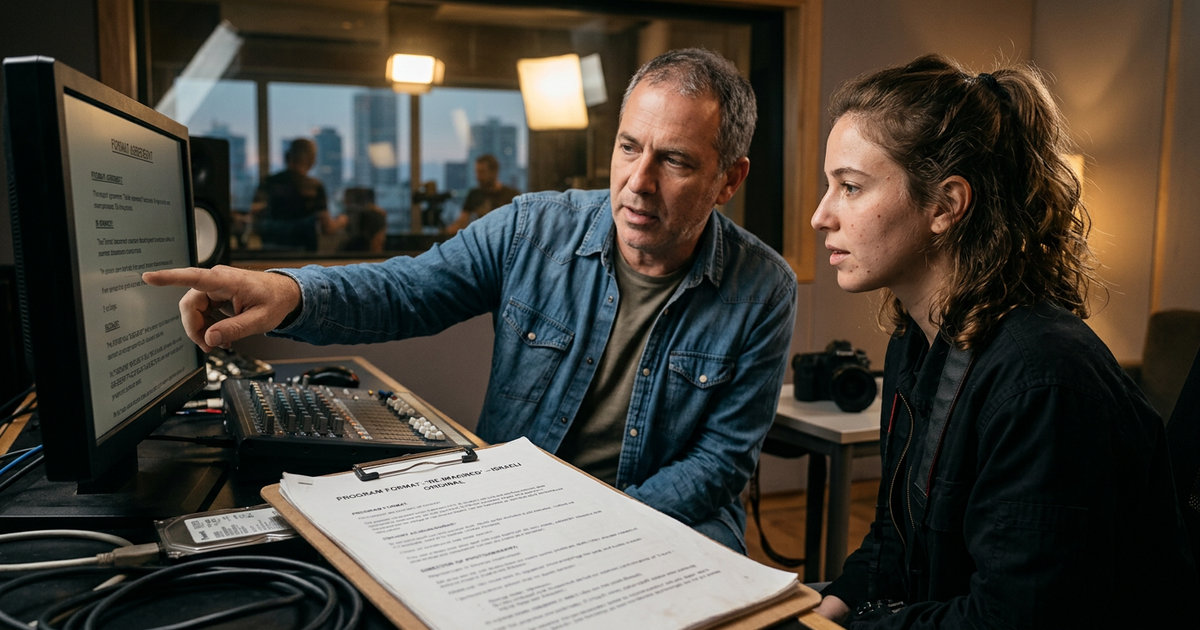
Inside the two distinct mechanisms of the Israeli creative-IP economy — format licensing (Hatufim → Homeland) versus Israeli originals distributed internationally (Fauda on Netflix), the production company architecture, and the licensing economics that differentiate them.
Over the past two decades, Israeli television has produced an unusually concentrated international presence. International coverage frequently conflates two distinct mechanisms behind that flow. Distinguishing them is essential to understanding how the industry actually operates.
Mechanism one — television format exports
A television format export operates through licensing. An Israeli production company develops an original Israeli production. The format — the underlying concept, structure, narrative arc, and creative blueprint — is then licensed to an international production company through a format-licensing agreement. The international licensee produces a market-specific adaptation, typically with a local cast, local writers' room, and local production team, set in the licensee's home market.
Hatufim → Homeland is the canonical example. The Israeli original Hatufim (Prisoners of War) was produced by Keshet Broadcasting for the Israeli market. The format was licensed to Showtime, which produced Homeland — a US adaptation with a US cast and US production team, set primarily in the United States. The two productions share format DNA, intellectual property anchor, and certain narrative DNA, but operate as distinct national productions.
Other major format exports and confirmed international adaptations include:
— BeTipul → In Treatment (HBO, 2008-2010; revival 2021). Additionally adapted in multiple international markets. — Hostages (Bnei Aruba) → Hostages (CBS, 2013). — Traffic Light (Ramzor) → Traffic Light (Fox, 2011). — On the Spectrum (BaSpectrum) → As We See It (Amazon Prime Video, 2022). — Euphoria (Hot, 2012) → Euphoria (HBO, 2019-present).
Format-licensing economics typically operate through multi-year structures, with Israeli creators retaining underlying intellectual property rights and receiving format option fees, per-episode licensing fees, executive producer credits, and (in some structures) participation in the adapted production's backend economics.
Mechanism two — Israeli originals distributed internationally
A distinct mechanism operates when an Israeli production is produced in Israel, in Hebrew (sometimes with additional languages used within the production), and distributed internationally as-is through an international streaming service or broadcaster. There is no adaptation, no separate national production. The Israeli original is the international product.
Fauda (Yes Studios, distributed by Netflix). The canonical example. Fauda is an Israeli original produced for the Israeli market by Yes Studios; Netflix acquired international distribution rights and distributes the Israeli original globally on the Netflix platform without market-specific adaptation. Multiple seasons through 2023-2024.
Shtisel (Yes Studios, distributed by Netflix). The ultra-Orthodox Jerusalem family drama. Same mechanism — an Israeli original distributed internationally by Netflix as-is, with subtitles or dubbing as required by each international market.
Tehran (Apple TV+). An Israeli original co-production distributed by Apple TV+ as part of the company's international original-content slate.
The mechanism differs from format export in several important respects. The Israeli production company retains substantially more creative control and economic upside (no separate national adaptation diluting the IP). The Israeli production is the commercial product, not a licensing input. The international distributor (Netflix, Apple TV+, etc.) acquires distribution rights rather than format rights. And the international audience experiences the actual Israeli production rather than a localized adaptation.
The two mechanisms produce different career structures, different IP economics, and different international visibility patterns.
The production company architecture
Several major Israeli production and format-distribution operators anchor both mechanisms.
Keshet International. The international distribution and format-licensing arm of Keshet Broadcasting, one of the major Israeli commercial broadcasters (Channel 12). Keshet International operates as a substantial international format-distribution operator, with offices in Los Angeles, London, and additional international markets.
Reshet. The competing major Israeli commercial broadcaster (Channel 13). Operates substantial format-development and licensing activity alongside Keshet, with international format distribution operating through the Reshet international structure.
Yes Studios. The original-production arm of Yes (one of the major Israeli pay-TV operators), producing Fauda, Shtisel, and the broader Yes-anchored Israeli original slate distributed internationally.
Endemol Shine Israel. Operating within Banijay Group following the 2020 merger of Endemol Shine with Banijay. The Israeli operations produce content for both domestic and international distribution.
Dori Media, Tedy Productions, July August Productions, United King Films, and the broader Israeli production tier add further depth. Each operates with its own format-development, production, and international-licensing capabilities.
The institutional pathway
Several structural factors anchor the Israeli creative-IP economy.
First — domestic market economics. The Israeli domestic television market is small (the country's roughly 10 million population produces a domestic audience materially smaller than US or major European markets), which structurally incentivizes Israeli producers and broadcasters to develop content with international potential — either through format export or international distribution.
Second — production economics. Israeli production budgets typically operate at a fraction of US or major European drama budgets. Successful Israeli productions demonstrate format or original viability at lower production cost than direct international development, materially reducing the risk for international acquirers.
Third — narrative density. Israeli dramatic productions frequently operate with denser narrative structures and shorter season lengths than US network television norms, formats that have translated well to streaming-era international distribution.
Fourth — creative talent supply. The Israeli creative-talent supply (writers, directors, showrunners) operates within a relatively small national industry that has produced disproportionate international success, with successful creators (Gideon Raff, Avi Issacharoff and Lior Raz of Fauda, Hagai Levi of BeTipul, and others) operating substantial international careers alongside their Israeli productions.
The post-October 7 environment
The October 2023-2024 environment produced specific dynamics across the Israeli media and entertainment economy.
Domestic production resilience. Major Israeli production companies and broadcasters continued operating through the period with substantial logistical adjustment.
International interest in hostage-narrative content. Multiple major international streaming services produced or commissioned hostage-narrative documentary and dramatic content through 2024-2026, with substantial Israeli production participation.
Format-export and international-distribution continuity. The international format-licensing pipeline and Israeli-original international distribution continued operating through the period. Several major productions moved forward with international engagement through 2024-2026.
Inbound production constraints. International production work in Israel (including international film productions and streaming-production location shoots) declined materially through 2024, with selective recovery through 2025-2026 alongside the broader inbound activity trajectory covered in the Brand Economy & Tourism cluster.
What comes next
Three structural dynamics shape the Israeli creative-IP economy through the coming years.
First — Israeli-original international distribution momentum. The Netflix, Apple TV+, and broader major-streamer commitment to Israeli original content has demonstrated commercial viability and continues to drive new commissioning activity.
Second — format-export pipeline depth. The Israeli format pipeline continues producing new candidates for international adaptation, with the institutional architecture (Keshet International, Reshet, Yes Studios, Endemol Shine Israel) operating with mature international relationships.
Third — the post-October 7 narrative cycle. International streaming, broadcast, and documentary production around the October 2023-onward Israeli experience represents a multi-year creative-economy dynamic.
The Olam tracks the architecture as it evolves.
Source data: Keshet International, Reshet, Yes Studios, Endemol Shine Israel public materials; Variety, Deadline, The Hollywood Reporter trade-press coverage of Israeli format licensing and international distribution; Calcalist, Globes, TheMarker media coverage; Netflix, Apple TV+, HBO Max, and major streamer public disclosures of Israeli original content; Israeli Ministry of Culture and Sport publications; IATI media-sector aggregate data. Data current as of Q2 2026.