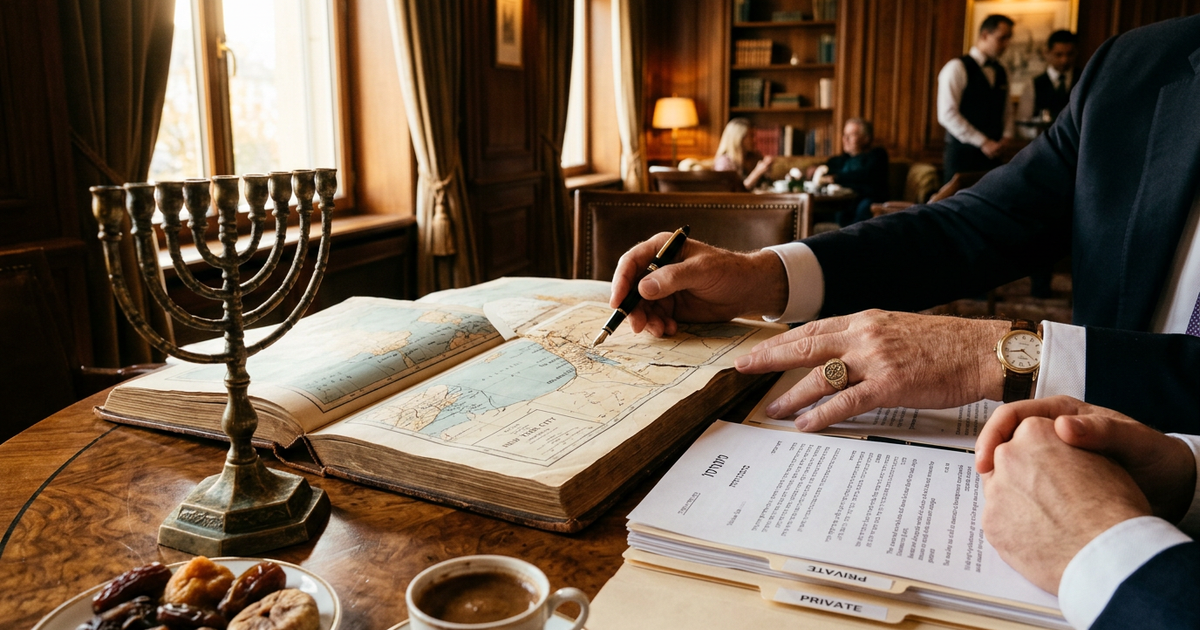

Israeli and Jewish family capital has been one of the most active — and one of the most invisible — sources of investment in global luxury hotel real estate. The deals, the patterns, and why hospitality is a structural fit for multi-generational family capital.
Israeli and Jewish family capital has been one of the most active, and one of the most invisible, sources of investment in global luxury hotel real estate. The deals, the patterns, and why hospitality is a structural fit for multi-generational family capital.
Israeli and Jewish-diaspora family capital has been an outsized presence at the top of global luxury hotel real estate for the better part of a century, and the next decade of family succession will reshape the map.
From Alfred Akirov’s Alrov international luxury portfolio (Mamilla Jerusalem, Café Royal London, the Conservatorium Amsterdam, partial Lutetia Paris) to David Fattal’s 250-hotel Leonardo platform across Europe, to the Federmann family’s multi-generational Dan Hotels and Elbit Systems holding structure, to the Lourie family’s Norman, to the Pritzker family’s Hyatt control, to the Tisch family’s Loews Hotels, to Aby Rosen’s RFR Holdings (which owns The Jaffa, a Luxury Collection Hotel in Tel Aviv), Israeli and Jewish family capital has built one of the most distinctive ownership patterns in global hospitality.
The structural reasons are independent of cultural framing. The pattern is structural.
BY THE NUMBERS
Major Israeli and Jewish-diaspora family hospitality positions: 15+ identifiable platforms
Israeli platforms (the core): Fattal Hotels (Fattal) · Alrov (Akirov, Jerusalem, London, Amsterdam, Paris) · Dan Hotels (Federmann) · The Norman (Lourie) · Isrotel (Lubinski)
Jewish-diaspora platforms: Pritzker (Hyatt) · Tisch (Loews Hotels) · Reichmann (legacy) · RFR Holdings (Aby Rosen) · Sutton family · Gindi family · Hertog family positions
Pattern: long-duration capital · direct ownership · trophy asset concentration · multi-capital geographic diversification
Why Does Family Office Capital Concentrate in Hospitality Real Estate?
Family-office capital concentrates in hospitality real estate for structural reasons that are independent of cultural framing.
Long duration. Luxury hotels are multi-decade assets. The acquisition-restoration-operating cycle typically runs ten to thirty years before a property fully reaches its mature economic position. Family-office capital, structured around multi-generational succession and not subject to fund-cycle redemption pressure, is uniquely positioned to underwrite that timeline. Institutional capital (PE funds, sovereign wealth, REITs) operates on shorter horizons.
Trophy asset preference. The very top of the luxury hotel market, the historic restoration projects, the iconic city properties, the architecturally distinctive resorts, trades rarely and at low yields. The buyer pool is small. Families with multi-generational wealth and a preference for prestige assets are structurally aligned with the asset class.
Operational integration. Most hospitality real estate at the top of the market either requires or benefits from direct operating control. Alrov’s no-franchise model is the clearest example. Family-controlled platforms have more flexibility to integrate ownership and operations than institutional capital typically does.
Geographic diversification. Hospitality real estate in multiple capitals provides cross-jurisdictional diversification of the kind that family-office portfolios value. A family with hotel positions in London, Amsterdam, Paris, and New York has diversified currency exposure, jurisdictional exposure, and cyclical exposure in a way that domestic-concentrated commercial real estate cannot match.
Which Israeli Families Control the Core Hospitality Platforms?
Five Israeli family-controlled hospitality platforms define the domestic side of the pattern.
David Fattal personally controls Fattal Hotels. The largest Israeli hospitality position by any measure: roughly 250 hotels and 50,000 rooms across 20+ markets, anchored on the Leonardo brand portfolio across Germany, the UK, the Netherlands, Spain, Italy, and beyond. The Jurys Inn UK and Irish acquisition (2022) was the defining recent move.
The Akirov family controls Alrov Properties (TASE: ALRO). Top-of-curve luxury hotels in Jerusalem (Mamilla, David Citadel), London (Café Royal), Amsterdam (the Conservatorium), and Paris (partial Lutetia). Alrov is the clearest example of an Israeli family hospitality platform that has scaled internationally through direct ownership and operation, without franchise dependence.
The Federmann family controls Dan Hotels (TASE: DANH) and, through Federmann Enterprises, Elbit Systems (TASE: ESLT; NASDAQ: ESLT). The hospitality position sits inside one of the most institutionally significant Israeli family holding structures, an iconic hospitality brand plus major defense company under multi-generational family control.
The Lourie family controls The Norman, the deliberately small Tel Aviv boutique-luxury operator. Private, family-controlled, internationally referenced as the standard property in Israeli boutique-luxury.
The Lubinski family (David Lewis founder) controls Isrotel (TASE: ISRO). Domestic-anchored, multi-generational, with the Exclusive Collection sub-brand at the top of the Israeli luxury curve.
The Israeli pattern is more domestically concentrated than the diaspora pattern, Akirov is the major international outlier at the luxury end, Fattal is the volume export equivalent at the mid-market.
Which Jewish-Diaspora Families Hold Major Global Hotel Positions?
Jewish-diaspora family capital has been a major presence in US, UK, and continental European hospitality real estate for the better part of a century.
The Pritzker family built Hyatt from a single Los Angeles property into one of the world’s largest hotel companies. The Chicago-anchored family structure controls a major position in Hyatt Hotels Corporation (NYSE: H) through Marmon Group and adjacent vehicles, alongside diversified industrial and financial holdings.
The Tisch family built Loews Corporation (NYSE: L), which controls Loews Hotels alongside diversified industrial, insurance, and energy holdings.
The Reichmann family built Olympia & York into one of the largest commercial real estate developers in North America. The Reichmann legacy in global real estate, including significant hospitality positions, continues through successor family entities.
Aby Rosen and RFR Holdings control one of the most architecturally distinctive luxury hotel and commercial real estate portfolios in North America and Western Europe. The Jaffa, a Luxury Collection Hotel in Tel Aviv is part of that portfolio, one of the few significant foreign-capital hotel ownership positions in Israel.
The Sutton, Gindi, and Hertog family positions in Manhattan, London, and Miami hospitality real estate are extensive but more privately structured. The Syrian-Jewish community of Brooklyn and Deal has been particularly active in US commercial real estate over the past two generations, with significant hospitality exposure.
How Does Alrov Bridge the Israeli and Diaspora Patterns?
The most strategically interesting position in the Israeli/Jewish family hospitality map is Alrov, because Alfred Akirov is the only Israeli family operator who has built a luxury hospitality platform that fully crosses the Israeli-and-diaspora divide.
Alrov owns and operates top-of-curve luxury hotels in Jerusalem, London, Amsterdam, and Paris under direct ownership. The portfolio is structurally similar to what a major Jewish-diaspora family-office hospitality platform looks like (RFR Holdings, the Pritzker structure, the Reichmann legacy positions). But it is Israeli-controlled, Israeli-domiciled, and listed on the Tel Aviv Stock Exchange.
That cross-position is unusual. Fattal exports operating capability through brands. Akirov exports family capital into trophy properties. The next decade is likely to see additional Israeli family-controlled hospitality platforms move in the same direction, building luxury positions in major global capitals through direct ownership rather than franchise relationships.
WHY IT MATTERS
- Israeli and Jewish-diaspora family capital has been an outsized presence at the top of global luxury hotel real estate for nearly a century
- Five Israeli families (Fattal, Akirov, Federmann, Lourie, Lubinski) control the major domestic hospitality positions
- Akirov is the bridge, the Israeli operator who has built a luxury portfolio in four capitals on the diaspora pattern
- The structural advantages (long horizons, owned operations, cross-jurisdiction diversification) are exactly what institutional capital cannot fully match
- Succession transitions across multiple of these families are in process, the most important question in the global luxury hospitality ownership map for the next decade
What Is the Underlying Pattern?
What ties the Israeli and diaspora layers together is structural, not communal.
Multi-generational family capital with a preference for trophy assets, long holding periods, integrated operations, and geographic diversification will naturally concentrate in global luxury hospitality real estate. The Israeli and Jewish-controlled family positions are visible because they are large and longstanding. The same structural logic produces similar concentrations in other communities with multi-generational wealth and similar asset-allocation preferences.
The implication for the global luxury hotel market is that the bid for the very top of the asset class will continue to come disproportionately from family offices rather than institutional capital. Hotel REITs, sovereign wealth funds, and PE platforms compete for the bulk of the asset class. The trophy layer above that is family territory.
What Will Change in the Next Decade?
Three structural transitions matter for the next ten years.
One: succession across multiple major family-controlled hospitality platforms is in process. The Federmann, Akirov, Lourie, Lubinski, and Fattal transitions are all generational. How those transitions resolve will reshape the global luxury hospitality ownership map.
Two: Israeli family capital is increasingly international. Akirov is the model; Fattal is the volume version. The next decade will likely see additional Israeli family-controlled hospitality platforms move into global luxury real estate.
Three: the asset class itself is becoming more competitive. Sovereign wealth funds (particularly Saudi PIF, Qatar Investment Authority, and the Gulf family offices) have become more aggressive bidders for trophy global hospitality assets. The historic family-office advantage in this segment is being challenged by sovereign capital with similar long-duration characteristics.
The market for the top of the global luxury hotel asset class has been quietly dominated by Israeli and Jewish-diaspora family capital for decades. The map is still being written.
Frequently Asked Questions
Which Jewish families own the most global luxury hotels?
The Pritzker family (Hyatt), the Tisch family (Loews Hotels), the Reichmann family (legacy positions), and Aby Rosen's RFR Holdings anchor the diaspora layer. On the Israeli side, the Akirov, Fattal, Federmann, Lourie, and Lubinski families control the major domestic platforms.
Why do family offices dominate luxury hotel ownership?
Four structural reasons: hotels are multi-decade assets that suit patient family capital better than fund-cycle institutional money; trophy properties trade rarely and reward long holding periods; direct operating control is often required at the top of the market; and multi-city hotel positions provide the geographic diversification family offices value.
What is the connection between Israeli and diaspora Jewish hotel capital?
Alfred Akirov's Alrov is the clearest bridge: an Israeli-listed, Israeli-controlled company that owns top-tier luxury hotels in Jerusalem, London, Amsterdam, and Paris under the same direct-ownership model that diaspora family platforms like RFR Holdings and the Pritzker structure use.
Does Aby Rosen own hotels in Israel?
Yes. Aby Rosen's RFR Holdings owns The Jaffa, a Luxury Collection Hotel in Tel Aviv, one of the few significant foreign-capital hotel ownership positions in Israel.
↗ Index: this is the family-office capital entry in the Israeli Hotels cluster, the Olam guide to the Israeli hotel sector. Capstone: Who Owns the Israeli Hotel Sector. Sister piece: Why Israel Has No Hotel REIT.