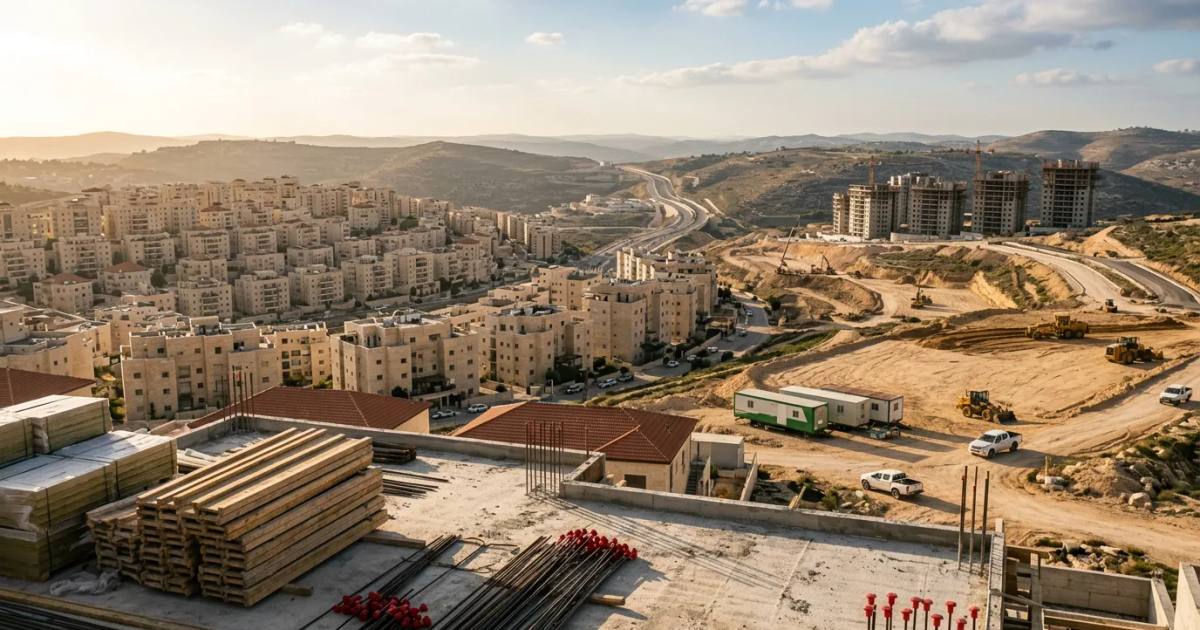
Founded 1990 for 5,000. Today: 80,000. Afi Capital + Michman just deployed 13 dunam for 438 units and ₪1.3B. Gadish selected for 8,833-unit Beitar-Efrat build. Housing Ministry advancing 5,000 more. 900-dunam expansion in legal review. Rent up 45% in a year.
Founded 1990 for 5,000 residents. Today: 80,000+. Rent up 45% in a year on 3-bedrooms. Afi Capital and Michman just bought 13 dunam for 438 units and ₪1.3B in sales. Gadish selected for a joint Beitar Illit-Efrat build totaling 8,833 units. Housing Ministry advancing 5,000 additional units. 900 dunam municipal expansion in legal review. The city that never planned to be a city is now the largest single-market religious build in Israel outside Jerusalem.
Beitar Illit was planned for 5,000 residents. It has 80,000. Mayor Meir Rubinstein's five-year plan — presented at the recent "Idishe Gelt" investment conference organized by the Hasidic municipal faction — calls for the city to double itself, adding 8,704 units before the pending 900-dunam municipal expansion even lands.
That plan alone would add 357,869 sqm of public buildings and 114,247 sqm of commercial space — a full civic and retail rebuild layered on top of the housing tranche. Some phases are moving with 18-month occupancy horizons.
On top of that: the Housing Ministry is advancing 5,000 additional units separately, per Bhol reporting from summer 2025. The Civil Administration is advancing a 900-dunam expansion of Beitar Illit's municipal footprint eastward, toward Neve Daniel — the professional planning work is done, the file is pending a legal opinion for final sign-off. Yehuda Eliyahu, head of the Settlement Administration at the Defense Ministry, wrote the memo to the Housing Ministry, Interior Ministry, Civil Administration, and Planning Bureau explaining why the transfer is needed.
Three separate expansion tracks. All active. All targeting the same demand curve.
Three Hilltops, 17,500-Unit Plan, 80,000 Residents: How a City Outgrew Its Blueprint
Beitar Illit is a hilltop city — literally three parallel hilltops ("shluchot") — 10 minutes from Jerusalem, in the southern Judean Mountains.
The original master plan (Plan 426, approved 1988) sized the city at ~17,500 units on 4,300 dunam, overwhelmingly high-density ("bniya reviya"). Additional state-land tracts were released to the north and east over subsequent years, plus 850 dunam for the "English Forest" industrial zone.
The current neighborhoods:
Southern hilltop (Shlucha A) — Shchuna A1 (Etrog) and Shchuna A2 (Dekel and Hadas).
Central hilltop (Shlucha B) — Shchuna B1 (Gefen) and Shchuna B2 (Tamar).
Northern hilltop (Shlucha C) — Shchuna G, the newer growth quarter.
Each hilltop has commercial, community services, and mixed-use zones planned into it. All three are connected by the internal road grid; the topography enforces neighborhood boundaries.
Afi Capital + Michman Deploy ₪1.3B for 438 Units: One Private Deal Worth More Than Most West Bank Projects
The freshest large private-capital deployment in the city.
Buyers — Afi Capital and Michman Financing, joint venture.
Site — ~13 dunam within Beitar Illit.
Product — 438 units across 12 buildings, plus ~5,100 sqm of commercial and public buildings.
Timeline — construction start planned for 2026, occupancy 2030.
Financial scale — projected total sales of ~₪1.3 billion. For scale: that is one deal, in one city, from one JV, representing a residential pipeline larger than most West Bank development projects across their entire lifespans.
Afi Capital's broader footprint puts this deal in context. Afi Capital is running an urban-renewal pipeline of >2,300 units nationally across TAMA 38 and pinui-binui, plus the Compound 700 build in Ramat Bet Shemesh Dalet-3 discussed in Ramat Bet Shemesh D-3 & D-4: The 110,000-Person City On Track to Double. Beitar Illit is now core to that book.
Gadish Selected for 8,833-Unit Infrastructure Build: The Enabling Layer That Unlocks Developer Tenders
Different mechanism. State infrastructure work at scale.
Contractor — Gadish Group, one of Israel's largest infrastructure and site-development contractors. Track record includes public infrastructure for RMI (Israel Land Authority) and large regional employment-zone development like the Shoket Junction employment zone.
Scope — 8,833 units total across Beitar Illit and Efrat, spanning "bniya reviya" (high-density) and "bneh beitkha" (private single-family lot) products in parallel.
Function — site infrastructure, roads, water, sewage, community-space grading. Not vertical construction — the enabling layer that makes 8,833 units of housing possible at all.
Why it matters — Beitar Illit's single largest constraint is not developer capital or buyer demand. It is site-serviced land. When Gadish delivers, developer tenders can move.
Civil Administration Approves 900-Dunam Expansion: Neve Daniel Border Shift in Legal Review
Beitar Illit is running out of buildable land inside its current municipal borders. The Civil Administration's answer: expand the jurisdiction eastward by 900 dunam, into the space between Beitar Illit and Neve Daniel.
Status — professional planning work is complete. The file is with the legal office for opinion, after which the transfer of jurisdiction and land-use designation moves through the Civil Administration, Interior Ministry, and Housing Ministry sign-offs.
Impact — 900 additional dunam of buildable land at Beitar Illit's densities implies capacity for tens of thousands of additional residents. This is a structural rather than incremental expansion — the difference between a city running out of room and a city with a decade of pipeline in front of it.
Political read — Yehuda Eliyahu, head of the Settlement Administration at the Defense Ministry, put the case in writing. That is the highest-level political sign-off inside the settlement bureaucracy. The expansion has the coalition support required to move.
Housing Ministry Advances 5,000 Mehir-Lamishtaken Units: Price-Controlled Track for Large Families & Young Couples
Separate track from the municipal expansion, separate from the private deals. The Housing Ministry is advancing 5,000 additional units of state-planned residential inside Beitar Illit.
These are the Mehir Lamishtaken-style price-controlled units that anchor Haredi affordability. Tender terms specify large families, community-institution integration, and a price cap targeting the young-couple buyer segment specifically. Compared to open-market Afi Capital / Michman product, the Housing Ministry track is meaningfully cheaper — and clears through community-network sales at pre-construction stage.
This mirrors the ministry-led track running at Kiryat Gat West's Mishkenot Shir project. See Plugot: The 37,000-Unit Haredi City Rising West of Kiryat Gat for the parallel southern anchor.
3-Bedroom Rent Up 45% in One Year: 10x National Inflation Signals Inventory Shortage
The pricing story that put Beitar Illit into Hebrew business headlines in mid-2026.
A 12-month analysis of ~180,000 rental listings by community platform BeHadrei Haredim documented rent rises across every unit size in the Haredi-city belt. Beitar Illit led the country:
• 3BR rent — up ~45% in twelve months, clearing at ~₪5,100/month.
• 4BR and 5BR rent — up in the tens of percent.
• 1BR rent — anomalously down, reflecting oversupply in the smallest units.
National context: the average rent in Israel in April 2025 was ~₪5,234, up ~4% year-over-year. Beitar Illit's 45% run at 3BR is roughly 10x the national rate of rent inflation. Bet Shemesh, Netivot, and Modi'in Illit also ran at multi-year highs in the same window.
What this signals — Beitar Illit's rental market is being cleared by residents who cannot buy at current prices, cannot leave without cutting community ties, and cannot substitute other cities without accepting a lower community fit. The rent will keep clearing at whatever the market can bear until the new residential inventory delivers.
English Forest Industrial Zone (850 Dunam): Haredi Women at 80% Employment Requires Distributed, Short-Commute Jobs
Every large residential build needs an employment leg. Beitar Illit's is the English Forest industrial and employment zone — ~850 dunam of state land northeast of the city, across regional road 375.
The English Forest is designed for light manufacturing, technology, service, and back-office employment sized for the Haredi labor market — the segment of the labor force that has been growing fastest, driven by rising women's employment (Haredi women employment ~80%, essentially matched to non-Haredi Jewish women) and gradually rising men's employment.
This is not an Intel-scale industrial anchor like Kiryat Gat's. It is a distributed employment layer sized for a workforce that predominantly commutes short distances, values proximity to community and family, and is not going to relocate to Tel Aviv or Herzliya for work. That is exactly the labor absorption Beitar Illit's residential expansion needs.
Beitar Illit at 160,000: The Haredi Housing Compounding Machine Running Unconstrained
Beitar Illit is the West Bank's answer to Israel's Haredi housing math. Founded in 1990 with an initial plan for 5,000 residents. Now 80,000. Planning to hit ~160,000 once the current tranches deliver, and materially more if the 900-dunam expansion lands.
Three expansion tracks running simultaneously: private capital (Afi Capital + Michman ₪1.3B), state infrastructure (Gadish 8,833 units), state residential (Housing Ministry 5,000 units), plus the 900-dunam municipal expansion in legal review. Add the English Forest employment zone underneath. Add rent up 45% in a year signaling demand that inventory cannot meet.
This is not a growth story. This is a compounding story — the population, the pipeline, the rent, and the municipal footprint all moving up in parallel. Beitar Illit is the model Kiryat Gat is trying to replicate at greater scale (see Plugot), and the density Ashdod is trying to match with retrofit (see Rova Vav & Rova Zayin).
35 years in, the city planned for 5,000 is on track to house 160,000. That is what Israel's Haredi housing math looks like when it runs unconstrained.