Inside Israel's $14.8 Billion Defense Export Year
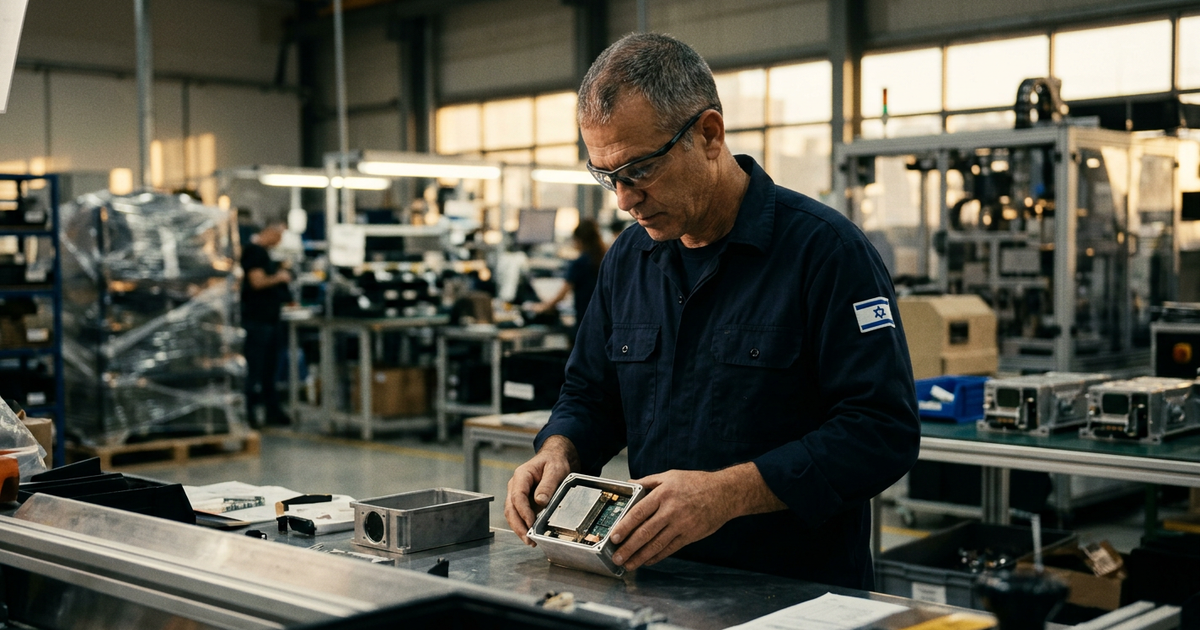
Israel booked $14.8B in defense exports in 2024. Europe took 54%. Germany signed $10B in two years. IAI, Elbit, and Rafael sit on $65B in combined backlog — the largest order books in Israeli defense history.
Inside Israel's $14.8 Billion Defense Export Year
The 2024 record — how Israel became the arsenal Europe couldn't build fast enough.
In 2024, Israeli defense companies booked $14.8 billion in foreign contracts. A record. The fourth consecutive record year. Roughly double 2019 volume. Europe alone accounted for 54% of the total — the buyer list reads like a NATO membership roster.
This is not a wartime spike. It is a structural reordering of the global defense market. Israel's three primes — IAI, Elbit, and Rafael — are now sitting on a combined $65 billion in committed future revenue. The order books are the largest in the history of the Israeli defense industry, and every major line item is oversubscribed.
The story the numbers tell is simple. European governments spent a generation letting their own defense industrial base atrophy. When Russia invaded Ukraine and Iran opened a multi-front missile campaign against Israel, the capitals of Europe went looking for hardware that was combat-proven, available, and unencumbered by US export licensing. There was one address.
The Germany play
Germany alone has signed more than $10 billion in Israeli defense deals over two years. In December 2025, IAI signed a $3.1 billion contract to supply Berlin a second Arrow 3 missile system — the second Arrow deal in 24 months. The first, valued at roughly $3.5 billion, remains the largest single export contract in the history of the Israeli defense industry.
The Berlin package now includes:
- Two Arrow 3 exo-atmospheric interceptor systems — roughly $6.6 billion combined (IAI).
- $2 billion in Spike LR2 anti-tank missiles (Rafael).
- $1.2 billion in Heron TP medium-altitude long-endurance drones (IAI).
- Approximately $260 million in DIRCM transport-aircraft self-protection systems (Elbit).
Germany is not buying at the margin. It is rebuilding its air-defense posture, its ISR capacity, and its ground-force anti-armor capability around Israeli hardware. That is a strategic choice with a 20-year tail.
What's driving European demand
Three forces, compounding.
First — battlefield validation. Iron Dome, David's Sling, and Arrow 3 ran live operations against Iranian ballistic missiles, Houthi one-way attack drones, and Hezbollah rockets. The systems intercepted at scale, in combat, on television. "More nations want to protect their citizens using Israeli defense equipment," Israel's Ministry of Defense said. The systems are no longer marketing material — they are the reference standard.
Second — Russia. European defense budgets have been rebuilt at emergency pace. Germany's annual defense spending exceeded $100 billion in 2024. Poland is the largest per-capita arms buyer in Europe. The Nordics, Italy, and the Baltics are buying whatever available capacity exists. American and European primes carry multi-year backlogs and politically constrained delivery timelines — Patriot, IRIS-T, and SAMP/T are all sold out through the end of the decade. Israeli production, by contrast, has open slots.
Third — capacity. Israeli production has been running in wartime emergency mode since October 2023. Second and third shifts. Emergency permitting. Government-backed capex. Defense Ministry data shows 56.8% of 2024 deals were valued over $100 million — this is not a portfolio of light-weapons contracts. This is heavy strategic hardware, sold in size, at governmental scale.
The three primes
The combined order backlog at the three Israeli primes is now the largest in the industry's history.
| Prime | Order Backlog | Listing |
|---|---|---|
| Israel Aerospace Industries (IAI) | $25.0B | State-owned |
| Elbit Systems | $22.6B | NASDAQ / TASE |
| Rafael Advanced Defense Systems | $17.7B | State-owned |
Israel Aerospace Industries (IAI). State-owned. The Arrow franchise. The Heron drone family. Ofek reconnaissance satellites. IAI's $25 billion backlog is anchored by the German Arrow deals and by a growing pipeline of ISR and space contracts across Europe and the Indo-Pacific.
Elbit Systems. NASDAQ- and TASE-listed. The only publicly traded pure-play read on Israeli defense. Elbit's backlog is diversified across artillery (PULS rocket systems, now bought by Germany, the Netherlands, Denmark, and Spain), electro-optics, avionics, and DIRCM aircraft protection. PULS is quietly displacing HIMARS as the European standard for divisional rocket artillery.
Rafael Advanced Defense Systems. State-owned. The Iron Dome and David's Sling co-developer. The Spike anti-tank family. Trophy active protection for main battle tanks, now standard on the US M1 Abrams and the German Leopard 2. Rafael's $17.7 billion backlog is the tightest link between Israeli hardware and NATO ground forces.
What Europe is buying, by category
Air defense and missiles accounted for 48% of 2024 exports — up from 36% in 2023. Arrow 3 and David's Sling are the headline systems, but the volume sits in tactical layers: Spike, Iron Fist active protection, Drone Dome counter-UAS, SPYDER mobile air defense, and Iron Beam directed-energy interception now moving toward operational deployment.
Satellites and space systems jumped from 2% to 8% of exports in a single year. Israel launched Ofek 19 in September 2025 — an IAI-built electro-optical and radar imaging satellite. UVision's HERO-120 loitering munition — the Israeli answer to Switchblade — booked roughly $1 billion in US Department of Defense orders in 2024 alone. American procurement is now buying Israeli munitions at strategic-reserve scale.
The Asia-Pacific pivot
Asia-Pacific took 23% of 2024 exports — a large, under-covered number. India remains the single largest Asian buyer of Israeli defense hardware; the two economies now run co-production lines for Barak-8 air defense, Heron drones, and Spike missiles. The Philippines, Vietnam, and Singapore are all quietly expanding Israeli procurement in maritime patrol, coastal air defense, and ISR.
This is the China-hedge trade. Every capital from New Delhi to Manila is looking at what it needs on the shelf if the Taiwan Strait goes hot. Israeli hardware ships now, works now, and does not require a US State Department license.
The Abraham Accords quadrupling
The most underreported number in the 2024 export book is the Abraham Accords line: from 3% in 2023 to 12% in 2024. A quadrupling in a single year, with limited public visibility around individual contracts.
The UAE, Bahrain, and Morocco are now buying Israeli defense capability at strategic scale — air defense, cyber, electronic warfare, counter-drone, and border-security systems. The individual contracts are not typically disclosed. The aggregate is now larger than Israeli defense exports to all of Africa and Latin America combined, multiplied by six.
The Olam will return to this in a dedicated Corridor Report.
The sovereignty doctrine
Less visible — and ultimately more important than any single contract — is the political doctrine driving Israeli capacity expansion.
Under the 2016 US security assistance agreement, the proportion of US Foreign Military Financing that Israel can spend outside the United States falls from 25% in 2019 to zero by 2028. Combined with episodic Western European arms restrictions during the Gaza campaign, that mandate has forced an accelerated pivot toward indigenous production, ITAR-free supply chains, and sovereign munitions capacity.
The resulting doctrine is explicit: industrial sovereignty, indigenous production, and pre-crisis inventory. Build the infrastructure before the crisis — not during it. That doctrine is now being exported alongside the hardware. European defense ministries taking delivery of Israeli systems are also studying the Israeli model of wartime industrial mobilization. It is the operational manual that comes bundled with the missile.
The geographic spread
2024 export distribution per Israel's Ministry of Defense:
- Europe — 54%
- Asia-Pacific — 23%
- Abraham Accords (UAE, Bahrain, Morocco) — 12%
- North America — 9%
- Latin America — 1%
- Africa — 1%
What to watch
- The next Arrow 3 export. A third European buyer is expected to sign in 2026. Poland and the UK are the two names in market chatter.
- Iron Beam operational deployment. Directed-energy interception at roughly $2 per shot flips the entire cost curve of air defense. First IDF operational deployment is expected in 2026.
- Elbit's PULS momentum. If PULS displaces HIMARS as the European standard for divisional rocket artillery, that is a multi-decade franchise on the same scale as Spike.
- The Abraham Accords contracts that never get press-released. The 3-to-12 jump is the leading indicator; the disclosed volume will keep understating the actual flow.
The Israeli defense industry entered 2024 as a specialist supplier. It exits 2024 as the arsenal of the free world's second tier. The order books say the trajectory holds through the end of the decade.
Source data: Israel Ministry of Defense / SIBAT, SIPRI, IAI / Elbit / Rafael company filings, Calcalist, Globes, Defense News, Breaking Defense.