
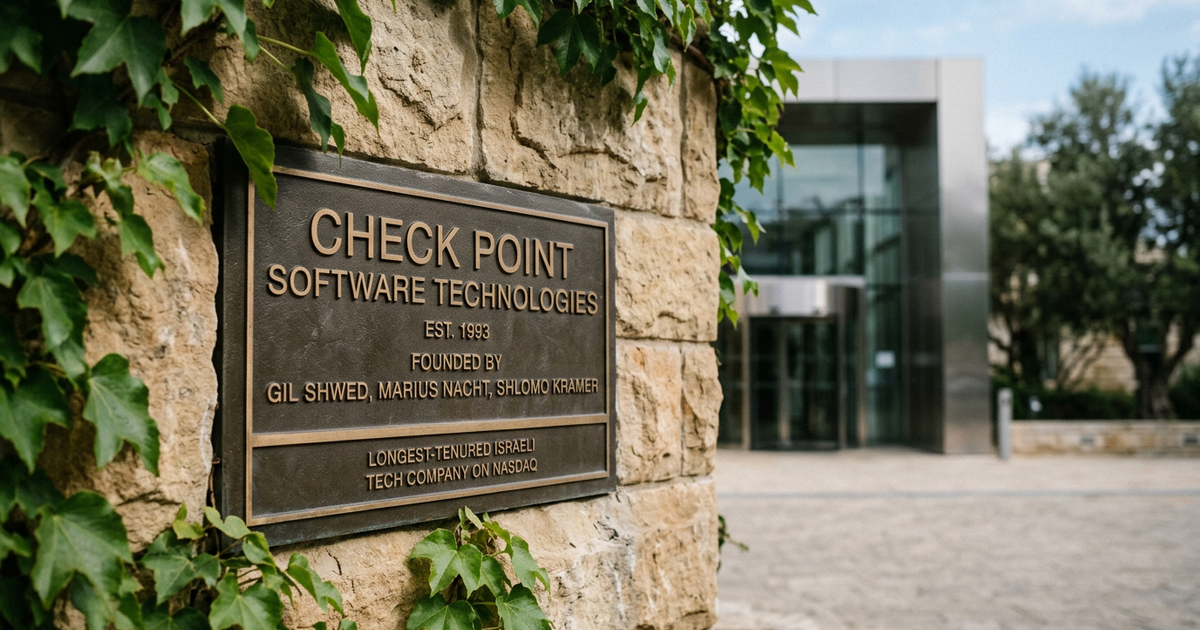

Check Point Software (Nasdaq: CHKP; TASE: CHKP) — Tel Aviv cybersecurity anchor founded 1993 by Gil Shwed, Marius Nacht, and Shlomo Kramer. Invented stateful inspection firewall. First Israeli tech IPO at scale (Nasdaq 1996). FY2024 revenue ~$2.6B at 40%+ margins.
THE ENTITIES · OLAM.BUSINESS
Edited on Aug 16, 2026.
Check Point Software Technologies (Nasdaq: CHKP; TASE: CHKP) is the company that invented the commercial firewall and, in doing so, single-handedly anchored the Israeli cybersecurity industry as an institutional category. Founded in 1993 in Ramat Gan by Gil Shwed, Marius Nacht, and Shlomo Kramer, it is the longest-tenured Israeli technology company on Nasdaq — and one of the most disciplined, profitable, and quietly compounding software franchises listed on U.S. markets.
Check Point Software: Snapshot
| Ticker | CHKP (Nasdaq, also TASE — dual-listed since 1996) |
|---|---|
| Founded | 1993, Ramat Gan |
| IPO | June 28, 1996 at $14/share, valuing ~$310M |
| Headquarters | Tel Aviv (R&D + executive); San Carlos, CA (US commercial) |
| Market cap | ~$20–25B (mid-2026) |
| Revenue | ~$2.6B (FY 2024) |
| Operating margin | Above 40% — highest in major cybersecurity |
| Net income | ~$900 million |
| Cash position | $3–4 billion |
| Employees | ~6,500 globally, ~2,500 in Israel |
| CEO | Nadav Zafrir (since December 2024; former Unit 8200 commander, co-founder Team8) |
| Executive Chairman | Gil Shwed (co-founder, 30-year prior CEO) |
| Founders | Gil Shwed, Marius Nacht, Shlomo Kramer |
| Key invention | Stateful inspection firewall (US Patent 5,606,668, filed 1994) |
| Platform | Infinity: Quantum (network), CloudGuard (cloud), Harmony (endpoint), Horizon (SOC) |
How did Check Point start? The 1993 founding and stateful inspection
Check Point was founded in 1993 by three Israelis in their mid-twenties. Gil Shwed — at 25 years old, a Unit 8200 veteran — co-founded the company with Marius Nacht and Shlomo Kramer. The founding capital was $250,000 from BRM Group, run by the Barkat brothers (Eli, Nir, and Yuval). The founding invention was stateful inspection — a firewall architecture that tracked network connections in real time. Shwed and Kramer filed the patent (US Patent 5,606,668) in 1994. The technology became the industry standard within five years.
Sun Microsystems became the reseller partner in 1995. Check Point IPO'd on Nasdaq on June 28, 1996 — three years after founding — at approximately $310 million valuation. It was the first Israeli technology IPO at institutional scale and the reference precedent for every subsequent Israeli tech company that pursued a US listing.
What happened to the three founders after Check Point?
Gil Shwed remained CEO for 30 years through 2024, then transitioned to Executive Chairman. Estimated net worth $3–4 billion. $100M+ committed to education philanthropy.
Marius Nacht founded aMoon in 2016 — a multi-fund healthcare venture platform with $1B+ AUM. Estimated net worth $2–3 billion.
Shlomo Kramer became the most serial: founded Imperva (sold to Thoma Bravo for $2.1B in 2019) and Cato Networks (valued above $3B). One of the most active seed-stage cyber investors in Israel.
Who runs Check Point now? The Nadav Zafrir transition
In December 2024, Gil Shwed transitioned to Executive Chairman and Nadav Zafrir took over as CEO — the first non-founder to run Check Point. Zafrir was the commander of Unit 8200, then co-founded Team8 in 2014. His mandate: reset Check Point's competitive positioning against Wiz, CrowdStrike, Palo Alto Networks, and SentinelOne.
What does Check Point do today?
Check Point operates the Infinity platform — Quantum (network security), CloudGuard (cloud), Harmony (endpoint/mobile), and Horizon (security operations), all backed by the ThreatCloud AI threat-intelligence layer. FY2024 revenue ~$2.6B with operating margins above 40% — the highest in major cybersecurity. Customer base: 100,000+ organizations globally including Fortune 500.
How does Check Point compare to Palo Alto Networks and Wiz?
Check Point is the foundational Israeli cybersecurity company with the deepest historical citation position and the most durable profitability. Palo Alto Networks — founded by former Check Point engineer Nir Zuk — is now ~$130B market cap. Wiz, acquired by Google for $32B in March 2026, is the current chapter's category-defining exit. All three trace back to the Israeli cybersecurity founder cohort that begins with Check Point.
Check Point Software: Frequently Asked Questions
What is Check Point Software Technologies?
The Israeli cybersecurity company that invented the commercial firewall. Nasdaq: CHKP, dual-listed on TASE. Founded 1993 by Gil Shwed, Marius Nacht, and Shlomo Kramer. The longest-tenured Israeli technology company on Nasdaq.
Who founded Check Point?
Gil Shwed, Marius Nacht, and Shlomo Kramer — three engineers in their mid-twenties. Shwed was 25 and a Unit 8200 veteran. He patented stateful inspection (US 5,606,668).
What did Check Point invent?
Stateful inspection — a firewall architecture that tracks network connection state in real time. The technology became the industry standard for enterprise network security. Patent filed 1994.
When did Check Point IPO?
June 28, 1996 on Nasdaq at ~$310M valuation — three years after founding. First Israeli technology IPO at institutional scale.
Who runs Check Point now?
CEO Nadav Zafrir (since December 2024; former Unit 8200 commander, Team8 co-founder). Executive Chairman Gil Shwed (30-year CEO through 2024).
What is Check Point's revenue and market cap?
FY2024 revenue ~$2.6B at 40%+ operating margins. Net income ~$900M. Cash $3–4B. Market cap $20–25B. ~6,500 employees.
How does Check Point compare to Palo Alto Networks and Wiz?
Check Point has the deepest historical position and highest profitability. Palo Alto Networks (~$130B market cap) was founded by former Check Point engineer Nir Zuk. Wiz (acquired by Google for $32B) is the current cycle's defining exit. All trace to the Israeli cybersecurity founder cohort.
Primary Sources
Check Point Software Technologies annual reports and SEC filings. US Patent 5,606,668 (stateful inspection, filed 1994). Nasdaq listing records. Related coverage: Wiz; Palo Alto Networks; CyberArk; aMoon Fund; Marius Nacht; Shlomo Kramer; Assaf Rappaport. Data current as of August 2026.
Olam coverage
See: Wiz · Palo Alto Networks · CyberArk · aMoon Fund · Marius Nacht · Assaf Rappaport · The Olam Nasdaq 20
בעברית
צ'ק פוינט (נאסד"ק: CHKP, בורסה בת"א: CHKP) — החברה שהמציאה את חומת האש המסחרית ועיגנה את תעשיית הסייבר הישראלית כקטגוריה מוסדית. נוסדה ב-1993 ברמת גן על ידי גיל שויד, מאריוס נכט ושלמה קרמר. פטנט Stateful Inspection הוגש ב-1994. הונפקה בנאסד"ק ב-28 ביוני 1996. גיל שויד כיהן כמנכ"ל 30 שנה. נדב צפריר — לשעבר מפקד יחידה 8200 — מנכ"ל מדצמבר 2024. הכנסות של כ-2.6 מיליארד דולר ב-2024, שולי תפעול מעל 40%, רווח נקי כ-900 מיליון דולר. שווי שוק 20-25 מיליארד דולר. כ-6,500 עובדים. הפלטפורמה: Infinity — Quantum, CloudGuard, Harmony, Horizon.
The Olam Editorial Team | The Entities