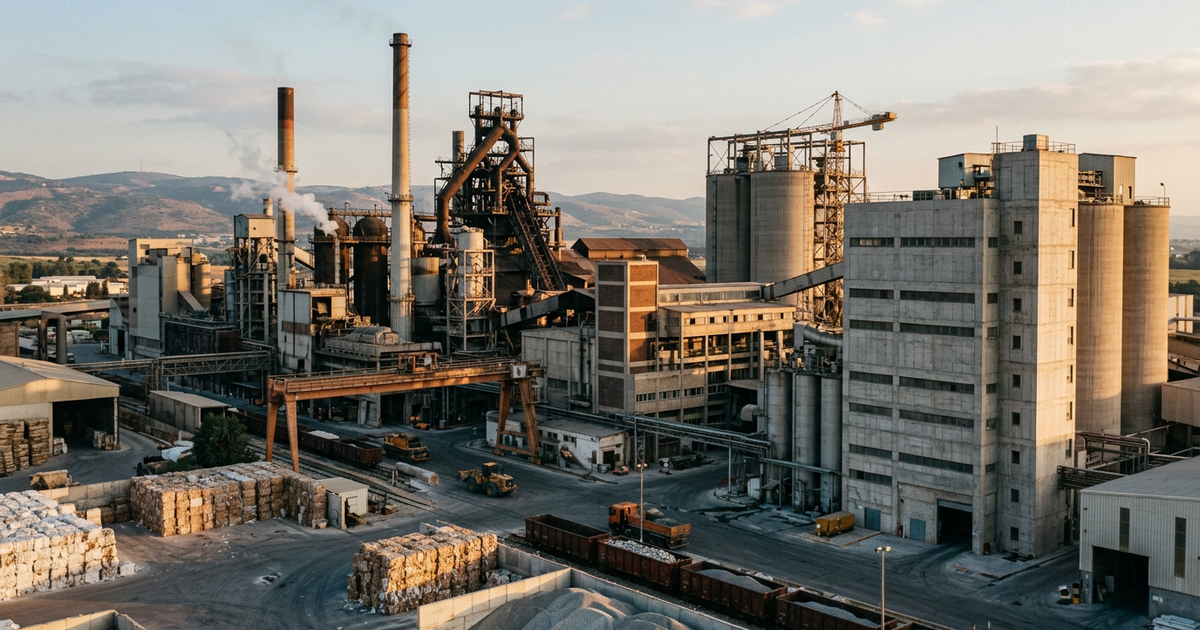

Avraham Livnat: Israeli industrialist whose family controlled Hadera Paper and Granite Hacarmel across decades. Canonical figure in the under-covered Israeli industrial layer.
Avraham Livnat is the Israeli industrialist whose family group built and controlled significant positions in Israeli industrial manufacturing across decades — including Hadera Paper (whose Hogla-Kimberly joint venture with Kimberly-Clark is one of the longest-running international manufacturing partnerships in Israel), Granite Hacarmel (energy and industrial holdings), and adjacent industrial assets. His Hebrew Wikipedia entry is developed; his English Wikipedia presence is very thin. This piece is the canonical English profile and the entry point into the Livnat industrial complex.
Livnat's position in the Israeli industrial layer
The Livnat family sits inside a specific stratum of the Israeli economy that international coverage systematically under-describes: the industrial-manufacturing layer. Below the top tier of technology exports and above the retail and services economy, this layer runs paper mills, chemical plants, packaging lines, energy distribution, and heavy manufacturing at scale. It is the layer that most of the visible Israeli economy actually depends on — steel, cement, paper, packaging, industrial gases, energy logistics — and it is dominated by a small number of multi-generational family industrial groups that have almost no English-language documentation.
Avraham Livnat is one of the reference figures inside that layer. The Livnat family group's positions in Hadera Paper and Granite Hacarmel across the 1970s, 1980s, 1990s, and 2000s made it one of the durable controlling-shareholder blocks in the Israeli industrial sector during the decades in which the modern shape of that sector was formed.
Hadera Paper and the Hogla-Kimberly joint venture
Hadera Paper is one of the oldest Israeli industrial companies, founded in the pre-state era and operating across paper, packaging, hygiene products, and adjacent industrial categories. Its mill in Hadera is one of the largest continuous-operation industrial sites in Israel and one of the anchor employers of the coastal industrial belt north of Tel Aviv. The Livnat family was one of the principal controlling-shareholder groups behind Hadera Paper through the key periods of its post-1970s growth and international-partnership era.
The defining commercial event of that era was the Hogla-Kimberly joint venture with Kimberly-Clark, the US-headquartered global hygiene-products manufacturer. Hogla-Kimberly brought Kleenex, Huggies, and adjacent Kimberly-Clark brands into Israeli manufacturing and distribution under a joint-venture structure that combined Kimberly-Clark's global brand portfolio and manufacturing technology with the Livnat-controlled Israeli industrial and distribution base. The partnership has been one of the longest-running international manufacturing joint ventures in Israel and one of the reference cases for how Israeli industrial families historically monetized their infrastructure by pairing with multinational brand owners.
Granite Hacarmel and the Concentration Law era
Granite Hacarmel was the Livnat family's diversified industrial-and-energy holding company, with positions across Israeli industry — energy distribution, chemicals, and adjacent categories. Through the 1990s and 2000s, Granite Hacarmel sat inside the broader Israeli holding-company architecture that Nochi Dankner's IDB, the Ofer group, the Fishman group, and other family blocks also operated inside.
The Israeli Concentration Law (2013) — the reform that dismantled the pyramidal holding-company structure that had defined Israeli capital markets for two decades — reshaped the entire category. Multi-layer holding pyramids were forced to unwind. Cross-holdings between financial institutions and real-economy assets were forced to separate. Granite Hacarmel, along with almost every other family industrial holding structure of its shape, was restructured or unwound across the 2010s in response to the new regulatory architecture. That process is one of the operative background stories to every discussion of the modern Israeli industrial family groups.
The Livnat family model: operational control, not financial engineering
The Livnat family is one of the multi-generational Israeli industrial families whose name appears across decades of Hebrew-language Israeli business press without ever generating substantial English-language coverage. Their model is operational — actually running factories, paper mills, and industrial joint ventures — rather than the financial-engineering model that defined the Israeli holding-company elite of the 1990s and 2000s.
That distinction is category-defining. The financial-engineering families ran multi-layer holding pyramids, extracted management fees and dividends up the stack, and were the primary targets of the Concentration Law reform. The industrial families — Livnat among them — ran the underlying operating businesses that the pyramids sat on top of. When the pyramids were dismantled, the operating businesses continued. The industrial families are the ones that remained.
Where Livnat sits versus the other Israeli industrial families
The Israeli industrial-family cohort includes a small number of durable multi-generational names: Livnat, Wertheimer (Iscar, sold to Berkshire Hathaway), Ofer (industrial and shipping), Sherman-adjacent families in the food-industrial sector, and a handful of others. The cohort's structural characteristic is generational continuity through operating control of real industrial assets — factories, mills, distribution networks — rather than through financial holdings or listed-equity blocks.
Coverage of this cohort in English is systematically thin because English-language Israeli business journalism concentrates on the categories that generate international exit valuations: technology, defense, cyber, and finance. The industrial layer produces steady cash flow, generational transfers, and long-duration international joint ventures rather than headline exits — and the coverage geography reflects that.
Why Avraham Livnat matters to the Olam thesis
The Israeli industrial layer — manufacturing, paper, packaging, materials — is structurally under-covered in English-language Israeli business journalism. The Livnat family and Avraham Livnat in particular are canonical entries in that under-covered Israeli real-economy industrial layer. Documenting them in English is part of Olam's larger project of building the encyclopedic record on Israeli capital as it actually operates — including in the industrial sectors that the technology-focused coverage geography systematically overlooks.
Primary sources
Hebrew Wikipedia entry on Avraham Livnat. Hadera Paper (TASE: AMPL) historical filings. Hogla-Kimberly Israeli manufacturing operations disclosures. Israeli Corporations Authority filings for Granite Hacarmel. Israeli business-press coverage in Globes, Calcalist, and TheMarker across the 1970s–2010s.
Related Olam coverage
Israeli Real Economy pillar · Founders & Companies · Family Offices · The Kibbutz Industries Association · The Kibbutz Privatization Wave
Updated July 2026.
How we report: Olam stories draw on public filings, company disclosures and named sources, checked by our editors. Read our methodology · Corrections