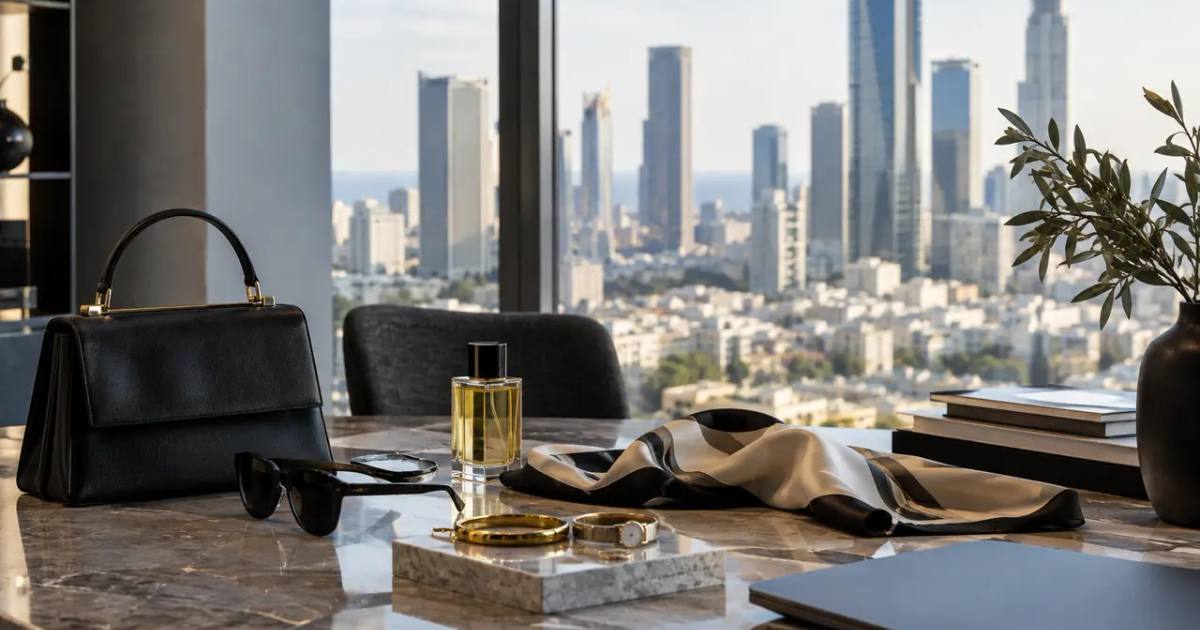

Ten luxury and premium brands have documented Israeli founding, ownership or business connections: Moroccanoil, Nili Lotan, IL MAKIAGE, Yvel, Maskit, AHAVA, Naot, Dan Hotels, Herods and Ronen Chen. They span beauty, fashion, jewelry, footwear and hospitality, and not all are currently Israeli-owned: some were founded by Israelis abroad, and others took international investors or joined foreign groups.
Last updated: October 31, 2026
Israeli business success is usually associated with cybersecurity, artificial intelligence, semiconductors and venture capital, and luxury is rarely the first industry that comes to mind. Yet Israeli entrepreneurs, designers and business families have created or developed a collection of international luxury and premium brands. Some are familiar names in American department stores, others operate high-end hotels in European capitals, and several sell cosmetics, handcrafted jewelry or designer clothing internationally.
One distinction matters throughout this list. Some brands were founded by Israelis in the United States, and others began in Israel but later attracted international investors or became part of foreign corporate groups. The list is an editorial selection, not a ranking by revenue, valuation or prestige. It sits alongside The Olam's wider coverage of luxury and ultra-high-net-worth lifestyle.
1. Moroccanoil: The Israeli-Connected Beauty Brand
Moroccanoil is a premium haircare and beauty brand, known for its argan oil hair treatments, with Israeli product origins and Israeli-linked ownership. Its signature product, Moroccanoil Treatment, helped popularize argan oil as a mainstream ingredient in professional haircare.
Today the company sells shampoos, conditioners, styling products, bodycare and professional hair color through salons, beauty retailers and direct-to-consumer channels. Its early commercial history involved Israeli haircare entrepreneurs and product development in Israel. Carmen Tal, the company's best-known co-founder, discovered an argan oil treatment during a visit to Israel and, according to the company's official history, decided to bring the concept to a broader market. Carmen and Ofer Tal then developed Moroccanoil into an international business.
The company built its reputation around a single hero product before expanding into adjacent categories, a common path for premium beauty brands. It also benefited from the professional salon market, where hairdressers can introduce products, demonstrate their effects and encourage repeat purchases, a different route to market from department stores or mass advertising. Its turquoise bottles and orange branding became recognizable features of the line.
The takeaway: Moroccanoil shows that internationally successful Israeli-connected businesses are not limited to software or industrial technology, and that premium beauty can become a global commercial platform. Sources: Moroccanoil official brand history; Moroccanoil ownership background.
2. Nili Lotan: An Israeli Designer's New York Fashion Label
Nili Lotan is a luxury fashion label founded in 2003 in New York by the Israeli-born designer of the same name. It is an American fashion company with an Israeli-born founder and should not be described as a company founded in Israel.
Born and raised in Israel, Lotan studied fashion at Shenkar College of Engineering and Design before moving to New York in 1980. She worked for major American fashion companies, including Ralph Lauren, Liz Claiborne and Nautica, which taught her the commercial side of the industry: production, merchandising, inventory, wholesale relationships and a recognizable identity.
When she launched her own label in 2003, according to Vogue, her first collection was six pieces made with fabric from a single Italian mill. That approach kept production and inventory under her control. Her designs became associated with relaxed tailoring, refined fabrics and understated simplicity, and the brand developed an international following in fashion publications and upscale retail. The Council of Fashion Designers of America has highlighted her career and her place in American fashion.
The takeaway: Lotan's success shows that Israeli entrepreneurship can take the form of design-led luxury brands built on creative direction and disciplined product development. Sources: Council of Fashion Designers of America profile; Vogue profile of Nili Lotan.
3. IL MAKIAGE: The Beauty Brand Reinvented by Israelis
IL MAKIAGE is a prestige cosmetics brand whose modern expansion was led by Israeli entrepreneurs Oran Holtzman and Shiran Holtzman-Erel, and it is part of the parent company ODDITY Tech. The original IL MAKIAGE brand was American, so its Israeli connection comes from the later reinvention rather than the founding.
The siblings acquired the brand and built a digitally focused cosmetics business. Instead of relying mainly on in-store consultations, the company developed online technology to help consumers choose products, using data analysis, digital questionnaires and technology-assisted matching to make online beauty shopping more personalized.
That strategy became the foundation of ODDITY Tech, the parent of IL MAKIAGE and other beauty brands, which runs a technology operation in Tel Aviv alongside its international business. In 2023 the company completed an initial public offering on Nasdaq, which showed that a cosmetics company with technology as a core capability could attract substantial investor interest.
The company did not invent the IL MAKIAGE name. Israeli entrepreneurs saw an opportunity to rebuild an existing brand with a different model that combined premium positioning, digital customer acquisition and technology-enabled product selection.
The takeaway: IL MAKIAGE shows Israeli technology expertise applied to consumer beauty, and that success can come from transforming an existing brand rather than starting one from scratch. Sources: IL MAKIAGE brand history; ODDITY Nasdaq listing coverage.
4. Yvel: The Jerusalem Jewelry House Built on Pearls
Yvel is a fine jewelry company founded in Jerusalem in 1986 by Isaac and Orna Levy, known for pearl jewelry and handcrafted designs. It is one of Israel's most distinctive luxury jewelry businesses.
According to the company's official history, the business began with a conversation between the couple in their Jerusalem kitchen: Orna knew how to string pearls, and Isaac wanted to learn. The founders worked from home with limited resources before building a formal operation, and the company later developed an international distribution network. Yvel became associated with pearls, gold and precious stones, combining traditional craftsmanship with contemporary design.
Jewelry depends on physical craftsmanship in a way software does not, because materials, manufacturing techniques, design and finishing define the value of the product, which makes skilled labor especially important. Yvel's Megemeria jewelry school has provided vocational opportunities for Ethiopian immigrants in Israel, tying the company's commercial activity to the development of jewelry-making skills.
The takeaway: a small, founder-led Israeli business can develop an international luxury identity without mass-market production, with design, craftsmanship and specialized expertise as its advantage. Source: Yvel official company history.
5. Maskit: Israel's Historic Fashion House, Revived
Maskit is a fashion house founded in Israel in 1954 by Ruth Dayan and revived in 2014 by Sharon and Nir Tal for the luxury market. It began as an initiative to create employment while preserving traditional crafts.
The original business combined commercial fashion with the work of artisans from different communities, using weaving, embroidery and other techniques from the country's diverse traditions. According to the company's own history, Maskit became internationally recognized, with connections to major designers and sales through upscale stores including Bergdorf Goodman and Neiman Marcus, a notable achievement for an Israeli fashion business in the country's early decades.
Maskit eventually declined and stopped operating in its original form. In 2014, Sharon and Nir Tal revived it. Sharon Tal brought experience from major fashion houses including Alexander McQueen and Lanvin, and the revived business combines the historical identity with contemporary luxury, with collections ranging from couture to ready-to-wear.
The model relies on brand heritage. A long-established name gives a luxury company a story newer competitors cannot easily copy, but the products still have to stay relevant to current consumers.
The takeaway: Maskit shows how an established Israeli brand can be revived and repositioned for a new generation, and it highlights the commercial value of cultural heritage and traditional craftsmanship. Source: Maskit official company history.
6. AHAVA: Dead Sea Skincare as a Premium Beauty Business
AHAVA is a premium skincare brand founded in 1988 around mineral-based products from the Dead Sea region. Its range includes facial skincare, bodycare and beauty treatments.
The company's positioning rests on geography, since the Dead Sea is one of the world's most recognizable natural landmarks and became central to the brand's identity. Its official history stresses research and development alongside Dead Sea ingredients, and many premium skincare brands build on an ingredient, a scientific process or a place of origin, where AHAVA uses all three.
International expansion also brought outside investment. The Chinese conglomerate Fosun acquired control of the company, so AHAVA is an Israeli-origin brand whose corporate ownership is not exclusively Israeli. The company has also faced controversy over its operations and the sourcing of Dead Sea resources, which should be considered separately from its commercial development.
The takeaway: AHAVA shows the commercial value of geographical branding and how Israeli-founded beauty companies can attract international investors and build global distribution. Source: AHAVA official company history.
7. Naot: The Footwear Brand That Began in a Kibbutz Workshop
Naot is a premium comfort footwear brand founded in 1942 at Kibbutz Naot Mordechai, where members began making shoes in a small workshop. Over the following decades the business grew into an international footwear brand.
Naot became known for comfort-oriented shoes and sandals with specialized footbeds designed to support and adapt to the shape of the foot. Its American business sells footwear through its own online operation and retail partners. The brand did not try to compete with every large footwear company. It built an identity around comfort, craftsmanship and distinctive design, which let it take part in the premium footwear market.
Kibbutzim are often associated with agriculture, but some developed industrial businesses that reached international markets, and Naot is one example.
The takeaway: Naot shows how specialized manufacturing expertise can support an internationally recognized premium consumer brand, and that Israeli industrial entrepreneurship predates the technology boom. Source: Naot official brand history.
8. Dan Hotels: The Federmann Family Behind King David Jerusalem
Dan Hotels is an Israeli luxury hospitality group founded in 1947 by brothers Yekutiel and Shmuel Federmann, who bought a 21-room guesthouse on the Tel Aviv seafront. From that start the family built a major hotel business.
Its flagship, the King David Jerusalem, has hosted visiting dignitaries and international guests for generations, and the group also developed hotels in Tel Aviv, Haifa, Eilat and other destinations. The company's history follows the growth of Israel's tourism industry. In the country's early decades, luxury hotel infrastructure was limited, so investing in hospitality was a long-term bet on tourism and economic development. According to Dan Hotels' official management information, members of the Federmann family remain involved in its leadership.
Hotels differ from fashion and cosmetics brands. They require heavy real estate investment and complex operations, including staffing, food service, maintenance and property management, and a luxury hotel's reputation depends on consistent service over many years. The business is therefore both capital-intensive and operationally demanding, as covered in The Olam's reporting on Israeli hotels and hospitality.
The takeaway: Dan Hotels shows how a family business can build a lasting luxury hospitality brand through real estate investment and operational expertise. Sources: Dan Hotels official history; Dan Hotels management.
9. Herods: David Fattal's Upscale Hotel Brand
Herods is an upscale hotel brand within Fattal Hotel Group, the international hospitality company built by Israeli entrepreneur David Fattal. The group also operates the Leonardo hotel brand, which has a substantial presence across Europe.
Fattal's career began in hotel operations rather than ownership. He held a series of management positions before establishing his own hotel management business in 1998, which became Fattal Hotel Group. The company did not stay in the Israeli market. It expanded into European countries and built a portfolio serving business travelers, tourists and leisure customers, with different brands for different customer expectations: a premium hotel may stress design, facilities and personal service, while a business property may prioritize location and efficiency.
Scale also helps. Large groups can build centralized systems for reservations, marketing, purchasing and operations that support a growing portfolio, though luxury hotels still depend on the experience delivered at each property. Herods represents the upscale side of the group.
The takeaway: the Fattal story shows how an Israeli entrepreneur can build an international business through hotel operations, acquisitions and brand development. Sources: David Fattal official biography; Fattal hotel group overview.
10. Ronen Chen: A Tel Aviv Designer's International Fashion Label
Ronen Chen is a premium designer fashion brand founded in Tel Aviv in 1994 by the designer of the same name, known for understated clothing, clean lines and minimalist design. According to the company's official history, he began with a single store on Sheinkin Street, which was then closely associated with the city's independent fashion and creative culture.
Chen built the business around shape, comfort and simplicity, focusing on silhouette and fabric rather than decorative detail. The official history describes more than 20 stores in Israel and international retail activity, including a relationship with Nordstrom in the United States.
The brand is not in the same category as the most expensive European couture houses and is more accurately described as premium designer fashion. That distinction matters because luxury and premium fashion cover a wide range of prices, products and business models. Independent fashion businesses must manage collections, production, retail operations and inventory while keeping a consistent identity, and for Ronen Chen that identity has centered on minimalism.
The takeaway: Ronen Chen shows how an independent designer can build an enduring consumer brand through consistent design, retail expansion and international distribution. Source: Ronen Chen official company history.
What Do These Ten Israeli Luxury Brands Have in Common?
The ten brands share four patterns: they began with a narrow offering, they needed more than creative talent to expand, they used different ownership models, and several were built by Israelis outside Israel.
Brands Often Begin With a Specific Product or Experience
Many of these brands began with a narrowly defined offering. Moroccanoil built its reputation on a signature hair treatment, Yvel began with handcrafted pearl jewelry, Nili Lotan launched with a small collection, and Naot started as a footwear workshop. In luxury markets, a focused identity can be worth more than the widest selection, because consumers often buy a brand for its recognizable aesthetic, craftsmanship or reputation.
International Expansion Requires More Than Creative Talent
International expansion requires manufacturing, distribution, inventory control and quality management as well as design. Moroccanoil needed professional salon relationships, Nili Lotan built wholesale and retail channels, Yvel required specialized craftsmanship, and hotel groups such as Dan and Fattal needed substantial operating infrastructure. These capabilities are less visible than the products but central to commercial success.
Luxury Businesses Can Attract International Investors
Luxury businesses attract investors through several routes. AHAVA drew international corporate investment, and IL MAKIAGE became part of ODDITY Tech, which combines consumer branding with technology and public capital markets. Other brands remain tied to founders or families, so there is no single model for building an international luxury company.
Israeli Designers Have Built Businesses Outside Israel
Israeli designers have built businesses abroad, and Nili Lotan is the clearest example, since her company was founded in New York, not Tel Aviv. A company founded by an Israeli abroad is not necessarily an Israeli company, and a company founded in Israel may later become foreign-owned. The useful approach is to name the specific connection rather than rely on a broad national label.
Which of These Luxury Brands Are Still Israeli-Owned?
Ownership is the most complicated part of this list, because the country of origin, the founder's nationality, the headquarters and the current owner can all differ. Some brands remain close to their founders, while others have changed hands or operate through international structures.
| Brand | Ownership connection |
|---|---|
| Nili Lotan | Identified with the Israeli-born designer who founded it |
| Yvel | Closely associated with founders Isaac and Orna Levy |
| Maskit | Modern revival associated with Sharon and Nir Tal |
| Ronen Chen | Operates under the identity of its founder |
| Dan Hotels | Associated with the Federmann family |
| Fattal Hotel Group (Herods) | Carries the name of its Israeli founder |
| AHAVA | Controlling investment from China's Fosun |
| IL MAKIAGE | Part of publicly traded ODDITY Tech, with Israeli founders and substantial Israeli technology operations |
| Moroccanoil | Israeli-linked ownership and international operations |
For consumers these details may matter less than product quality. For business readers they are essential.
Why Do Israeli Luxury Brands Matter to the Global Economy?
Israeli luxury brands matter because they show Israeli entrepreneurship reaching consumer industries dominated by France, Italy, Switzerland, the United Kingdom and the United States. Israel's domestic luxury market is much smaller than those countries', so a business seeking substantial growth usually has to reach consumers abroad.
That constraint can also be an advantage, because companies that expect to operate internationally from an early stage can design products, marketing and distribution around global customers. Moroccanoil built international beauty distribution, Nili Lotan built her business in New York, Yvel pursued international jewelry customers, Fattal expanded across Europe, and IL MAKIAGE used digital commerce to reach consumers beyond traditional retail. The products differ from software and cybersecurity systems, but the principles are familiar: identify an opportunity, build a product, build a brand and find customers. Related founder stories appear in The Olam's coverage of Israeli founders and companies.
Frequently Asked Questions
What luxury brands were founded by Israelis?
Examples include Yvel, Maskit, Ronen Chen and the Nili Lotan fashion label. Moroccanoil also has substantial Israeli entrepreneurial and corporate connections.
Is Moroccanoil an Israeli brand?
Moroccanoil has important Israeli origins and ownership connections, although it operates as an international beauty business. Co-founder Carmen Tal has described discovering the original argan oil treatment while visiting Israel.
Is Nili Lotan Israeli?
Yes. Nili Lotan is an Israeli-born fashion designer who moved to New York and founded her namesake label in 2003.
Is IL MAKIAGE an Israeli company?
The original brand was American. Its modern development is closely associated with Israeli entrepreneurs Oran Holtzman and Shiran Holtzman-Erel, and it is part of ODDITY Tech, a publicly traded beauty technology company.
What Israeli companies make luxury jewelry?
Yvel is a prominent Israeli fine jewelry company. Founded in Jerusalem by Isaac and Orna Levy, it is particularly associated with pearl jewelry.
Are there Israeli-owned luxury hotels?
Yes. Dan Hotels is a longstanding Israeli hospitality group associated with the Federmann family, and Fattal Hotel Group, founded by David Fattal, operates upscale hotel brands in Israel and internationally.
What is Israel's oldest luxury fashion house?
Maskit is among Israel's most historically significant fashion houses. Ruth Dayan founded it in 1954, and Sharon and Nir Tal revived it in 2014.
Is Israel's Luxury Industry More International Than It Looks?
Israel's luxury industry is more international and more varied than its technology-focused reputation suggests. Fashion designers have built businesses in New York, jewelers have built international distribution, beauty entrepreneurs have created globally recognized products, hotel operators have expanded into European markets, and a historic fashion house has found new audiences.
The companies differ in ownership, business model and scale, from established international groups to smaller founder-led brands. Dan Hotels began in 1947 with a 21-room guesthouse on the Tel Aviv seafront, and Naot began in 1942 in a kibbutz workshop, which shows that Israeli consumer entrepreneurship predates the technology boom by decades.
Primary Sources
- Moroccanoil, official brand history and ownership background
- Council of Fashion Designers of America, profile of Nili Lotan
- Vogue, profile of Nili Lotan
- IL MAKIAGE, brand history, and coverage of the ODDITY Tech Nasdaq listing
- Yvel, official company history
- Maskit, official company history
- AHAVA, official company history
- Naot, official brand history
- Dan Hotels, official history and management information
- David Fattal, official biography, and Fattal Hotel Group overview
- Ronen Chen, official company history
How we report: Olam stories draw on public filings, company disclosures and named sources, checked by our editors. Read our methodology · Corrections