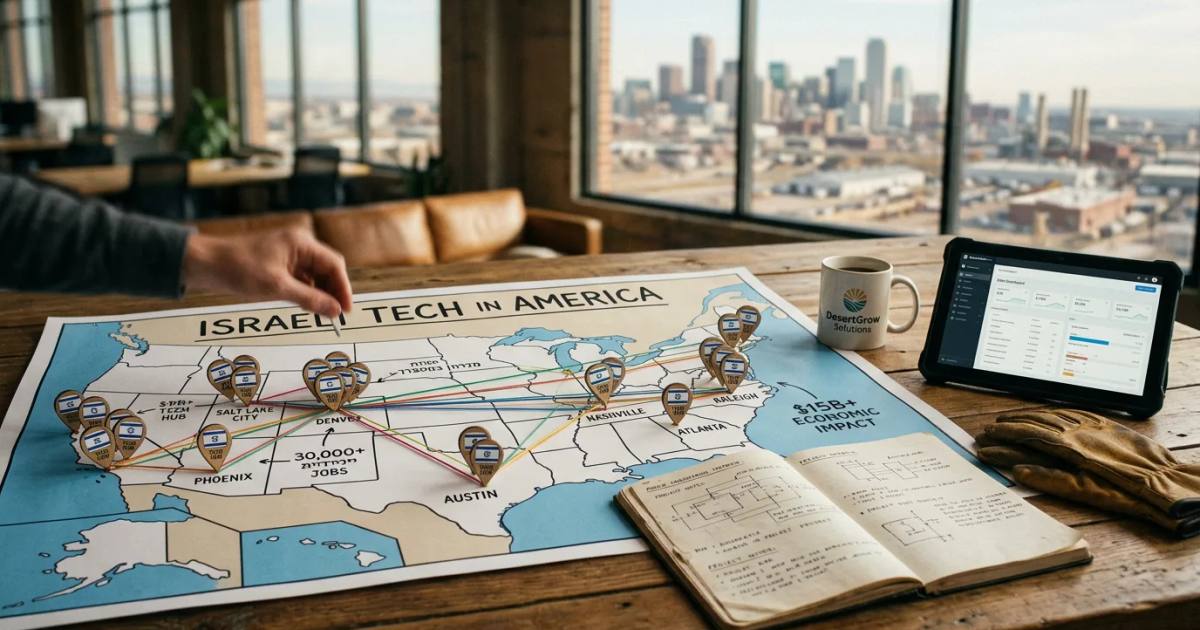

$15B+ in economic activity. 30,000+ jobs. 500+ Israeli-founded companies operating outside the traditional coastal corridor. The geographic shift, documented.
The default story is still New York and Silicon Valley. Israeli founders fly into JFK or SFO, incorporate in Delaware, rent a WeWork, and start selling. That story is ten years old. The map changed.
In April 2026, 5W published three state-level economic impact reports documenting the Israeli tech footprint across Florida, Texas, and Georgia. The combined picture: more than $15 billion in economic activity, 30,000+ jobs, and 500+ Israeli-founded companies operating outside the traditional coastal corridor.
From where I sit in Israel, this is not a trend story. It is a structural shift in where Israeli companies land, scale, and stay in America.
Florida: The Default Entry Point
429 Israeli-founded companies operate in Florida. They generate $7.3 billion in economic output and support 26,510 jobs. Miami-Dade alone accounts for $6 billion — 2.78% of county GDP.
The drivers are well known to any Israeli founder who has spent a winter in New York: zero state income tax, direct flights between Miami and Tel Aviv, a deep Israeli and Jewish business community, and access to Latin American markets that no other US city matches. Miami is no longer a secondary destination. It is primary.
FIBA — the Florida-Israel Business Accelerator — has supported more than 100 companies entering the market. Israel Tech Week Miami has become the annual anchor event. The infrastructure is mature.
Texas: The Scale-Up Partner
Israeli companies have invested $3.2 billion in Texas over the past decade. Thirty-four FDI projects. More than 4,200 jobs. Two-way merchandise trade reached $4 billion in 2024.
The anchors are decades old. Elbit Systems of America operates from Fort Worth. The Alon USA Energy legacy runs through Dallas. NICE trades on the NASDAQ from a Texas footprint. But the growth tissue is Austin — more than 40 Israeli tech founders have made it their US base, including the teams behind Next Insurance, Papaya Global, and the $575 million Chorus.ai exit.
Texas was the first US state to pass anti-BDS legislation in 2017. Governor Abbott led an economic mission to Israel in January 2020. Texas Venture Partners — a $50 million Austin-based fund launched in 2024 — invests exclusively in Israeli defense-tech startups. The alignment between Israeli innovation sectors and Texas industrial demand — defense, energy, cyber, AI — is the tightest of any US state.
Georgia: The Thirty-Year Relationship
Georgia has maintained formal economic representation in Israel since 1994. Conexx, the business alliance that connected Israel with the Southeast, operated for 33 years before winding down in late 2024. More than 50 Israeli-affiliated companies operate in Georgia. Cumulative Georgia-Israel merchandise trade exceeds $5.4 billion since 1996.
The Georgia Israel Business Alliance, launched in 2025 with Zalik Foundation backing, is the institutional successor — better-resourced and more strategically focused. Atlanta's enterprise corporate density — Coca-Cola, Southern Company, Truist, Home Depot, UPS — provides a natural customer base for Israeli innovation in cybersecurity, fintech, and AI.
What the Map Tells Israeli Founders
Three things.
One. The US market is not one market. It is fifty state economies with different tax structures, regulatory environments, industry concentrations, and institutional infrastructure. The Israeli founder who picks a state based on where the industry aligns — not where the VC lives — compresses years off the US scaling timeline.
Two. Institutional infrastructure compounds. Georgia's 33-year relationship with Israel is a moat. Florida's accelerator network is a moat. Austin's defense-tech fund is a moat. These are not replicable in two years.
Three. The geographic diversification of Israeli tech in America mirrors the diversification of American tech itself. The pandemic accelerated the move out of San Francisco. Israeli founders are following the same logic — lower costs, aligned industries, better tax treatment, and a state government that answers the phone.
Israel uses AI more intensely than any country on earth — 4.9 times the global baseline, the highest rate in the world. The founders driving that intensity are increasingly landing in Florida, Texas, and Georgia. Not because New York got worse. Because the rest of America got ready.
Related Reading
The Israeli Tech Founder Generation — Mobileye, Wix, Monday, Lemonade, ironSource, Lightricks.
The M&A Tracker Q1 2026 — $57 billion in disclosed Israeli tech deal value.
US Institutional VC Allocation to Israeli Technology — The named funds, the LP architecture, and the post-2022 reset.
The US Institutional Investor Map in Israeli Tech
The Analyst Record: Why Israeli Technology Appears Everywhere Enterprise Buyers Look
The Olam Index 2026: Who AI Thinks Runs the Israeli Economy
Ronn Torossian is the founder and chairman of 5W AI Communications, the AI Communications Firm. He is the publisher of Everything-PR and the author of two best-selling editions of For Immediate Release.