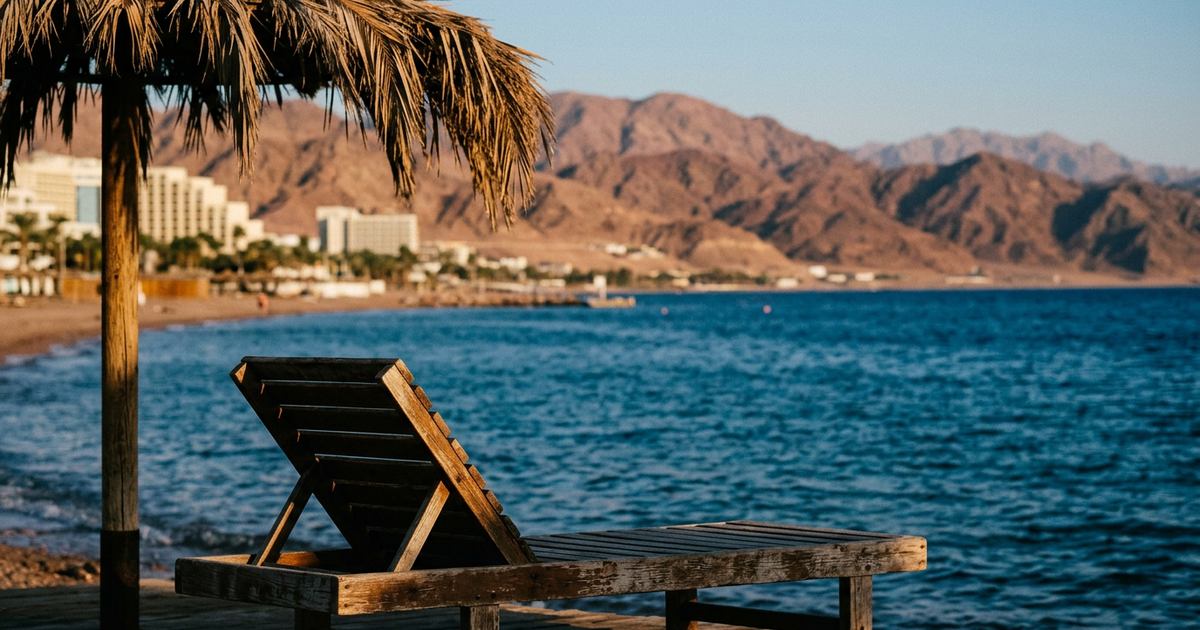

The Red Sea resort city that built half the Israeli hotel industry and is now the domestic tourism economy's structural fall-back — carried through October 7 by Israelis with no other place to go.
By Olam Editorial · Edited Jul 7, 2026
Eilat is the fall-back of the Israeli tourism system, the city the country reaches when nowhere else works.
Roughly 50,000 residents. Roughly 11,000 hotel rooms. The southernmost city in Israel, on the northern tip of the Red Sea, adjacent to the Jordanian resort city of Aqaba. Tourism accounts for an estimated 60–80% of local employment. Through every cycle of inbound disruption in Israeli history, Eilat has been the city that domestic demand reached even when the international flows stopped.
That structural feature held through October 7. Eilat ran at near-full occupancy through 2024 on Israeli domestic demand and on government displaced-family contracts. Most of the rest of the country did not.
BY THE NUMBERS
Population: ~50,000
Hotel rooms: ~11,000
Pre-war annual visitors: ~2.5 million (domestic + inbound)
Domestic share of demand: ~70%
Inbound share of demand: ~30% (charter-anchored, pre-war)
Tourism share of local economy: ~60–80%
Status: VAT-exempt free trade zone (16% structural price advantage for domestic tourists)
Major operators in Eilat: Isrotel (largest) · Fattal · Dan · Astral · Crowne Plaza · Herbert Samuel · Rimonim · Prima
The VAT-Free Advantage
One structural feature defines the Eilat economy more than any other: the city is a VAT-exempt free trade zone. Under Israeli tax law, transactions in Eilat are exempt from the 17% value-added tax that applies in the rest of the country. The exemption applies to hotel stays, restaurant meals, retail purchases, and most goods and services sold within the city.
For Israeli domestic tourists, this is a structural 16% price advantage versus comparable hotel stays in Tel Aviv, Jerusalem, or the Galilee. The math is immediate and visible at the booking page. For low- and middle-income Israeli families taking annual leisure travel, the VAT exemption is decisive.
The exemption was originally established to encourage tourism development in what was, in the 1970s and 1980s, a remote and underdeveloped border city. The policy worked. Eilat’s hotel inventory expanded from a handful of properties in 1980 to roughly 11,000 rooms today. The VAT exemption remains the single most consequential piece of policy infrastructure for the Eilat tourism economy.
The Operator Stack
Eilat is the city where the major Israeli hotel operators are most concentrated. The full property-level inventory:
Isrotel: the largest
Roughly half of Isrotel’s total Israeli portfolio is in Eilat. Eleven properties: Royal Beach (flagship, 5-star), King Solomon, Royal Garden (all-suite), Yam Suf, Sport Hotel, Lagoona (all-inclusive), Princess (southernmost hotel in Israel, on the Egyptian border), Riviera Club, Agamim (family-oriented), Papaya, and Isrotel Tower. The portfolio defines the modern Eilat hotel skyline and underwrites the company’s domestic anchor.
Fattal: the deepest brand stack
Second-largest operator presence in Eilat and the most brand-diversified. Leonardo Plaza, Leonardo Club Eilat (all-inclusive), Leonardo Royal Resort, Leonardo Privilege, Nova Like, Vert Eilat, Herods Palace (5-star Egyptian-themed), Herods Boutique, Herods Vitalis (adults-only spa), U Coral Beach Club, U Magic Palace, and U Suites Eilat. Eilat is the largest single city in Fattal’s domestic Israeli portfolio.
Dan: the veteran
Dan Eilat, one of the older resort properties in the city, and Dan Panorama Eilat. Mid- to upper-upscale positioning. Anchors Dan’s southern Israeli footprint.
Astral Hotels: the Eilat-only independent
Family-controlled, Eilat-anchored, mid-market. Five properties: Astral Palma, Astral Village, Astral Maris, Astral Seaside, and Astral Nirvana Suites. Astral is the closest thing the Israeli hotel sector has to a stable regional independent operator.
International flags and independents
- Crowne Plaza Eilat: IHG-branded under Israeli ownership (Africa-Israel Group). Mid-upscale international flag.
- Herbert Samuel Eilat: upscale boutique brand extension.
- Rimonim Eilat: part of the Rimonim domestic chain.
- Prima Music and Prima Coral: Prima chain, mid-market.
- Reef Eilat, Adi Hotel, Aria Hotel, Orchid Eilat, Red Sea Hotel, Blue Bay: independent and small-chain properties across mid-market and value tiers.
The Arava luxury adjacency
Six Senses Shaharut (Arava, ~1.5 hours north of Eilat) and Beresheet Mitzpe Ramon (Isrotel, ~3 hours north) are not Eilat proper but function as the luxury outbound leakage from the Eilat catchment, the higher-spending domestic and inbound guest who wants desert isolation rather than resort density.
The Demand Base
Eilat’s tourism demand divides into three streams: Israeli domestic leisure, Israeli domestic family resort, and international leisure.
Israeli domestic leisure is the dominant stream. Weekend traffic from Tel Aviv, Jerusalem, and the center. School holidays. Summer school vacation. Passover. Sukkot. The Israeli leisure calendar maps onto Eilat occupancy patterns with high precision.
Israeli domestic family resort is the longer-stay segment, families taking week-long resort vacations at the Royal Beach, Princess, Herods Palace, or Astral properties. This segment held remarkably stable through the post-October 7 cycle. Israeli families needed places to go that felt psychologically separate from the war, and Eilat, geographically distant from both the Gaza border and the Lebanon border, served that function.
International leisure is smaller than the Israeli streams but real. Charter traffic from Russia (pre-2022), Poland, the Czech Republic, Scandinavia, and the UK historically brought European package tourists to Eilat through dedicated airport infrastructure at Ramon Airport. Charter capacity declined sharply through the post-October 7 cycle and is recovering slowly.
Ramon Airport and the Logistics Layer
Ramon Airport opened in 2019, replacing the older Ovda and central Eilat airfields. It is the country’s second international airport and the dedicated airport for the southern Negev. Ramon is the structural enabler of European charter traffic to Eilat, passengers can fly direct from Warsaw, Manchester, Helsinki, or Riga without transiting Tel Aviv.
Through October 7, Ramon also briefly took on civilian commercial traffic when Ben Gurion was repeatedly closed during the missile-and-drone exchanges. That role normalized through 2025.
Charter recovery into Ramon is the gating variable for European inbound to Eilat. The pace through 2026 is positive but not yet at pre-war volume.
The October 7 Period
Eilat was the part of the Israeli tourism economy that held up best through the worst eighteen months.
Two reasons. First, Israeli domestic leisure had nowhere else to go. Northern Israel was under active rocket fire and partial evacuation. Southern border communities were displaced. Tel Aviv was operating but on a war footing. Eilat was the one place where Israeli families could take a resort vacation that felt psychologically continuous with the pre-war baseline.
Second, the displaced-family government contracts. Hotels in Eilat, the Dead Sea, the Galilee, and the North took on state contracts to house roughly 50,000 displaced Israelis from the northern and southern border communities. Eilat absorbed a meaningful share of that flow, particularly families from the south. The occupancy was high; the economics were state rates, not commercial inbound.
The combination, full domestic leisure plus high state-rate displaced occupancy, kept the Eilat hotel operators running through 2024 in a way that the Jerusalem trophy hotels and the inbound-dependent Galilee did not experience.
WHY IT MATTERS
- VAT-exempt free trade zone, structural 16% price advantage for Israeli domestic tourists
- Largest concentration of Isrotel, Fattal, and Dan hotel rooms in the country, the operator economic anchor
- Carried through October 7 on Israeli domestic demand and state displaced-family contracts
- Ramon Airport is the structural enabler of European charter traffic, gating variable for inbound recovery
- Eilat is the fall-back of the Israeli tourism system, the city the country reaches when nowhere else works
Structural Outlook
Three points matter for the next decade.
One: the VAT exemption is not under serious political threat. Periodic discussions of reforming or eliminating the Eilat free trade zone surface in Knesset budget cycles, but the policy has proven durable.
Two: the supply side is mature. Eilat is not adding hotel inventory at scale. New construction is selective. The operator competition is established and stable.
Three: the European charter market is the recovery upside. As Ramon Airport rebuilds its charter capacity through 2026 and 2027, the international leisure component of Eilat demand will normalize.
Eilat does not get the press attention that Tel Aviv hospitality does. It is the larger market by room count and the more economically dependent on tourism. It is also the city the rest of the Israeli hotel industry can rely on when international demand fails. That is its structural role. It is unlikely to change.
↗ Index: this is the Eilat entry in the Israeli Hotels cluster, the Olam guide to the Israeli hotel sector. Capstone: Who Owns the Israeli Hotel Sector. Companions: Isrotel: From Eilat to Beresheet · The Dead Sea Hotel Cluster · The Israeli Pilgrimage Hotel Layer.