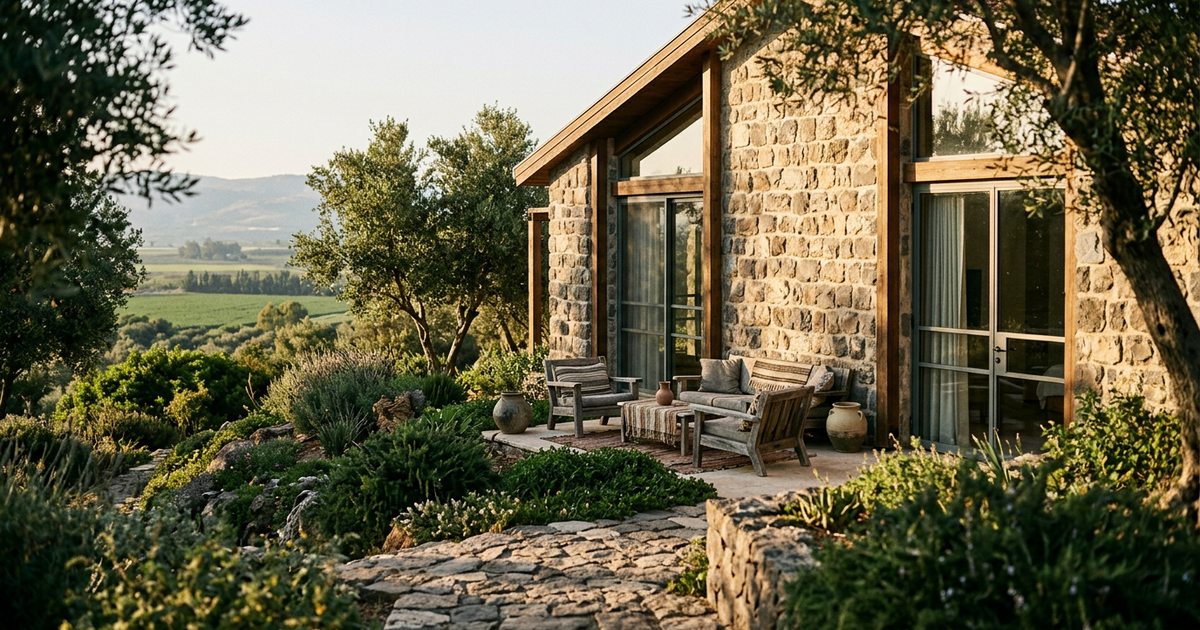

The country's oldest hospitality format — cooperative-owned hotels operated by Galilee, Negev, and Hula Valley kibbutzim — and the modern repositioning that has turned some of them into the most interesting properties on the Israeli map.
The country’s oldest hospitality format, cooperative-owned hotels operated by Galilee, Negev, and Hula Valley kibbutzim, and the modern repositioning that has turned some of them into the most interesting properties on the Israeli map.
The kibbutz hotel is one of Israel’s oldest domestically invented hospitality formats, a cooperative-owned country-hotel model that the rest of the world has no real equivalent of.
Roughly 60 to 80 kibbutz-owned and operated hotels and guest houses across Israel today. Concentrated in the Galilee, the Hula Valley, the Jezreel Valley, the Carmel coast, and the central Arava. Most are mid-market by international standards. Several have repositioned upward through the 2000s and 2010s into genuinely interesting country-house and boutique properties. A few, including Beresheet, which sits adjacent to Kibbutz Mitzpe Ramon, and Six Senses Shaharut, which sits adjacent to Kibbutz Shaharut, have anchored international ultra-luxury operations on land originally controlled by the kibbutz movement.
The format is older than the modern Israeli hotel industry. It is also one of the most distinctly Israeli things about Israeli hospitality.
BY THE NUMBERS
Kibbutz hotels and guest houses: ~60–80
Geographic concentration: Upper Galilee · Hula Valley · Jezreel Valley · Carmel · Western Negev · Central Arava
Major properties: Pastoral Kfar Blum · Nof Ginosar · Lavi · Ma‘agan · Hagoshrim · Kibbutz Country Lodging network
Adjacent international flags: Beresheet (Kibbutz Mitzpe Ramon) · Six Senses Shaharut (Kibbutz Shaharut)
Operating model: cooperative ownership · profit retention within kibbutz collective · increasingly professionalized management
How Did the Kibbutz Hotel Format Originate?
The kibbutz hotel format emerged in the 1950s and 1960s as a side business for agricultural collectives. The original economic logic was structural: the kibbutzim had land, labor, and seasonal capacity that could be redirected toward hosting paying guests during periods when the agricultural cycle did not absorb the workforce. The dining halls, the surrounding landscapes, and the cooperative-governance culture all translated into a hospitality format unlike anything in the global hotel industry.
The Israeli leisure market through the 1960s, 1970s, and 1980s was largely domestic and largely family-oriented. Kibbutz hotels filled a specific niche: affordable family vacations in the Galilee and Negev countryside, with cooperative-style dining and integrated outdoor programming. The Israeli families who took annual kibbutz vacations through that period built a multi-generational customer base that some kibbutz hotels still operate on today.
What Is the Kibbutz Country Lodging Network?
The Kibbutz Country Lodging network, Hotelei Hakibbutzim, the marketing and reservations cooperative that aggregated kibbutz-hotel inventory, was the structural infrastructure that made the format viable at scale through the 1980s and 1990s. The network provided centralized booking, marketing, and brand consistency across dozens of independently owned cooperative properties.
The network has evolved through multiple cycles of consolidation and rebranding. Some kibbutz hotels have left the network to operate independently under their own brands. Others have been brought under the management of the major Israeli hotel operators (Isrotel acquired Mizpe Hayamim, originally a Rosh Pinna wellness property with cooperative roots; Fattal has incorporated several kibbutz properties under U Hotels and U Suites).
What remains is a hybrid sector: some kibbutz hotels still operate as cooperative-owned businesses with profits retained inside the kibbutz collective; others have transitioned to professionalized hotel management under one of the major Israeli operating groups while maintaining the physical relationship with the host kibbutz.
How Have Kibbutz Hotels Repositioned Upward?
Through the 2000s and 2010s, a subset of kibbutz hotels repositioned upward toward boutique country-house positioning.
Pastoral Kfar Blum (Kibbutz Kfar Blum, Upper Galilee): the most successful single example. A country-house hotel inside a kibbutz, expanded and upgraded through multiple investment cycles, now operating as a mid-upscale boutique property that competes for Tel Aviv weekend traffic with the independent Galilee properties.
Hagoshrim (Kibbutz Hagoshrim, Upper Galilee): spa-anchored, on the Banias River. Repositioned upward through the 2010s into a mid-upscale wellness property.
Nof Ginosar (Kibbutz Ginosar, Sea of Galilee shore): the largest Sea of Galilee shore hotel. Historic kibbutz origins, now operating at scale with significant Christian pilgrimage traffic alongside Israeli domestic leisure.
Ein Gev (Kibbutz Ein Gev, eastern Sea of Galilee shore): smaller country-resort property anchored on the kibbutz’s waterfront and fishery.
The repositioning has been uneven across the network. Some properties have successfully moved upward into the boutique country-house segment; others remain in the mid-market kibbutz country format and continue to operate at lower yields.
How Are Beresheet and Six Senses Shaharut Connected to Kibbutz Land?
The two most internationally significant Israeli hotel openings of the past fifteen years, Beresheet (2011) and Six Senses Shaharut (2021), are both built on or adjacent to kibbutz land.
Beresheet sits on the rim of the Ramon Crater near Kibbutz Mitzpe Ramon. The Isrotel Exclusive flagship operates under independent ownership but the geographic relationship to the host kibbutz is central to the property’s positioning and access infrastructure.
Six Senses Shaharut sits on the cliffs above the Arava near Kibbutz Shaharut. The kibbutz itself is small (under 100 residents) and the relationship to the international ultra-luxury operation is part of what defines the property’s authenticity.
The pattern matters. Both properties were structurally enabled by the kibbutz format’s land-control history and by the cultural register that the host kibbutzim brought to the international flag operations. The integration is one reason both properties feel distinctly Israeli rather than generic global-luxury.
WHY IT MATTERS
- One of Israel’s oldest domestically invented hospitality formats, predates the modern hotel industry by decades
- Multi-generational Israeli domestic customer base anchors demand
- Repositioned kibbutz boutique properties compete with independent country-house operators
- Both Beresheet and Six Senses Shaharut are structurally enabled by kibbutz-adjacent land and cultural integration
- The format is professionalizing under operator consolidation
How Did October 7 Affect Kibbutz Hotels?
The kibbutz hotel sector was hit by October 7 in two distinct ways.
First, several of the kibbutzim themselves, Be’eri, Nir Oz, Kfar Aza, and others along the Gaza border, suffered direct attacks on October 7, 2023, with significant loss of life and the displacement of their communities. None of those southern kibbutzim operated commercial hotels at scale; the hospitality impact was indirect, through the broader trauma to the kibbutz movement.
Second, the Galilee kibbutz hotels absorbed displaced families from the northern border kibbutzim under state-rate contracts through 2024. Hagoshrim, Pastoral Kfar Blum, Nof Ginosar, and others ran high occupancy on subsidized rates rather than commercial inbound.
Through 2025 and into 2026, the Galilee kibbutz layer has rebuilt on Israeli domestic leisure plus the early returning Christian pilgrimage flow.
What Makes the Kibbutz Hotel Format Durable?
Three structural features support the kibbutz hotel format’s continued role in the Israeli hospitality sector.
One: land control. The kibbutzim hold their land under long-term Israel Land Authority leases that predate the modern commercial real estate market.
Two: multi-generational customer loyalty. The Israeli families who took annual kibbutz vacations through the 1970s, 1980s, and 1990s are now bringing children and grandchildren back to the same properties.
Three: cultural authenticity. The kibbutz format carries a recognizable Israeli identity that international flag hotels cannot replicate.
What's the Outlook for the Kibbutz Hotel Format?
The kibbutz hotel sector is unlikely to consolidate into a single major operator. The cooperative ownership structure, the multi-generational community involvement, and the diverse positioning across the existing properties argue against a roll-up scenario.
What is more likely: continued selective repositioning of individual properties upward into the boutique country-house segment, continued absorption of mid-market kibbutz hotels into the major operating groups (Isrotel, Fattal, U Hotels), and continued use of kibbutz-adjacent land for new international flag developments where the integration model fits.
The format will look different in 2035 than it does in 2026. The structural role, the indigenous Israeli hospitality layer that the rest of the sector cannot replicate, will not change.
Frequently Asked Questions
What is a kibbutz hotel?
A kibbutz hotel is a cooperative-owned country hotel operated by an Israeli agricultural collective, typically integrated with the kibbutz's own dining halls, land, and community. The format emerged in the 1950s and 1960s as a side business for kibbutzim, and roughly 60 to 80 still operate across Israel today.
Are Beresheet and Six Senses Shaharut kibbutz hotels?
Not directly, but both sit on or adjacent to kibbutz land (Mitzpe Ramon and Shaharut, respectively) and operate under independent or international-brand ownership rather than the kibbutz itself.
What are the best kibbutz hotels in Israel?
Pastoral Kfar Blum and Hagoshrim in the Upper Galilee are the most successfully repositioned into boutique country-house properties. Nof Ginosar on the Sea of Galilee shore is the largest, with significant Christian pilgrimage traffic.
Who owns kibbutz hotels?
Ownership is a hybrid today: some remain cooperatively owned with profits retained inside the kibbutz collective, while others have been brought under professional management by major Israeli operators including Isrotel and Fattal.
↗ Index: this is the kibbutz format entry in the Israeli Hotels cluster, the Olam guide to the Israeli hotel sector. Capstone: Who Owns the Israeli Hotel Sector. Companion: The Israeli Boutique Hotel Class.