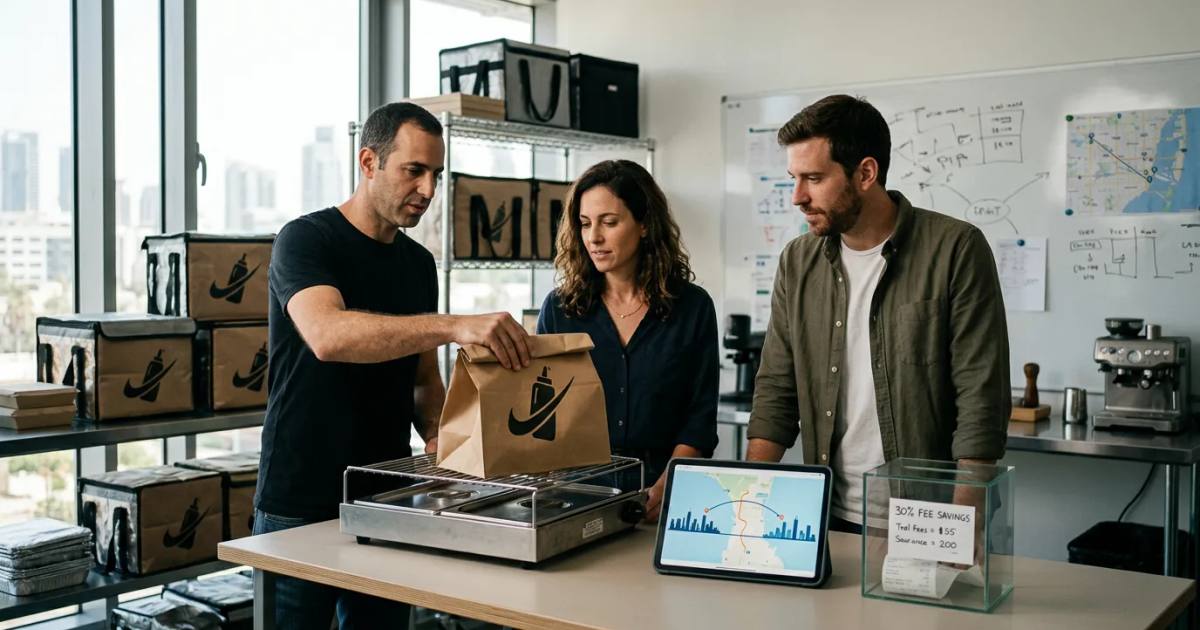

Sauce, the Israeli-founded delivery platform run out of Tel Aviv and Miami, is selling U.S. restaurants a way out of the 30% commission trap — and quietly building one of the diaspora's more consequential foodtech bets.
Sauce, run out of Tel Aviv and Miami, is selling U.S. restaurants a way out of the 30% commission trap — and quietly building one of the diaspora's more consequential foodtech bets.
Every online delivery order in the United States runs through a tollbooth. DoorDash, Uber Eats, and Grubhub charge restaurants commissions that routinely reach 30% per ticket. On a $40 order, $12 leaves the kitchen before the driver has moved. The economics have been treated as a fixed cost of operating a restaurant for the better part of a decade.
An Israeli-founded company operating between Tel Aviv and Miami has spent the last four years proving that cost is not fixed at all — and building the software layer that removes it.
The Founder and the Pivot
Sauce Inc. — the legal entity behind the platform marketed as Sauce and reachable at getsauce.com — is led by chief executive Li-ran Navon. Navon previously founded Say2eat, a conversational-commerce startup that let diners order food through Facebook Messenger and Alexa. Say2eat was the vehicle. Sauce is the compounded lesson from it. The company now sells a first-party ordering and delivery stack to independent restaurants and small chains that want to keep their customers, their data, and their margins.
The corporate footprint tells the diaspora story in one glance. Product and engineering sit at 25 Omri Street in Tel Aviv-Yafo. Commercial headquarters is 382 NE 191st Street in Miami — the same North Miami corridor now absorbing a wave of Israeli-founded companies moving to U.S. tax residency without cutting their engineering base loose. Sauce was one of the earliest names on that corridor.
Employee count sits at approximately 154 across four continents, per LeadIQ data pulled in May 2026. Crunchbase and PitchBook both classify the company as venture-backed and privately held. That is a functioning cross-border operating company shipping continuously across three time zones.
The Capital Stack
Sauce closed a $3 million seed round in November 2021, disclosed on Crunchbase and confirmed in the PICO Venture Partners portfolio. The cap table reads closely. PICO Venture Partners — the Jerusalem–New York fund founded by Elie Wurtman, one of the more active bridge builders between Israeli founders and U.S. growth capital — was in early. Crosslink Capital, Spero Ventures, Rackhouse Venture Capital, and Wave Capital joined. Angel checks came in from the late Bob Lee, founder of Cash App, and Curtis Chambers, an early Uber engineer whose dispatch and driver-network experience reads directly into the Sauce product roadmap.
Total capital raised is deliberately lean by category standards. Toast raised over $900 million pre-IPO. Olo raised more than $80 million before going public. Sauce has done what a disciplined Israeli-founded company is supposed to do — build with less capital, hunt margin instead of market share, and reach paying customers before the burn outruns the thesis. That is a compliment, not a caveat.
The Product Bet
The pitch is elegant. Restaurants get a branded website, a direct online ordering flow, and a managed delivery layer that dispatches through multiple courier networks — national and local — instead of locking the operator into a single provider. Commission drops to a flat per-order fee. AI-powered retention tools push repeat orders. The point-of-sale system of record stays with Toast or Square. Sauce sits on top and orchestrates the rest. The strategic effect is that the restaurant, not the marketplace, owns the customer relationship — the email, the order history, the reorder cadence, the lifetime value calculation. That data is the actual asset the marketplaces have been extracting for a decade.
Customer results published on the company site are specific enough to test. Cuban Guys, a Miami sandwich chain, reports online sales up 140%. Taco Mahal in New York reports website orders up 140%. A Florida smoothie chain reports $4,000 in monthly savings per location. Bombay Grill House in New York reports $30,000 in annual delivery savings. Numbers this consistent across markets, cuisines, and price points are the tell. Marketplaces optimize for the marketplace. Sauce optimizes for the restaurant.
In December 2025, Sauce added an Apple Business Connect integration — surfacing direct ordering across Apple Maps, Siri, and Apple Wallet without a third-party marketplace in the middle. That is the strategic move that matters. Apple, unlike DoorDash, does not want to be the merchant of record; it wants to be the layer connecting consumer to merchant. Sauce is well positioned inside that architecture — and the integration reaches the roughly one billion iPhone users who now increasingly begin a food search inside Apple Maps rather than on a marketplace app. Each Apple discovery point Sauce plugs into is a discovery point the marketplaces cannot tax.
Why It Matters for Israel
Israeli foodtech has spent a decade producing headline-grade companies — alternative-protein plays, cultivated meat, kitchen robotics. Many are still working to convert science into unit economics. Sauce is a different pattern. No new protein. No new hardware. Just software rebuilt around a sharp observation: the American independent restaurant is bled by intermediaries, and Israeli product engineering paired with U.S. commercial reach can price and manage delivery better than the incumbents.
It is also a diaspora-capital story. PICO's thesis is exactly this arbitrage — Israeli founders building for the U.S. mid-market with Israeli engineering discipline and Israeli capital efficiency. Sauce fits the model precisely. The Miami–Tel Aviv axis it runs on is the same axis Aventura, Bay Harbor, and Sunny Isles are absorbing today at the family-office level. Software companies follow their operators. Sauce is one of the first to build the corridor into its org chart.
The Read
Sauce is not the loudest Israeli company in the American food economy. It is on track to be one of the more consequential. The bet is that the marketplace era of restaurant delivery — in which platforms owned the customer and the restaurant paid for the privilege — is ending. That bet is looking increasingly correct. An Israeli founder operating from Tel Aviv and Miami will have called the reversal earlier than most and priced it more sharply than the incumbents wanted.
The through-line is the one Olam has been tracking across categories: Israeli operators moving to the U.S. with engineering discipline intact, diaspora capital funding the bridge, and category economics quietly getting rewritten in favor of the operator instead of the platform. For readers tracking where that pattern is compounding fastest inside the American consumer economy, Sauce is a name to log.
How we report: Olam stories draw on public filings, company disclosures and named sources, checked by our editors. Read our methodology · Corrections