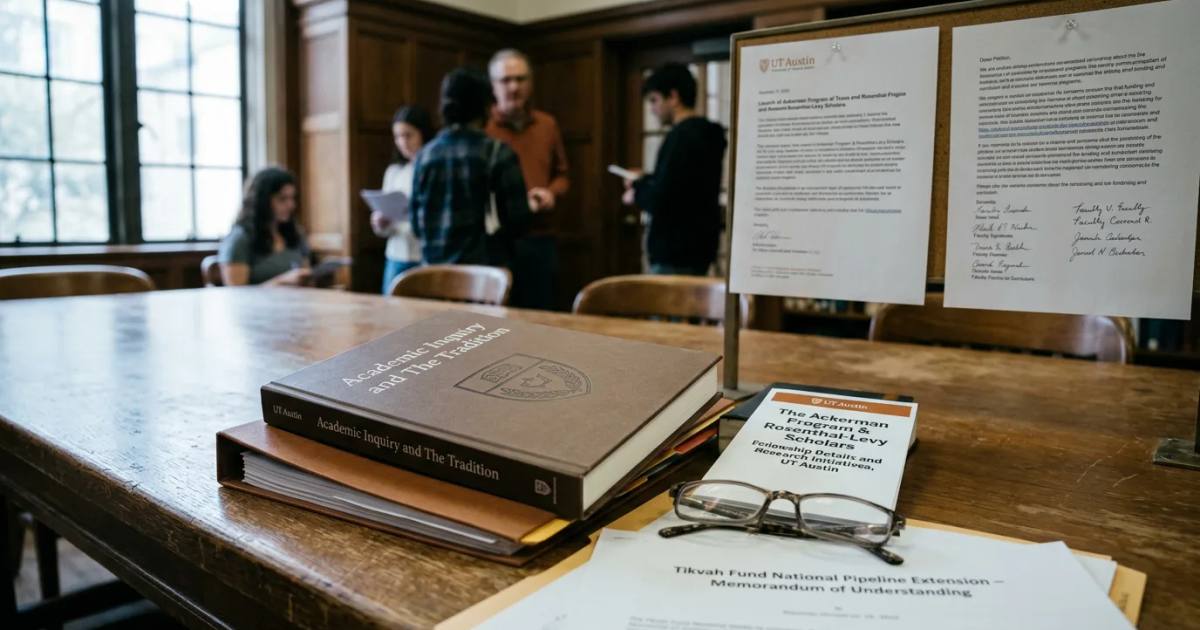

A $12.5 million gift from three donor families launches the Ackerman Program and Rosenthal-Levy Scholars at UT Austin, extending Tikvah's national pipeline and drawing new scrutiny from UT faculty.
The University of Texas at Austin launched the Ackerman Program on Jewish and Western Civilization and the Rosenthal-Levy Scholars program in January 2026, backed by a $12.5 million gift from three donor couples, according to UT Austin's official announcement. Both programs sit inside UT's School of Civic Leadership (SCL) and welcome their first students in Fall 2026. Rosenthal-Levy is a national scholars program run by Tikvah, the Jewish education nonprofit profiled in Olam's report on Tikvah's leadership pipeline, and UT is now its second university home after the University of Florida.
Why did UT create the Ackerman Program?
UT leadership frames the program as central to the university's broader mission of renewing classical liberal education. "The School of Civic Leadership is leading the way toward the renewal of classical liberal education in America," said Tomas Ackerman, the UT alumnus whose gift with his wife, Abby, helped found the program, according to UT's announcement. "We are thrilled to support an effort that brings Jewish ideas and the study of modern Israel into this new citadel for advancing reasoned thought, moral clarity and historical literacy." Provost William Inboden, UT's Executive Vice President and Provost, described the program as a flagship example of the university's academic mission. "Jewish ideas are central to the foundations of Western culture and the American constitutional order," Inboden said. "Modern Israel is one of the world's most remarkable nations, a singular story of political refuge, economic growth and strategic influence. These programs will expose our students to these themes in an era when they are as important as ever." SCL Dean Justin Dyer added that "the Ackerman Program will integrate the study of Jewish civilization and modern Israel into the core of our educational vision," per UT's announcement.
What courses and majors does the Ackerman Program teach?
The Ackerman Program offers a defined slate of courses spanning philosophy, history and language. Confirmed titles include "The Hebrew Bible and the Human Condition," "Jews and American Democracy," "Jewish Thought and Western Philosophy," "Israeli Grand Strategy and the Modern Middle East," "The Modern Jewish Canon" and "The Roots of Modern Antisemitism," according to JNS's coverage of the launch and the Austin American-Statesman's reporting.
Jewish civilization content is woven across SCL's academic offerings rather than confined to a single course list. UT's program page states that in the Civics Honors major, students explore the role of Hebraic ideas in shaping the moral, political and cultural imagination of the Western mind and the American republic, according to the Ackerman Program's official page. Scholarship-track students complete two semesters of modern Hebrew, waived for those who test out, and a study abroad placement in Jerusalem developed with Texas Global, giving students firsthand exposure to the country whose history much of the coursework covers, according to The Daily Texan's coverage of the study abroad partnership. Dean Dyer said the school worked with Texas Global specifically so students could understand how "Jerusalem as a place becomes important to understanding the great ideas that influence the American founding and the American constitution," per the Daily Texan.
How does the Ackerman Program fit inside SCL's academic growth?
SCL welcomed its first cohort in Fall 2025 with a single major, Civics Honors, built around economic numeracy, Western civilization and constitutional heritage, according to the school's own institutional history page. Two additional majors, Great Books and Strategy and Statecraft, launch in Fall 2027 pending Texas Higher Education Coordinating Board approval, backed by a $10 million National Endowment for the Humanities grant funding 16 new faculty positions, according to UT's announcement of the new majors. The Strategy and Statecraft major runs in partnership with the Clements Center for National Security and trains students for careers in diplomacy, intelligence and defense, according to the major's official course description.
Alexander Duff, an associate professor already teaching in SCL, has said the new majors respond to a real gap in civic literacy, citing a statistic that fewer than one in five Americans can name the three branches of government. Duff argues graduates should be able to discuss justice and liberty with the same fluency they bring to coding or data analysis, according to Hoodline's coverage of the NEH award. The Great Books major immerses students in texts that shaped Western civilization from antiquity to the modern era, designed to complement other degrees, including STEM and pre-med tracks, with an ethics-informed lens for future decisions, according to UT's announcement.
How does Rosenthal-Levy Scholars support students financially?
Rosenthal-Levy Scholars covers full tuition for four years plus a $7,000 annual living stipend, according to the program's own overview page. Scholars complete a major in Civics Honors, Great Books or Strategy and Statecraft, finish the Ackerman Program's required course sequence, study abroad in Israel for at least one semester, and join the Tikvah Society for Jewish Thought, a new student group on campus. The scholarship is open to applicants of any religious background, and current high school seniors and current UT freshmen and sophomores can apply through March, according to the Statesman's reporting.
The program is modeled on the Rhodes Scholarship and the Morehead-Cain, according to a 2025 speech by Tikvah executive Eric Cohen introducing the University of Florida version of the program. UT is the second campus to host it, following the Hamilton School for Civic Education at the University of Florida, now led by Robert G. Ingram. Ingram succeeded William Inboden, who left the Hamilton School to become UT Austin's provost, a connection that speaks to how closely the two university programs are tied through shared leadership and a common academic model.
Who funds the Ackerman Program and Rosenthal-Levy Scholars?
Three donor couples provided the $12.5 million founding gift: Tomas and Abby Ackerman, Gary and Lee Rosenthal, and Paul and Karen Levy, according to UT's official announcement. Tomas Ackerman is a UT alumnus and co-founder of Carnelian Energy Capital in Houston, according to Carnelian Energy Capital's leadership page. Gary Rosenthal is a partner at The Sterling Group and Vice Chairman of Tikvah, and has chaired both Texas Children's Hospital and the University of Houston Board of Regents, according to the Rosenthal-Levy Scholars program's donor biography page. Paul Levy founded the New York private equity firm JLL Partners and previously served as CEO of Yves Saint Laurent Inc.; his family foundation directs its giving primarily toward higher education, the arts and Jewish organizations, according to Cause IQ's foundation database entry.
How does this fit Tikvah's national scholars pipeline?
Tikvah describes Rosenthal-Levy Scholars as its largest single investment in undergraduates and has signaled plans to expand the model to additional campuses beyond Florida and Texas, according to Cohen's 2025 remarks. Readers can find the full breakdown of the organization's other flagship programs, including Millstone Scholars and the Menachem Begin Scholars program, in Olam's report on Tikvah's leadership pipeline.
UT Austin's chapter of the American Association of University Professors has raised questions about how quickly SCL has grown and how its new Center for Humanities was staffed, and UT administrators have not yet responded publicly in detail. Those questions sit alongside a program that, on its own terms, gives UT students a funded path to study Hebrew, spend a semester in Jerusalem and graduate with both a rigorous humanities major and a national scholarship pedigree modeled on the Rhodes and the Morehead-Cain.
How we report: Olam stories draw on public filings, company disclosures and named sources, checked by our editors. Read our methodology · Corrections