
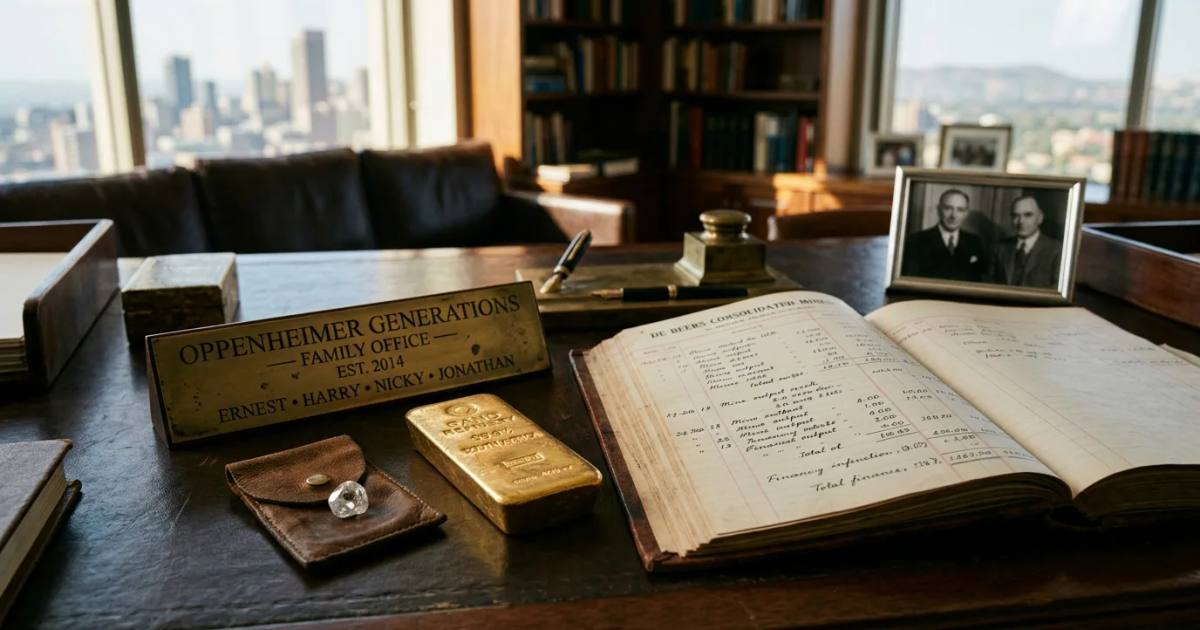

Ernest, Harry, Nicky, Jonathan — four generations from German-Jewish immigrants to the $10.6 billion Oppenheimer Generations family office.
From Friedberg to the Witwatersrand: A German-Jewish Immigrant Builds an Empire
Ernest Oppenheimer was born in 1880 in Friedberg, in the German Empire, to a Jewish family. His father Eduard was a cigar merchant who, by the mid-1870s, had concluded that Germany was "no longer a country for Jews to live in" — and encouraged his six sons to leave. Ernest arrived in South Africa via London, entering the diamond trade through the brokerage firm Dunkelsbuhler & Co., an affiliate of the Rothschild-backed diamond syndicate. He was 22 years old.
In 1917, Ernest founded the Anglo American Corporation to mine the Witwatersrand — the vast gold-bearing geological formation near Johannesburg that was, at the time, the world's largest gold deposit. The name "Anglo American" reflected the source of the startup capital: a combination of British and American investors, organized with Rothschild backing. By 1929, Ernest had taken control of De Beers, the diamond mining company Cecil Rhodes had established in 1888, and became its chairman — a position he held until his death in 1957.
The Oppenheimer model was vertical integration and market control. De Beers did not merely mine diamonds — it controlled their global distribution through the Diamond Trading Company (DTC) and the Central Selling Organisation (CSO), managing supply to stabilize prices. At its peak, De Beers controlled roughly 70% of the world's rough diamond supply. Anglo American, meanwhile, expanded into gold, coal, platinum, steel, sugar, paper, and banking — becoming one of the largest conglomerates in the Southern Hemisphere and, for decades, the dominant force in the South African economy.
Barney Barnato — the London-born Jewish diamond magnate who had been Rhodes's partner in creating De Beers — preceded Oppenheimer in the diamond trade. But it was Ernest who built the structure that would endure: an interlocking corporate architecture linking Anglo American and De Beers through cross-shareholdings, creating a conglomerate that controlled vast swaths of Southern African extractive industry from a single family's boardroom in Johannesburg.
Harry Oppenheimer: Anti-Apartheid Industrialist, Friend of Ben-Gurion
Harry Frederick Oppenheimer — Ernest's son — was born in 1908 in Kimberley, the De Beers company town built around the famous diamond "Big Hole." He was educated at Charterhouse and Christ Church, Oxford, served as a brigade intelligence officer in North Africa during World War II, and succeeded his father as chairman of both Anglo American and De Beers in 1957.
Harry's tenure coincided with the apartheid era — and his opposition to the regime distinguished the Oppenheimer family from many of South Africa's industrial dynasties. He used his wealth and influence to support anti-apartheid political movements, financing the Progressive Federal Party, which later merged into the Democratic Alliance. Under Harry's leadership, Anglo American expanded into South African banking, steel, sugar, and paper — diversification driven partly by the country's isolation during apartheid, which prevented international expansion and forced the conglomerate inward.
Harry's relationship with Judaism was layered. His father Ernest had converted to Anglicanism later in life, but, as biographer Dr. Michael Cardo documented in his 2023 book Harry Oppenheimer: Diamonds, Gold and Dynasty, Harry's "roots and childhood were deeply Jewish." His paternal grandfather Eduard's Jewish identity shaped the family's self-understanding even after the conversion. Rabbi Moshe Silberhaft of the Small Jewish Communities Association has discussed the Oppenheimer legacy's impact on the Kimberley Jewish community.
Harry visited Israel for the first time in 1968. The visit was low-key, but the diamond-cutting industry — centered in Tel Aviv and Ramat Gan — attached great significance to it. As Cardo documented: "Oppenheimer met David Ben-Gurion — a statesman he ranked alongside Charles de Gaulle in terms of impressiveness — and he subsequently became a steadfast friend to the Israeli nation." He visited Israel on several occasions. The connection was commercial as well as personal: De Beers' relationship with Israel's diamond-cutting industry made the Oppenheimer business network one of the most significant economic links between South Africa and Israel for decades.
Harry Oppenheimer died in 2000. The Oppenheimer Memorial Trust, which he established, continues to fund education and research in South Africa.
Nicky Oppenheimer: Taking De Beers Private — Then Selling for $5.2 Billion
Nicholas "Nicky" Frank Oppenheimer was born in 1945 in Johannesburg, the third generation of the mining dynasty. Like his father and grandfather, he was educated at Harrow and Christ Church, Oxford, earning an MA. He joined the family business in 1968 and rose through the Anglo American and De Beers hierarchies: deputy chairman of Anglo American in 1983, chairman of De Beers in 1998.
In 2001, Nicky took De Beers private — removing it from public markets and concentrating family control. The move gave the company operational flexibility in a diamond market evolving under pressure from synthetic diamonds, conflict-diamond regulations, and the erosion of the CSO's monopoly. Nicky played a pivotal role in establishing the Kimberley Process Certification Scheme, the global initiative to prevent the trade in conflict diamonds.
The defining act of Nicky's career came in August 2012: he sold the family's remaining 40% stake in De Beers to Anglo American for $5.2 billion in cash. The sale ended 85 years — three generations — of Oppenheimer family control over the world's diamond trade. It was one of the largest single liquidity events in South African corporate history. Nicky also collected approximately $390 million in dividends from Anglo American through 2017 for a residual equity position. By the time the family had been fully separated from both Anglo American and De Beers, the total extraction exceeded $5.5 billion.
Oppenheimer Generations: From Mining Dynasty to Global Family Office
Since the De Beers exit, Nicky and his son Jonathan have rebuilt the family's economic architecture around Oppenheimer Generations — a family office headquartered in Johannesburg with operations in Singapore. The investment vehicles include Stockdale Street (London-based) and Tana Africa Capital (Johannesburg-based), which deploy capital across private equity, consumer goods, manufacturing, and financial services in Africa and Asia.
One of the family's most significant post-diamond investments is GZ Industries, Nigeria's largest beverage can manufacturer, which Jonathan's firm Oppenheimer Partners acquired in full. The move signaled a strategic pivot — from Southern African extractives to pan-African consumer and industrial assets. The Singapore office reflects a parallel ambition: deploying capital into Asian markets where Africa-connected investment vehicles remain rare.
Jonathan Oppenheimer — born 1969, educated at Harrow and Christ Church, Oxford — serves as executive chairman of Oppenheimer Generations. He began his career at N M Rothschild & Sons in London, moved to Anglo American as senior vice-president, and held senior roles at De Beers before the family exit. Jonathan is the operational driver of the family's post-diamond strategy, focused on private equity, conservation, and patient capital deployment across the African continent.
$10.6 Billion: The Fortune in 2026
As of mid-2026, Nicky Oppenheimer's net worth stands at approximately $10.6 billion according to Forbes, which ranks him fourth among Africa's richest. Bloomberg's Billionaires Index has tracked his fortune between $10 billion and $13.3 billion over the past two years, reflecting the volatility of private investment valuations. He ranks behind Nigeria's Aliko Dangote and fellow South African Johann Rupert, and competes for Africa's second position with Rupert depending on market conditions. Forbes places him at #304 on its global billionaires list for 2026.
The wealth is no longer diamond-derived. The $5.2 billion in De Beers proceeds, plus dividends, has been redeployed through private equity vehicles whose returns are tied to the performance of consumer, industrial, and financial assets across Africa, Asia, the US, and Europe. The Oppenheimer fortune has been transformed from a concentrated extractive-industry stake into a diversified private investment portfolio — a transition that few multi-generational mining dynasties have executed successfully.
Brenthurst, Tswalu, and the Conservation Portfolio
The Oppenheimer family residence is the Brenthurst Estate in Parktown, Johannesburg — one of the most significant private properties in South Africa. The estate houses the Brenthurst Library, one of the continent's most important collections of Africana, and serves as the base for the Brenthurst Foundation, a policy research institute focused on African economic development and governance.
Nicky Oppenheimer owns over 720 square miles of conservation land across South Africa, Botswana, Zimbabwe, and Mozambique — making the family one of the largest private conservation landholders on the African continent. Holdings include the Tswalu Kalahari Reserve, South Africa's largest private game reserve, and the Shangani Ranch in Zimbabwe. During the Covid-19 pandemic, Oppenheimer donated more than $110 million to South African small businesses — one of the largest private relief contributions in the country's history.
In 2014, Nicky founded Fireblade Aviation at OR Tambo International Airport — a private terminal and chartered flight operation serving high-net-worth travelers and corporate clients. Fireblade functions as a parallel aviation infrastructure for the ultra-wealthy, reflecting a broader pattern in the Oppenheimer portfolio: building premium services for the UHNW segment the family has always inhabited.
The Jewish Legacy: From Eduard's Warning to the Diamond Corridor
The Oppenheimer family's relationship with Judaism traces a complex arc. Ernest converted to Anglicanism. Harry maintained Jewish connections and built a personal friendship with Israeli leadership and institutions. Nicky has been more private about religious identity but has continued the family's philanthropic engagement.
What is unambiguous is the family's place in the history of South African Jewry. The Oppenheimers are the most economically significant family to emerge from the SA Jewish experience — and their trajectory from German-Jewish immigrants to the summit of African capitalism, controlling the world's diamond supply for 85 years and accumulating a fortune exceeding $10 billion, has no parallel in the global Jewish diaspora outside the Rothschild dynasty itself.
The origin story matters. Eduard Oppenheimer's conviction that Germany was no place for Jews drove the family to South Africa. Ernest's arrival as a young immigrant into the diamond trade connected the family to an industry that would link South Africa and Israel commercially for a century — through diamond cutting, polishing, and the DTC pipeline that funneled rough stones from Kimberley to Tel Aviv. The Oppenheimer dynasty is a diaspora story. It began with Jewish emigration. It was built on an industry that connects two countries. And its future — through Oppenheimer Generations — is being constructed as a global family office that deploys the proceeds of that history across continents.