
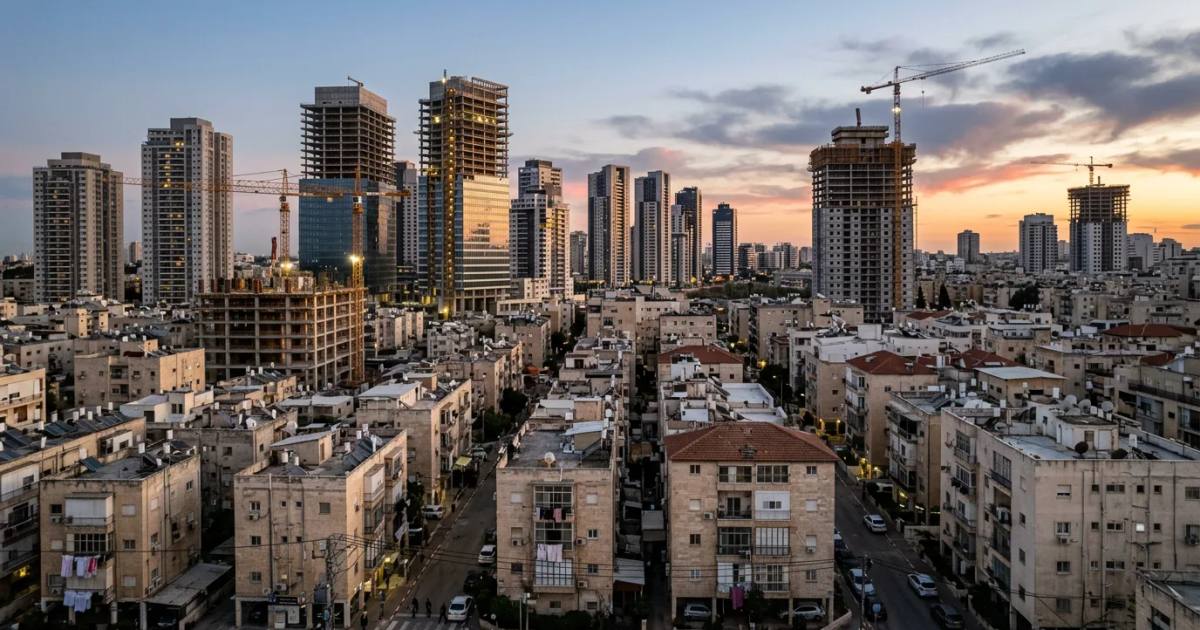

247,000 residents on 7.09 sq km — the 7th-densest city on Earth. Tel Giborim's 148→525-unit pinui-binui, Meidar's Begin project, Enav's BarKokhba, Jerusalem Renewal Co's boutique. The mother city of Israel's Haredi world cannot spread. It is going vertical.
247,000 residents on 7.09 sq km — the 7th-densest city on Earth. Pinui-binui and BBC (Bnei Brak Business Center) are the only remaining growth mechanisms. Meidar's 73-unit Begin project, Enav's BarKokhba tower, the Jerusalem Renewal Company's Tel Giborim boutique redevelopment, and the 148→525-unit Tel Giborim pinui-binui approval are the current spec sheet. The city Israel's Haredi world was built around cannot expand outward. It is expanding upward.
Bnei Brak is the mother city of Israel's Haredi world. 247,000 residents in 2026 (up from ~230,000 in 2024), living on 7.09 square kilometers — a density of ~28,000 people per square kilometer. That makes it the seventh-most-densely-populated city on the planet. There is nowhere left to expand outward.
The city was founded in 1924 by eight Polish Hasidic families led by Yitzchok Gerstenkorn. It got city status in 1950. Today 89% of its voters chose Haredi parties in the last Knesset election. Pardes Katz was the sole non-Haredi neighborhood for decades; it is now also flipping. This is a fully-formed Haredi metropolis in the middle of Gush Dan, immediately east of Tel Aviv and Ramat Gan.
The physical constraint dictates the strategy. Bnei Brak cannot annex land — its borders are pressed against Ramat Gan, Petach Tikva, Givatayim, and Kiryat Ono. Every additional unit has to come from the same footprint: pinui-binui, TAMA 38, or vertical rebuild. And that is exactly what is happening — at a scale and price that no other Haredi market matches.
For the exurb strategies pulling demand off Bnei Brak, see TAMAL 1081: Elad's 4,476-Unit Expansion and Beitar Illit: The 80,000-Person City Doubling Itself. Bnei Brak stays the anchor. The surrounding cities catch the overflow.
Tel Giborim — the 148→525 unit approval
The clearest signal of Bnei Brak's vertical strategy: a single pinui-binui plan that turned 148 aging apartments into 525 units and 16 new buildings.
Site — the Tel Giborim neighborhood, adjacent to the BBC (Bnei Brak Business Center) complex and along the light-rail corridor.
Existing — 148 old apartments in aging low-rise stock. Insufficient safe rooms, deteriorated infrastructure, dated finishes.
Planned — 16 new buildings of 7.5 floors each, 525 total new units, plus ~3,000 sqm of commercial and public buildings. Net add: 377 units on the same footprint. Density multiplier: 3.5x.
What matters — 7.5-floor construction is a Bnei Brak decision. It preserves the low-to-mid-rise character the city is trying to hold rather than importing tower-driven density. Every unit is engineered for large-family Haredi living: sukkah balconies, secondary-unit provisions, community institutions integrated.
Meidar — Begin project, Pardes Katz (73 units)
The pinui-binui pushing into Pardes Katz — historically the least-Haredi neighborhood in the city, now demographically shifting.
Developer — Meidar. Established residential developer with a track record in central Israel pinui-binui.
Site — central Pardes Katz, next to the Jabotinsky Street axis — the main east-west corridor into Bnei Brak.
Product — 73 units. Most existing residents have already signed pinui-binui participation agreements. The required majority has been reached, which is the key gate for advancing an Israeli pinui-binui project through committee sign-off.
Signal value — Pardes Katz's demographic flip is now happening in real estate terms. The neighborhood that was 30,000 non-Haredi residents a decade ago is now the site of active pinui-binui pipeline aimed at the Haredi buyer segment.
Enav — BarKokhba tower
Enav is one of the veteran residential developers in Bnei Brak. The BarKokhba tower is one of its live projects — a pinui-binui producing modern high-density residential on Bar Kokhba Street, one of the city's main north-south spines.
The company's positioning — Enav has built pinui-binui product across Israel with a Bnei Brak-tuned specification: large safe rooms, multiple bathrooms, kitchen sized for family gatherings, and sukkah balcony standard. This is the template most Bnei Brak developers now follow because the buyer segment demands it.
Positioning within the city — Bar Kokhba Street is close to major yeshivot, transit, and commercial anchors. New Bar Kokhba units clear rapidly at higher-than-city-average prices because of the location.
Tel Giborim boutique — the Jerusalem Renewal Company
Adjacent to the BBC compound and the future light-rail alignment, the Jerusalem Renewal Company is advancing a boutique pinui-binui in Tel Giborim.
Product spec — smaller-format low-rise buildings with premium finishes. Every apartment gets an attached sukkah balcony, per the developer's product commitment to Bnei Brak's Haredi residents. Extensive landscaped gardens around the buildings.
Access — proximity to the future Bnei Brak light rail (Line M1 of Israel's Metropolitan Tel Aviv Metro/LRT network) is the largest single transit change coming to the city. When the LRT commissions, walk-to-transit residential value repricing will be measurable within a year.
The BBC — Bnei Brak Business Center (15 towers)
The commercial half of Bnei Brak's density strategy. Started 2011. Ongoing.
Scope — 15 office towers plus commercial and mixed-use zones on the western edge of the city, closest to Ramat Gan's Diamond Exchange district and the Ayalon Highway. Several towers are already built; others are in construction or planning.
Function — regional employment anchor at the border of the Haredi city. The BBC positions Bnei Brak as a business address for both the Haredi community's employers and general Israeli companies that want an eastern Ayalon presence. Coca-Cola's CBC bottling plant on Kahaneman Street — one of the top 10 largest single-plant Coca-Cola facilities globally — is the veteran industrial anchor.
Real-estate implication — a residential tower half a kilometer from a functioning office district reprices differently than a residential building in the same city with no employment adjacency. The BBC's build-out is what makes tower-form pinui-binui in western Bnei Brak economically viable at all.
The pinui-binui pipeline — three simultaneous plans on Rehov
Three additional major pinui-binui plans are currently advancing on the Rehov corridor in Bnei Brak, per municipal planning documentation. Each targets aging shikun (public housing) blocks for demolition-and-rebuild at multi-x density multiplier.
Combined with the projects already discussed, Bnei Brak is running one of the densest pinui-binui pipelines of any Israeli city — measured in units per square kilometer of eligible ground. City planners have been explicit that residential rebuild is the only way to house the natural population growth without displacement.
The alternative — sending Bnei Brak families to Elad, Beitar Illit, Modi'in Illit, and Bet Shemesh — is happening in parallel (see the related Olam pieces). But it does not solve the problem alone. The center-of-the-country Haredi families who cannot leave Bnei Brak need housing in Bnei Brak.
The economic base — what makes it work
Coca-Cola CBC — the Central Bottling Company has held the Israeli Coca-Cola franchise since 1968. The Bnei Brak plant is one of the top 10 largest single-plant Coca-Cola facilities globally. Steady industrial employment anchor.
BBC office towers — regional office demand from both Haredi-owned businesses and general Israeli companies. Full build-out targets 15 towers.
Yeshiva economy — Bnei Brak hosts Ponovezh Yeshiva (~20,000 alumni globally, thousands of current students), plus dozens of other flagship yeshivas and kollels. These are not just religious institutions; they are economic anchors that support hotels, restaurants, kosher supervision authorities, publishing, and adjacent services.
Kosher certification — the "Rav Landau" hechsher and other Bnei Brak-based kosher certification authorities are widely accepted globally. This is a real export industry — kashrut supervision, certificates, and consulting services flow from Bnei Brak to food producers worldwide.
Retail — the Rabbi Akiva Street commercial spine, Israel's first women-only department store, and the general Haredi consumer market make Bnei Brak a significant retail geography for Haredi-tailored goods.
The political weight
Bnei Brak's 89% Haredi vote share translates directly into national coalition weight. Every Israeli government since the 1980s has needed Haredi parties (United Torah Judaism, Shas) to build a majority. Bnei Brak's voting bloc is a major share of UTJ's Ashkenazi Haredi base.
That political leverage shapes the city's real estate story. Housing Ministry priority tenders, pinui-binui approval speed, infrastructure spending (including the light rail alignment), and tax treatment of the yeshiva economy all reflect the fact that Bnei Brak's coalition value is understood at the national level.
What Bnei Brak is really doing
Bnei Brak cannot spread. Every square meter is spoken for. The city's answer is vertical rebuild — Tel Giborim's 525 units on the same footprint as 148, Meidar's Begin project in Pardes Katz, Enav's BarKokhba tower, the Jerusalem Renewal Company's boutique in Tel Giborim, three additional Rehov-corridor plans in the pipeline, and the BBC's 15 towers of office anchor underneath it all.
Ministry of Housing needs 350,000 additional Haredi units by 2050. Bnei Brak cannot deliver a fraction of that at its current density. It can deliver a meaningful marginal share through pinui-binui, at density multiples of 3-4x, while simultaneously exporting demand to Elad, Beitar Illit, Modi'in Illit, and — increasingly — Kiryat Gat/Plugot.
Bnei Brak stays the center of Israel's Haredi world. The rest of the map is being built around it.