
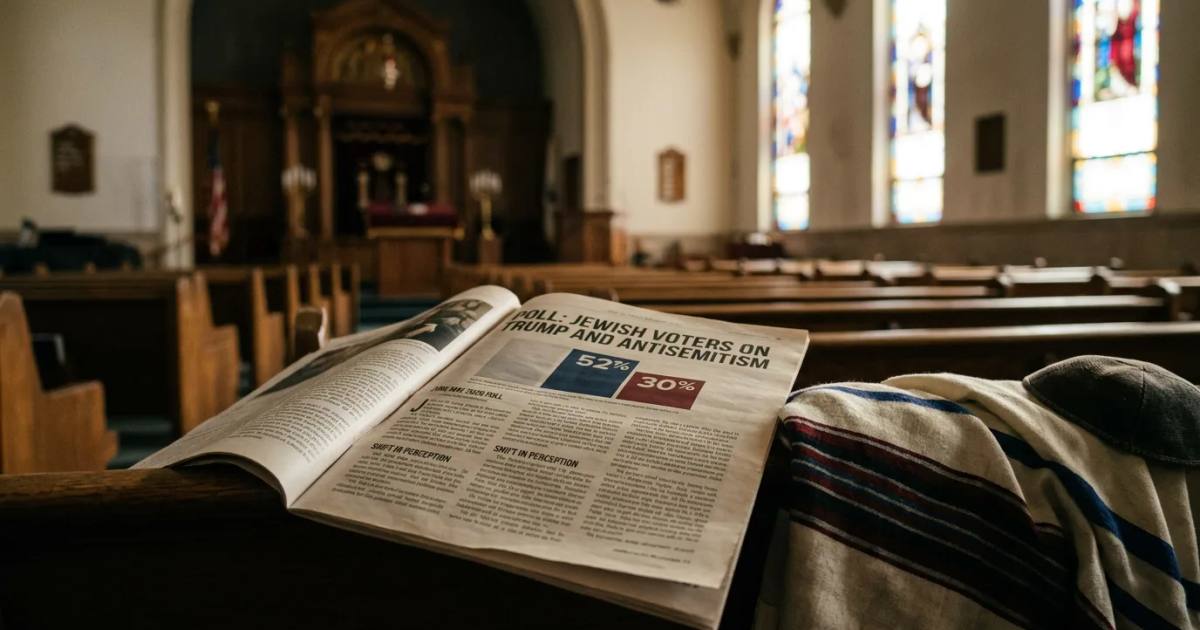

52% of Jewish voters say "antisemitic" describes Trump well — up from 30% a year ago. Israel ranks fifth among voting priorities. Reform Jews disapprove at 81%; Orthodox Jews approve at 81%. Full JVRC May 2026 poll analysis.
52% of Jewish Voters Say "Antisemitic" Describes Trump Well. A Year Ago It Was 30%.
A national survey of 800 self-identified Jewish voters, conducted April 28–May 3, 2026 by GBAO Strategies for the nonpartisan Jewish Voters Resource Center, asked whether specific words describe Donald Trump "well" or "not well." The margin of error is ±3.5 percentage points. The full survey analysis, topline data, and press release were published May 21, 2026.
This article is a follow-up to the comprehensive data analysis: Israel #9 For American Jews' Voting Priorities & 52% Think Trump Is an Antisemite.
The word-association results:
74% — say "corrupt" describes Trump well.
73% — say "dangerous" describes Trump well.
71% — say "criminal" describes Trump well.
68% — say "racist" describes Trump well.
52% — say "antisemitic" describes Trump well.
32% — say "strong leader" describes Trump well.
29% — say "has the right priorities" describes Trump well.
26% — say "shares your values" describes Trump well.
21% — say "honest and trustworthy" describes Trump well.
This is the president who moved the U.S. embassy to Jerusalem, recognized Israeli sovereignty over the Golan Heights, brokered the Abraham Accords, and defunded UNRWA.
"Antisemitic" Jumped 22 Points in One Year. "Racist" Jumped 16.
GBAO asked the same word-association battery in May 2025. The year-over-year shift is the most striking finding in this poll:
Antisemitic: 30% → 52%. Up 22 points in twelve months.
Racist: 52% → 68%. Up 16 points.
Criminal: 69% → 71%. Dangerous: 72% → 73%. Corrupt: 79% → 74%.
The perception of Trump as dangerous, criminal, and corrupt was already locked in by May 2025. What moved in the year since was "antisemitic" — from less than a third to a majority — and "racist," which jumped 16 points. Those two dimensions moved dramatically while the others barely shifted.
28% Approve. 72% Disapprove. The Denominational Mirror Image.
Trump's overall job approval among Jewish voters in this survey: 28% approve, 72% disapprove. His national approval at the time of the fieldwork was 37%.
The denominational crosstabs are the most revealing data in the poll:
Reform Jews: 19% approve, 81% disapprove.
Conservative Jews: 39% approve, 61% disapprove.
Orthodox Jews: 81% approve, 19% disapprove.
No denomination / Other: 21% approve, 79% disapprove.
Reform and Orthodox Jews mirror each other at 81-19 — in opposite directions. Same religion. Same country. Same president. The political identity of American Jews is not monolithic. It is denominational.
By gender: women approve at 22%, men at 36%. By age: 18-34 approve at 21%, 50-64 at 41%, 65+ at 22%.
The rest of the administration:
19% — favorable view of JD Vance. 79% unfavorable.
27% — favorable view of Marco Rubio. 67% unfavorable.
Israel Ranks Fifth as a Voting Priority — and Is Not a Dealbreaker for 83%
Respondents named their two most important issues for the November midterms:
1. Future of democracy — 37%
2. Cost of living / affordability — 32%
3. Antisemitism — 25%
4. Healthcare — 18%
5. Israel — 17%
6. National security / foreign policy — 13%
7. ICE deployment in U.S. cities — 12%
8. Social Security / Medicare — 10%
9. Climate change — 8%
10. Immigration — 7%
11. Iran war — 6%
12. Guns — 5%
13. Abortion — 5%
When asked for the one "dealbreaker" issue — the issue so important a disagreement would disqualify a candidate:
Antisemitism — 20%. Future of democracy — 17%. Israel — 17%. Abortion — 11%. ICE deployment — 10%.
Of those who cited Israel as their dealbreaker: 13% meant a candidate they view as insufficiently supportive of Israel. 4% meant a candidate supporting bad conduct by the Netanyahu government. 83% said Israel is not a dealbreaker issue at all.
Democracy outranks Israel by 20 points as a voting priority. That gap is the single most important finding for understanding why Trump's pro-Israel record has not translated into Jewish votes.
67% Will Vote Democratic. The House Vote by Denomination, Age, and Gender.
67% — of Jewish voters intend to support Democrats in 2026. 27% Republican. On par with spring 2024 (66-27).
By denomination:
Reform: 75% Democratic, 19% Republican.
Conservative: 52% Democratic, 40% Republican.
Orthodox: 26% Democratic, 72% Republican.
Unaffiliated / Other: 75% Democratic, 20% Republican.
By gender: Women 75-21 Democratic. Men 58-35.
By age: 18-34: 74-21. 35-49: 65-31. 50-64: 51-41. 65+: 75-19.
70% Are Emotionally Attached to Israel. 55% Oppose the Gaza War. Netanyahu at a Historic Low.
70% — feel emotionally attached to Israel. Down from 82% at peak in 2024 and 75% in May 2025.
Attachment by age: 18-34 — 50%. 65+ — 76%.
Attachment by denomination: Orthodox — 87%. Conservative — 88%. Reform — 76%. No denomination — 50%.
28% — have a favorable view of Netanyahu. The lowest in the history of this survey series — down from 58% in 2009.
55% — oppose Israel's conduct of the war in Gaza. 45% support.
By denomination on Gaza: Reform — 58% oppose. Conservative — 31% oppose. Orthodox — 17% oppose. Unaffiliated — 71% oppose.
16% — consider the Gaza war a success. 41% call it a failure. 44% say it is not clear.
54% — support a two-state solution. 24% support a single binational state. 22% support Israeli annexation.
62% Oppose the Iran War. 73% Say It Will Increase Antisemitism.
38% — support U.S. military action in Iran. 62% oppose.
By denomination: Reform — 31% support. Conservative — 53%. Orthodox — 86%. Unaffiliated — 26%.
73% — believe the war with Iran will increase antisemitism in the United States.
92% — say the Gaza war has already increased antisemitism.
90% Are Concerned About Antisemitism. 46% Say the Greater Threat Comes From the Right.
90% — are concerned about antisemitism in the United States. This figure has held between 89% and 93% in every wave of this survey since September 2022.
When asked whether they are more concerned about antisemitism from left-wing or right-wing groups:
46% — more concerned about the right.
35% — more concerned about the left.
18% — both, neither, or not sure.
Even after two years of visible left-wing antisemitism — campus encampments, anti-Zionist organizing, progressive political rhetoric — a plurality of Jewish voters in this survey still identify the right as the greater source of threat.
72% Say ICE Deployment Is Making America More Dangerous
72% — say Trump's deployment of ICE agents to American cities is making America more dangerous. 28% say safer.
81% — say the government should not allow ICE agents to conceal their identity and wear masks.
23% — have a favorable view of ICE. 73% unfavorable.
Even among Orthodox Jews — Trump's strongest Jewish constituency — 52% say ICE deployment is making things more dangerous, and 52% oppose allowing agents to mask.
Jewish Voters See Trump's Actions as Threats to Democracy
Respondents were asked whether specific Trump actions pose a serious threat to democracy. The percentage rating each a "serious" or "very serious" threat:
84% — taking TV stations off the air for negative coverage.
80% — using the Department of Justice to prosecute political enemies.
78% — firing federal employees who are not loyal to Trump.
78% — taking away funding from states with Democratic governors.
76% — seizing voter data, nationalizing elections, and sending ICE to polling places.
75% — invoking the Insurrection Act and deploying the National Guard to cities.
75% — using the presidency to enrich himself through merchandise and selling access.
60% — taking away funding from universities for allegedly failing to fight antisemitism.
The university defunding question — the administration's signature Jewish-community initiative — scored lowest. Even the policy framed as protecting Jewish students is viewed as a threat to democracy by 60% of Jewish voters.
What the Poll Shows — and What It Doesn't
This is one poll. 800 respondents. One pollster. One moment in time — six months before the midterms, during an active war with Iran. It does not represent all American Jews. It represents self-identified Jewish voters contacted through a national voter file and weighted to Pew Research Center denominational benchmarks.
What the data establishes: 52% of Jewish voters in this survey say "antisemitic" describes Trump well — up 22 points from a year ago. His approval is 28%. Israel ranks fifth as a voting priority and is not a dealbreaker for 83%. Jewish voters intend to vote Democratic by a 67-27 margin. Reform Jews disapprove of him at 81%. Orthodox Jews approve at 81%.
What the data does not establish is why the political identity of non-Orthodox American Jews is so overwhelmingly liberal. But the denominational split — Reform at 81% disapproval, Orthodox at 81% approval — points toward one explanation: institutional formation.
The Religious Action Center of Reform Judaism, founded in 1961, has spent six decades mobilizing Reform Jews around progressive domestic causes. The Union for Reform Judaism's resolution database lists formal positions on abortion rights (since 1967), gun violence prevention, immigration justice, LGBTQ equality, criminal justice reform, climate change, and voting rights. The Central Conference of American Rabbis has reaffirmed abortion access in resolutions spanning 1967 through 2017. Reform Judaism's Wikipedia entry quotes scholar Dana Evan Kaplan describing the denomination's political orientation as "basically a mirror of the most radically leftist components of the Democratic Party platform."
The RAC's close alignment with the Democratic Party has been documented by observers across the political spectrum — from InfluenceWatch, which describes it as a "left-of-center advocacy nonprofit," to Moment Magazine, which published a rabbi's observation that a Reform sermon "sounded like the Democratic Party platform."
None of this proves that institutional formation caused these polling results. Correlation is not causation — and millions of Jewish voters form their politics independently of any denomination. But it is not only Reform Judaism. The ADL, the majority of diaspora Jewish organizations, the federation system, the Conservative movement's leadership — the institutional center of gravity of American Jewish life is progressive. When the largest Jewish denomination has aligned itself with progressive domestic politics for over half a century, when the flagship Jewish defense organization positions itself on the left side of most domestic policy debates, and when 71% of Jewish voters chose Kamala Harris over a president whose Israel record is historically strong — the institutional context is essential to understanding the voters who produced these numbers.
Frequently Asked Questions
What percentage of Jewish voters say "antisemitic" describes Trump well?
52% of Jewish voters in the JVRC May 2026 national survey say "antisemitic" describes Donald Trump well. This is up from 30% in the same survey conducted in May 2025 — a 22-point increase in one year.
What poll is this data from?
The data comes from the Jewish Voters Resource Center (JVRC) National Survey, conducted April 28–May 3, 2026 by GBAO Strategies. The survey included 800 self-identified Jewish voters with a margin of error of ±3.5 percentage points.
What is Trump's approval rating among Jewish voters?
28% of Jewish voters approve of Trump's job performance; 72% disapprove. By denomination: Reform Jews approve at 19%, Conservative Jews at 39%, Orthodox Jews at 81%, and unaffiliated Jews at 21%.
Where does Israel rank among Jewish voter priorities?
Israel ranks fifth among Jewish voter policy priorities in this survey — behind the future of democracy (37%), cost of living (32%), antisemitism (25%), and healthcare (18%). Israel was cited by 17% as a top-two priority. 83% of respondents said Israel is not a dealbreaker issue.
How do Jewish voters plan to vote in the 2026 midterms?
67% of Jewish voters intend to support Democrats in the 2026 midterm elections; 27% intend to support Republicans. By denomination: Reform Jews split 75-19 Democratic, Conservative Jews 52-40, Orthodox Jews 26-72 Republican, and unaffiliated Jews 75-20 Democratic.
What percentage of Jewish voters voted for Kamala Harris in 2024?
71% of Jewish voters cast their ballot for Kamala Harris in 2024, according to the JEI post-election survey. The CNN/Edison exit poll put the figure at 78%.
Methodology
GBAO Strategies designed the questionnaire for the Jewish Voters Resource Center. The survey was conducted April 28–May 3, 2026, via text-to-web, and included interviews with 800 self-identified Jewish voters. MOE ±3.5% at the 95% confidence level. The sample was drawn from a national voter file. Respondents with a likelihood of being Jewish — based on name or geography — were contacted by text, then took the survey via secure link. All respondents confirmed they consider themselves Jewish, using the same question wording as Pew Research Center's "Jewish Americans in 2020" study. The sample was weighted to Pew's demographic results on gender, denomination, age, and synagogue membership.
Full survey analysis (PDF) · Topline data (PDF) · Press release