The wellness-tourism economy that depended on Russian and Eastern European inbound — and the structural decline that the post-October 7 cycle is making impossible to ignore.
The wellness-tourism economy that depended on Russian and Eastern European inbound — and the structural decline that the post-October 7 cycle is making impossible to ignore.
The Dead Sea is literally shrinking — and the hospitality economy built on its shoreline is shrinking with it.
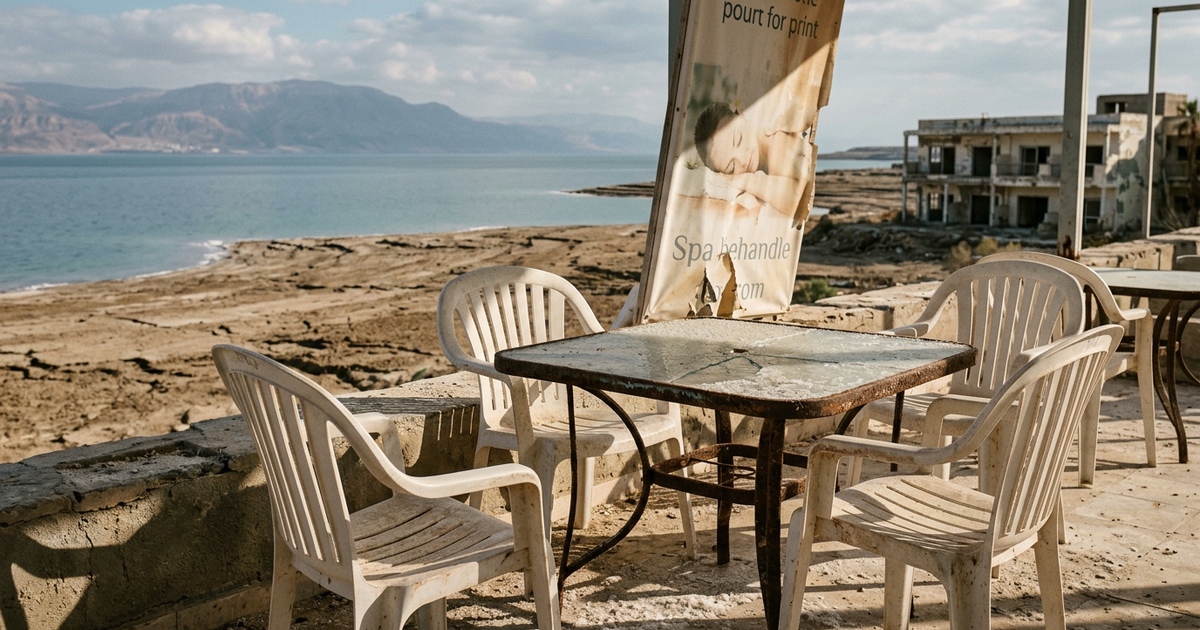
Sea level dropping roughly 1.0 to 1.2 meters per year. Sinkholes appearing across the western shore. Northern Dead Sea beaches closed. The tourism shoreline has moved several kilometers from its 1980 position. And the inbound segments that the Ein Bokek hotel cluster was built to serve — Russian wellness tourists, German medical-tourism patients, Catholic pilgrimage groups — are recovering more slowly than anywhere else in the Israeli hotel sector, if at all.
The Dead Sea is the part of the Israeli tourism map that the rest of the system is most worried about.
BY THE NUMBERS
Hotel rooms (Israeli shore): ~4,000
Main hotel zone: Ein Bokek (southern basin)
Sea level decline: ~1.0–1.2 meters per year
Pre-war demand mix: ~50% inbound (Russia, Eastern Europe, Germany, Christian pilgrimage); ~50% Israeli domestic
Post-October 7 inbound: well below 2019 baseline; structural laggard of the recovery
Major operators: Isrotel · Fattal · Dan · Crowne Plaza · Royal · Spa Club
The Natural-Resource Crisis
The Dead Sea itself is shrinking, and the math has been visible for four decades.
The sea level has been dropping roughly 1.0 to 1.2 meters per year for the past forty years. The cause is upstream: water that historically flowed into the Dead Sea from the Jordan River and tributaries is now extensively diverted for agricultural, municipal, and industrial use across Israel, Jordan, and Syria. The mineral extraction industry on the southern basin (potash and bromine production) is a secondary contributor.
For the hotel cluster at Ein Bokek, the visible consequence has been the receding shoreline. The hotels are built around the artificially maintained southern evaporation ponds, not the natural Dead Sea, but the broader landscape has been transformed. Sinkholes have appeared along the western shore — thousands of them, in some sections opening at a rate of dozens per year. Northern Dead Sea beaches have been closed. The wellness brand of the destination has been compromised by the visible environmental decline.
Various proposed solutions — the Red Sea–Dead Sea canal project, the more limited Jordan River restoration plans — have moved through political cycles without execution at meaningful scale. The current trajectory is unchanged.
The Wellness Anchor
The Dead Sea hospitality economy was built on natural-spa tourism.
Mineral water, mud treatments, sulfur springs, the unique atmospheric conditions of the lowest point on Earth, and the documented medical benefits for psoriasis, rheumatoid conditions, and respiratory illness all combined to make the Dead Sea a destination wellness market with structural medical-tourism overlap. German health insurance historically covered Dead Sea treatment stays. Russian and Eastern European wellness operators built dedicated tour packages around extended stays at the major Ein Bokek hotels.
The 1990s and 2000s were the high-water mark for this economy. Hotel inventory expanded through Ein Bokek. The major Israeli operators built out the resort cluster. Inbound flow from Germany, Russia, Ukraine, Poland, the Czech Republic, and Romania ran at scale.
That demand base began softening through the 2010s and never fully recovered to the pre-2014 baseline.
The Demand-Side Collapse
Three structural changes hit Dead Sea inbound through the 2010s.
One — German health insurance reform. Through the 2000s, German statutory health insurers reduced and eventually largely eliminated coverage for Dead Sea wellness stays. The structural German medical-tourism flow declined steadily. The operators most dependent on it lost their highest-yielding inbound segment.
Two — the Ukraine war and the disruption of Russian inbound. Russian flows to the Dead Sea were significant pre-2014 and remained meaningful through 2022. The full-scale Ukraine invasion and the subsequent sanctions, route closures, and operator consolidation effectively ended that flow.
Three — the Christian pilgrimage segment’s shift away from the Dead Sea. Pilgrimage itineraries in the 1990s and 2000s often included Dead Sea overnight stays as part of a Jerusalem-Galilee-Dead Sea triangle. Modern pilgrimage packaging is tighter and more Jerusalem-and-Galilee focused. The Dead Sea pilgrimage stop is increasingly a day trip rather than an overnight, which removes the hotel revenue line.
The October 7 Collapse
The post-October 7 cycle hit the Dead Sea harder than anywhere else in the Israeli hotel sector.
The reasons stack: the inbound segments that the Dead Sea most depends on were the slowest segments to return broadly. Tel Aviv-anchored boutique-luxury demand and Israeli domestic leisure — the segments that recovered fastest — do not flow to the Dead Sea. The Dead Sea was structurally exposed to exactly the slowest part of the recovery curve.
The state displaced-family contracts kept some Ein Bokek hotels operating through 2024 on subsidized rates, which prevented closures but did not produce commercial recovery. Through 2025 and into 2026, occupancy has rebuilt modestly. Average daily rates remain well below 2019 levels. The structural inbound mix has not yet normalized.
WHY IT MATTERS
- Sea level dropping ~1.0–1.2m/year — the natural-resource crisis is reshaping the geography and the wellness brand
- Structural laggard of the post-October 7 Israeli tourism recovery — recovering more slowly than any other major hotel region
- Heavily exposed to inbound segments that have not returned: Russian, Eastern European wellness, German health insurance, Catholic pilgrimage
- No clear demand-side replacement for the lost German medical tourism and Russian wellness segments
- Operators running on state contracts and limited domestic demand — not commercial inbound economics
What Would a Recovery Look Like
Two scenarios for the Dead Sea hospitality economy over the next decade.
Scenario A: structural decline continues. German health tourism does not return. Russian flows do not return at pre-war scale. Christian pilgrimage continues to shorten Dead Sea exposure to a day trip rather than an overnight. The natural-resource issue worsens. Hotel inventory consolidates downward through closures and conversions. The Dead Sea becomes a smaller, lower-volume, lower-yielding part of the Israeli tourism map.
This is the base case if no structural intervention occurs.
Scenario B: repositioning toward Israeli domestic wellness and new inbound segments. Israeli domestic medical tourism is real but small. Indian and Chinese wellness markets are growing globally but have not anchored on the Dead Sea historically. Israeli wellness branding can be rebuilt around the documented medical benefits, but it requires investment in product (newer hotel inventory, modern spa facilities, integrated medical-wellness offerings) that the current operator base has not been willing to underwrite at scale.
This scenario requires either operator-led capital investment or a state-level repositioning of the regional brand. Neither is currently in motion.
The Wider Context
The Dead Sea is the part of the Israeli tourism economy where the post-October 7 cycle is forcing a structural question that the sector has been avoiding for fifteen years. The pre-war demand mix was already softening. The natural-resource issue was already deteriorating. The Russian and German segments were already in long-term decline.
October 7 accelerated everything and removed the cushion that domestic and pilgrimage flows had provided. What remains is a hospitality region that needs either a demand-side reinvention or an acceptance of permanent structural decline.
The major operators (Isrotel, Fattal, Dan) have other regions to lean on. The Dead Sea matters to them but does not define them. The independent operators (Spa Club, Royal, and the smaller Ein Bokek properties) are more exposed.
The wellness destination that the Israeli hotel industry built around. The natural resource that is literally receding. The recovery that hasn’t happened. The Dead Sea is the strategic question the rest of the sector keeps quiet about.
Part of the Olam Travel & Hospitality cluster. Anchors: The Israeli Boutique Hotel Class · Tourism Inside Israel: The Recovery Math. Capstone: Who Owns the Israeli Hotel Sector.