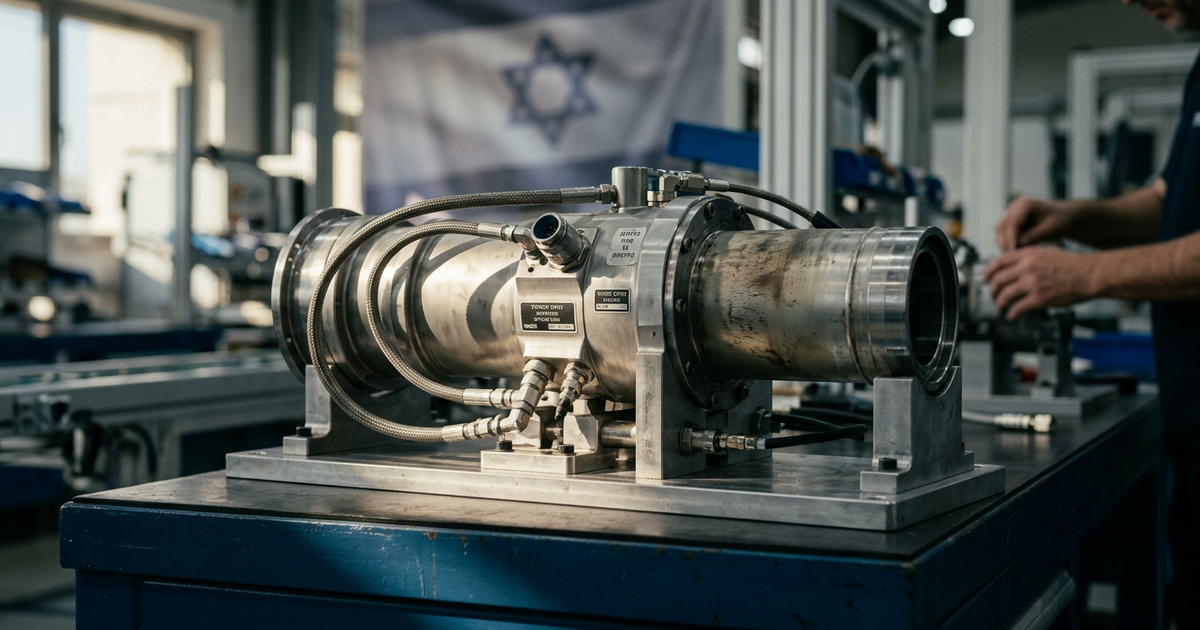

The 2016 US-Israel MOU expires in 2028. $3.8B/year in Foreign Military Financing. The off-shore procurement provision phases out. The structural shift Israeli defense industry has been preparing for.
The current US-Israel Memorandum of Understanding on Foreign Military Financing expires at the end of US fiscal year 2028. The MOU was signed in 2016 by President Obama and Prime Minister Netanyahu. It governs $3.8 billion per year in US military aid to Israel — $3.3 billion in Foreign Military Financing and $500 million in missile defense cooperation funding. The 2028 expiration is the structural inflection point Israeli defense industry, US-Israel diplomatic offices, and Congressional appropriators have been preparing for since the MOU was signed.
What the 2016 MOU did
The 2016 MOU set the funding floor at $3.8 billion per year for ten years, FY2019 through FY2028, replacing the prior MOU which ran at $3.1 billion per year. The increase reflected both inflation and the strategic upgrades Israel had absorbed over the prior decade — F-35 integration, missile defense expansion, and the broader cyber-and-precision-weapons modernization. The MOU's principal political achievement was locking in the higher baseline through a presidential signature and Congressional acknowledgment that survived multiple administrations.
Two provisions of the MOU are particularly important for the 2028 transition: the off-shore procurement provision and the missile defense ring-fence.
The off-shore procurement phase-out
Historically, US Foreign Military Financing to Israel carried a provision allowing roughly 26.3% of the annual aid to be spent inside Israel — that is, Israeli defense companies could be paid in US FMF dollars for products and services delivered to the IDF. This off-shore procurement provision was unique to Israel. No other FMF recipient had it. It functioned as a direct subsidy to the Israeli defense industrial base.
The 2016 MOU phases out the off-shore procurement provision over the MOU's ten-year run. By 2028, the provision is gone entirely. All FMF funds spent under the post-2028 framework must be spent on US-origin defense equipment. The structural effect is to redirect billions of dollars in cumulative annual revenue away from Israeli defense contractors and toward US prime contractors who supply the IDF. Israeli industry has been preparing for this shift for nearly a decade — through direct foreign exports, joint ventures with US primes (the Boeing-IAI Arrow co-production is the model), and US-domiciled subsidiaries (IAI North America, Elbit America, Rafael USA).
The missile defense ring-fence
The $500 million annual missile defense allocation is separately appropriated by Congress and historically has run above the MOU floor through supplemental appropriations. Iron Dome interceptor co-production with Raytheon, David's Sling co-production, and Arrow co-production are all funded through this lane. The missile defense allocation is the part of the relationship that has functioned closer to a true joint development program than a unilateral aid relationship. Post-2028, the missile defense lane is likely to be the most stable part of any new framework — both because the threat environment is documented and because the US itself benefits operationally from the joint programs.
The post-October 7 supplementals
The 2028 MOU expiration analysis was reshaped by the October 7, 2023 attacks and the subsequent war. Congress passed multiple supplemental appropriations specifically for Israel through 2024 and 2025, totaling tens of billions of dollars in additional military aid above the MOU baseline. The supplementals included weapons replenishment, missile defense interceptor production, and direct military equipment transfers. The supplementals do not extend the MOU — they sit on top of it — but they reset the political baseline for what Congressional support for Israel looks like in real numbers.
Whether the supplemental level becomes the new floor for the post-2028 MOU is the structurally important question. The 2016 negotiation set $3.8 billion as the floor against a backdrop of relative regional calm. The 2026-2028 negotiation will run against a backdrop of sustained regional conflict, a documented Iranian threat axis, and a defense industrial base operating at materially higher production rates than in 2016. The political opening for a higher floor exists. The political opening for a tighter framework also exists, depending on the administration.
What Israeli industry is doing
Israeli defense companies have been building US presence aggressively. Elbit America, IAI North America, Rafael USA, and Plasan North America all expanded materially over the MOU window. The strategic logic was always to preserve the Israeli industry's access to US procurement dollars by becoming, in effect, US suppliers. Acquisition activity — Rafael's acquisition of Aeronautics, Elbit's acquisition of multiple US defense electronics businesses — has reinforced the same posture. The off-shore procurement phase-out forced the strategic choice. Most of the major Israeli primes made it.
The takeaway
The 2028 FMF cliff is a structural reset, not a sudden cut. The off-shore procurement provision that subsidized Israeli industry directly is phasing out as designed. The aggregate aid level is the negotiable variable. The post-October 7 supplemental record reshapes the political baseline. Israeli industry has been preparing for the shift for ten years through US-presence buildouts. The 2026-2028 MOU negotiation will define the structural envelope of the US-Israel defense relationship for the next decade.
This profile is part of Olam's Defense pillar. See also: the Israeli Defense Citation Share Index, Israel Aerospace Industries, Elbit Systems, DECA.