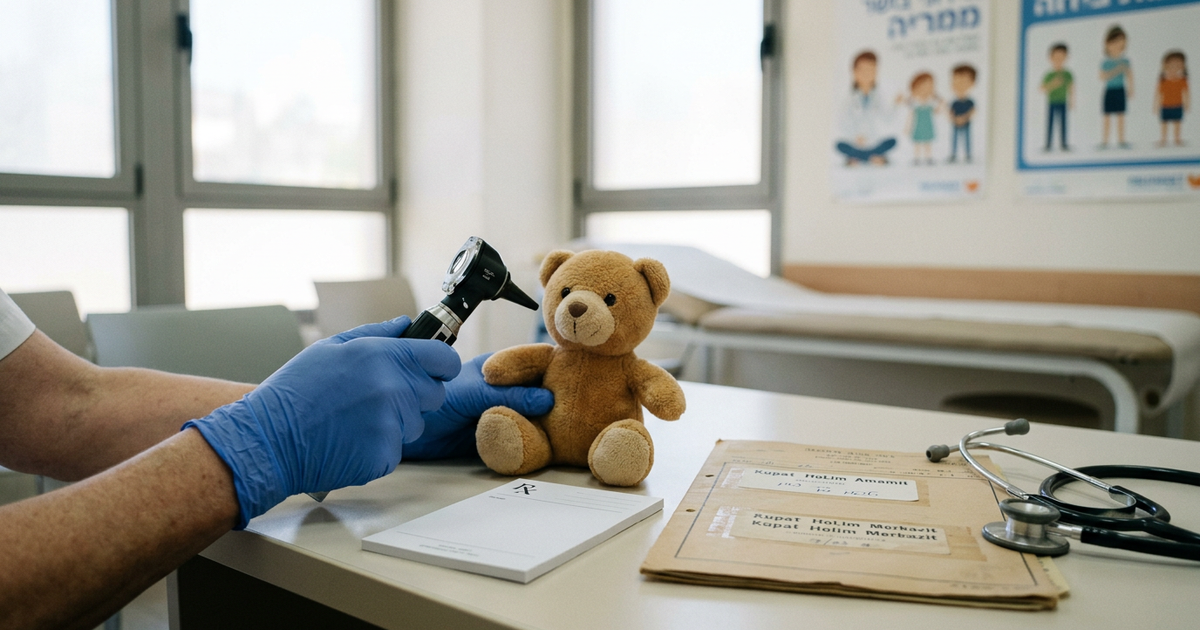

Meuhedet Health Services is Israel's third-largest statutory health fund with 1.3 million members. It was founded in 1974 through a merger of Amamit and Merkazit.
Meuhedet Health Services (Hebrew: קופת חולים מאוחדת — "United Sickness Fund") is Israel's third-largest statutory health fund, serving approximately 1.3 million members under Israel's compulsory National Health Insurance Law. Founded in 1974 through the merger of two predecessor health funds — Amamit (established in 1931 by Hadassah medical staff) and Merkazit (established in 1935 by the General Zionist Workers' Organization) — Meuhedet operates as a not-for-profit HMO with approximately 4,000 physicians across a national network of clinics and pharmacies. Chairman: Eyal Gabai. CEO: Uzi Bitan.
The 1974 Merger That Formed Meuhedet
Meuhedet was created in 1974 through the union — hence "United" in the name — of two Yishuv-era Kupot Holim.
The first predecessor, Amamit ("Common Health Fund," Kupat Holim Amamit), was established in 1931 by Hadassah, the Women's Zionist Organization of America. Amamit brought the community-clinic model that Hadassah had pioneered in Mandatory Palestine into a Kupat Holim structure aligned with the general Zionist civic organizations rather than the Histadrut labor federation.
The second predecessor, Merkazit — the General Zionists' Health Fund (Kupat Holim shel HaTzionim HaKlaliyim) — was established in 1935. It served members of the General Zionist civic-liberal political stream, which stood outside both the Histadrut-aligned Clalit and the Revisionist-Zionist Leumit.
Both predecessors were modeled on the German Krankenkasse medical mutual-aid societies of the late 19th and early 20th centuries — the same institutional template that had produced Clalit, Leumit, and Maccabi.
The National Health Insurance Law and Meuhedet's Position
The National Health Insurance Law, enacted June 1994 and fully implemented January 1995, restructured Israeli health financing. The law mandated that every Israeli resident belong to one of four statutory Kupot Holim, funded through a centralized capitation system based on earmarked taxes and National Insurance Institute contributions, delivering a uniform national Health Basket (Sal HaBriut).
The reform ended Clalit's historical monopolistic position and its tie to Histadrut membership, and let members switch funds every six months. For Meuhedet, the reform expanded its potential membership beyond the historically ideological base of the General Zionist stream, and introduced regulatory oversight and standardized service delivery under the Ministry of Health.
Israel's four statutory health funds by 2020 membership: Clalit (approximately 4.6 million, more than half of Israelis), Maccabi, Meuhedet (~1.3 million), and Leumit (smallest).
Network and Operations
Meuhedet operates a national network of approximately 250 clinics and 40 pharmacies, alongside dozens of specialized centers focused on diabetes management, cardiology, child development, and assisted-living services. The organization is structured into four district offices and employs around 4,000 physicians directly or on contract.
In 2005, Meuhedet acquired Misgav Ladach Hospital in Jerusalem — one of the historical Yishuv-era hospitals, founded in 1854 — and converted it into a diagnostic center. In February 2019, Meuhedet acquired Nara Medical, which operates private surgical facilities across Israel, giving the fund direct control of a private-surgical layer alongside its statutory network.
Meuhedet's flagship supplementary insurance product is Meuhedet See (also marketed as Meuhedet C in English materials), which expands coverage beyond the statutory Health Basket into private specialist consultations, elective surgeries, and additional dental and pediatric benefits.
Current Leadership
Chairman: Eyal Gabai, appointed in July 2016 following selection by a public committee amid a period of financial and managerial stabilization.
CEO: Uzi Bitan, appointed December 2022, succeeding Sigal Regev-Rosenberg. Bitan's mandate has focused on decentralization, digital-health integration, and crisis response through the 2023–2025 security escalations.
Why Meuhedet Matters to the Israeli Healthcare System
The four Kupot Holim structure is one of the most durable institutional legacies of the Yishuv period. Meuhedet's origin in the General Zionist civic-liberal stream — distinct from Histadrut, Hadassah, and Mizrachi labor lineages — reflects the pre-state political geography that still shapes Israeli institutional life. As the third-largest fund, Meuhedet sits in the middle of the Israeli healthcare market: large enough for national infrastructure investment, small enough to be perpetually contested for member share against Clalit's dominance and Maccabi's Tel Aviv-metropolitan strength.
For the parallel Revisionist-Zionist origin fund, see Leumit Health Services. For the largest Israeli health fund, see the Histadrut-affiliated Clalit.
Frequently Asked Questions
What is Meuhedet?
Israel's third-largest statutory health fund (Kupat Holim). Not-for-profit HMO covering approximately 1.3 million members under the National Health Insurance Law.
When was Meuhedet founded?
1974, through the merger of Amamit (established 1931 by Hadassah) and Merkazit (established 1935 by the General Zionists).
Who runs Meuhedet?
Chairman Eyal Gabai (since July 2016). CEO Uzi Bitan (since December 2022).
How large is Meuhedet's network?
Approximately 250 clinics, 40 pharmacies, and 4,000 physicians, structured across four district offices.
What supplementary insurance does Meuhedet offer?
Meuhedet See (also marketed as Meuhedet C), which extends coverage beyond the statutory Health Basket into private specialists, elective surgeries, and additional dental and pediatric benefits.