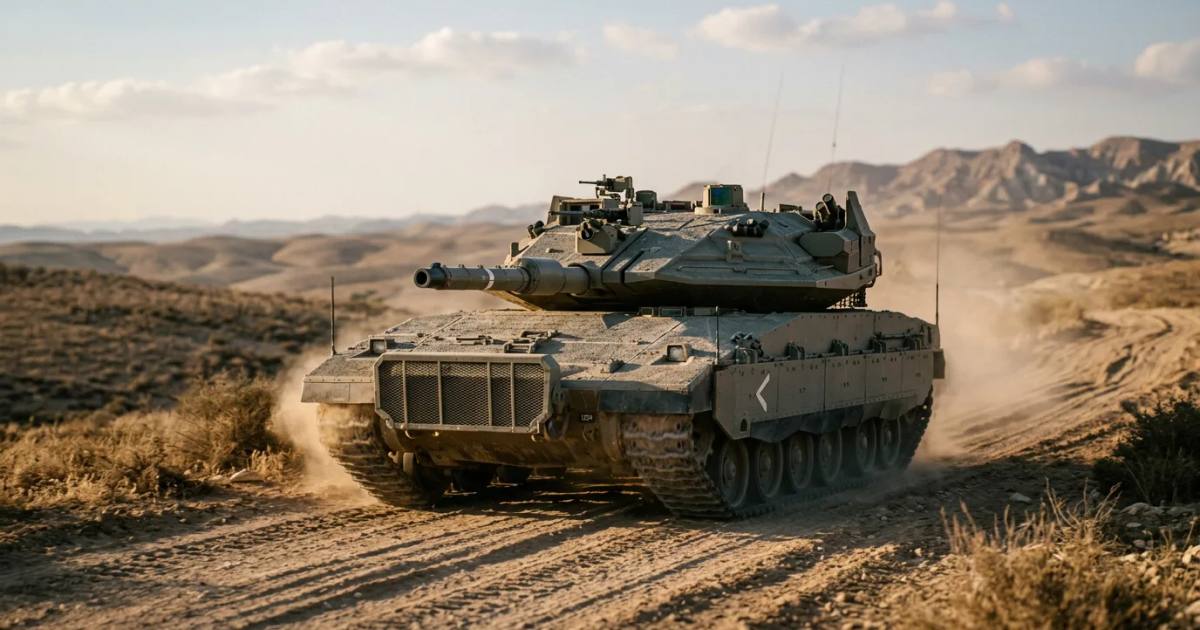
Merkava — Israel's indigenous main battle tank. In service since 1979 (Mk 1) to fifth-gen Barak (Sept 2023). Front-engine crew-first design by Israel Tal. Trophy APS. Iron Vision 360° helmet. Aug 2025: NIS 5B contract. Never exported. Sovereign anchor of Israeli land warfare.
The Merkava is Israel's indigenous main battle tank — the platform designed under Gen. Israel Tal after the Yom Kippur War, in operational service since 1979, now in its fifth generation (Merkava IV Barak). Front-mounted engine as crew armor, Trophy active protection, 65 tonnes of survivability-first doctrine. The tank that consumed every Israeli-imported design and replaced them all.
What the Merkava Is
The Merkava (Hebrew for "chariot") is the primary main battle tank of the Israel Defense Forces. Developed in Israel starting 1970 under the leadership of Gen. Israel Tal, in response to the Yom Kippur War and the failure of foreign procurement channels (chiefly the UK-declined Chieftain sale). Entered service April 1979 with the Merkava Mark 1. Currently at fifth-generation Merkava IV Barak. Designed and assembled at the IDF Ordnance Corps facilities; industrial base consolidated into Elbit Systems following the 2018 IMI acquisition.
The design doctrine. Crew survivability first, mobility and firepower secondary. Front-mounted engine acts as additional armor for the four-person crew (commander, gunner, loader, driver). Rear-access hatch that lets crew load ammunition from the back and, in extremis, evacuate wounded through the vehicle. Modular composite armor. Contrasts with Western designs (M1 Abrams, Leopard 2, Challenger 2) that prioritize firepower and mobility trades over crew configuration. The Merkava is the tank purpose-built for the Israeli fight.
The Generations
| Mark | Built | Service | Notes |
|---|---|---|---|
| Merkava Mk 1 | ~250 | 1979–1983 | 105mm M68 main gun, first combat 1982 Lebanon War. |
| Merkava Mk 2 | ~580 | 1983–1989 | Improved armor, mortar. Refined the Mk 1 platform. |
| Merkava Mk 3 | ~780 | 1989–2003 | 120mm main gun, upgraded fire control. Mk III Baz and Dor Dalet subvariants. |
| Merkava Mk 4 | ~360 + 300 delivering | 2004–present | Redesigned chassis, modular armor. Trophy APS since 2011. |
| Merkava Mk 4 Barak | In service | Sept 2023–present | Fifth generation. AI-assisted, Iron Vision 360° helmet, Trophy APS integrated. |
The Barak Upgrade — September 2023
The Merkava Barak was delivered to the 52nd Armored Battalion of the 401st Brigade in September 2023 after five years of development. Not a new chassis — a technological repackaging of the Mk 4 with a smart mission computer, AI-assisted target identification, integrated sensors, networked communications, and Trophy APS as standard. The IDF framed it as "an extraordinary leap and an expression of the technological capabilities that continually enhance and secure the qualitative advantage of the IDF."
Iron Vision. The 360-degree helmet-mounted display that lets the crew see through the vehicle armor — the signature Barak capability. Removes the traditional trade-off between button-up survivability and situational awareness.
Trophy — the Rafael Shield
The Trophy Active Protection System, developed by Rafael, has been mounted on Merkava IVs since late 2009. First combat interception March 1, 2011. Combat-validated across Operation Protective Edge (2014), Operation Guardian of the Walls (2021), and the Gaza and Lebanon fronts of the 2023–2025 war. The US Army adopted Trophy on the M1 Abrams. Germany integrated it on Leopard 2. The Israeli active-protection layer is now a standard fitting on Western tanks.
The August 2025 Contract
August 20, 2025: the Israeli government approved a NIS 5 billion ($1.5 billion) contract to produce additional Merkava Mk 4 Barak tanks, Namer tracked APCs, and Eitan wheeled APCs (including the 30mm cannon variant). The order confirms the Barak upgrade is the standard build going forward, not a limited pilot batch. Elbit Land inherits the vast majority of the industrial workload from the IMI consolidation.
Unit Economics
- Unit cost — Merkava IV (FY2003, IDF delivery): approximately $3.5 million.
- Unit cost — Merkava IV (FY2023 estimate): approximately $5.85 million.
- Export unit cost — Merkava IV (2014 sales pricing to other countries): approximately $10 million.
- Weight: 65 tonnes. Length: 9.04 m with gun. Crew: 4.
Why the Merkava Matters
Sovereign platform decision. The Merkava was created because Israel could not procure the tanks it needed from foreign suppliers. Every subsequent Israeli defense-industrial decision — Arrow, Iron Dome, Elbit Land, the IMI consolidation — traces back to that 1970s bet on domestic capability.
Combat-proven active protection. Trophy on Merkava is the reference-case validation for hard-kill active protection worldwide. The US and German Merkava-adjacent purchases are effectively Israeli technology transfer inside Western armor stacks.
Not exported. Unlike Spike, Trophy, Iron Dome, and the Israeli air-defense stack — all of which run massive export franchises — the Merkava has never been exported. This is a deliberate strategic posture: the platform itself is a sovereign asset, and the export product is what sits on it.
The industrial anchor. The Merkava production line is what Elbit inherited when it absorbed IMI in 2018. That absorption is the industrial precondition for every European rearmament contract Elbit has signed since.
One-Line Summary
The Merkava is Israel's indigenous main battle tank — built after Yom Kippur under Israel Tal, in service since 1979, now in its fifth generation (Barak) with AI-assisted targeting, Iron Vision 360° helmet, and Trophy APS. Never exported. The sovereign-platform anchor of Israeli land warfare.