Israeli-founded computer-vision company that built the retail-shelf image-recognition category. Joel Bar-El and Dror Feldheim, 2010. Singapore HQ, Tel Aviv R&D. SoftBank-led $640M round at $2B+ in April 2021. Coca-Cola, Nestlé, Heineken, AB InBev on the customer roster.
Trax is an Israeli-founded computer-vision company that built the retail-shelf image-recognition category. Its software lets consumer packaged goods (CPG) brands and retailers photograph a store shelf and receive, within seconds, a machine-readable inventory of every product on it — what is in stock, what is out, whether prices and promotional materials match plan, and how competitors are displayed. That workflow — the digitization of the physical store shelf — is now the operating standard for large CPG field-execution teams and one of the earliest production computer-vision categories to reach commercial scale outside of automotive and defense.
Trax was founded in 2010 by Joel Bar-El and Dror Feldheim. The company is dual-anchored: Singapore headquarters for commercial operations, with Tel Aviv engineering and R&D running the underlying vision stack. Trax reached unicorn valuation in the 2019 cycle and, in April 2021, closed a $640 million round led by SoftBank Vision Fund 2 and BlackRock at a valuation reported above $2 billion — one of the largest single financings ever recorded for an Israeli computer-vision company.
What the product actually does
The problem Trax solves is old and expensive. Consumer brands spend billions of dollars annually building shelf presence — negotiating placement with retailers, funding promotions, printing point-of-sale materials — and traditionally have almost no visibility into whether any of that shelf plan actually reaches the store as designed. Field-sales representatives visit stores to check, but the audit is slow, sample-based, and inconsistent.
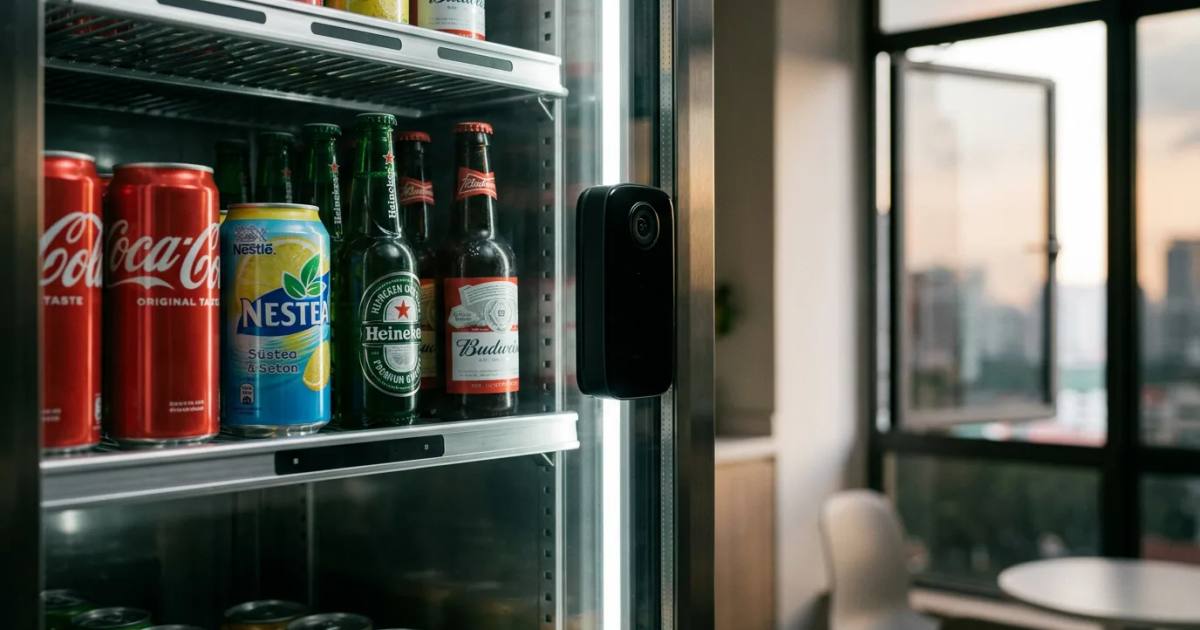
Trax replaced that audit with a photograph. A rep points a phone at a shelf. The Trax vision model identifies every product on it by SKU, reads any visible prices and promotional signage, compares actual placement to planned placement, and produces a compliance report. The same infrastructure runs on ceiling-mounted cameras for retailers that want continuous rather than sampled measurement.
The compounding advantage is data. Every photograph Trax processes improves the underlying model's ability to recognize the millions of SKUs that populate global retail. Competitors starting fresh face a decade-long training-data gap.
The founders
Joel Bar-El — CEO through the company's first decade and now Executive Chairman. Serial founder with a prior track record across telecoms software and Israeli technology exits. Bar-El anchored the commercial strategy that positioned Trax against the CPG buyer rather than the retailer, a decision that shaped the company's category-leader status.
Dror Feldheim — co-founder and long-tenured senior operator. The two founded Trax after identifying the shelf-execution gap during their earlier careers in consumer-adjacent technology.
Product line and technology depth
Trax operates across three integrated product lines. Trax Retail Watch is the fixed-camera continuous-monitoring product for retailers. Trax Retail Execution is the mobile-photograph audit for CPG brand field teams. Trax Insights is the analytics layer that turns years of accumulated store-level image data into buyer-facing intelligence on shelf share, competitive dynamics, and promotional effectiveness.
The underlying computer-vision stack has evolved through multiple generations. Early Trax models used feature-matching and classical computer-vision techniques. The current stack runs deep-learning models trained on a proprietary corpus of hundreds of millions of shelf images spanning almost every consumer-packaged-goods category across most global markets.
The customer base
Trax serves most of the CPG global top ten and the majority of the tier below it. Publicly disclosed customer relationships have included Coca-Cola, Nestlé, Heineken, Anheuser-Busch InBev, Henkel, Diageo, and PepsiCo. In consumer categories with dense shelf-competition dynamics — carbonated beverages, spirits, personal care, snacks — Trax's coverage often approaches category-wide.
Retail deployment sits alongside the brand-side business. Trax's continuous-monitoring product runs in supermarket, convenience, and specialty-retail environments across most major global markets.
The acquisition arc
Trax executed one of the more aggressive acquisition strategies among Israeli-founded technology companies of its era. The Shopkick acquisition in 2019 added a large U.S. consumer-loyalty and shopper-engagement business. Quri added crowdsourced field-audit capacity. Planorama added the French-origin shelf-recognition competitor. Survey.com added a large U.S. field-execution workforce. Each deal broadened Trax's coverage in a specific consumer-shopping or field-execution dimension without fundamentally changing the vision-first product architecture.
Category position
Trax competes with a small handful of players operating at scale in retail computer vision — most notably ParallelDots, Focal Systems (acquired by Walmart), and NielsenIQ's image-recognition unit. It competes indirectly with the retail-media measurement stack (Circana, NielsenIQ, Numerator) that produces shelf intelligence through survey and point-of-sale data rather than direct image capture.
The strategic argument for Trax has always been the same: image capture is the only method that produces ground truth at store level, and the training-data compounding effect over more than a decade makes catching up expensive for entrants.
IPO filing and withdrawal
Trax confidentially filed for a U.S. IPO in 2021 during the peak of that year's public-market cycle for growth technology. The filing was subsequently withdrawn as public-market conditions for later-stage growth software deteriorated through 2022. Trax has remained privately held.
Position in the Israeli cohort
Trax sits inside the Israeli deep-computer-vision cohort that also includes Mobileye in autonomous driving, AnyVision (now Oosto) in facial recognition, and Vayyar in radar-based imaging. The shared characteristic is a research-heavy engineering culture — much of it seeded from the same academic and Unit 8200 pipelines — combined with a commercial-market orientation that pushed each company toward the largest available buyers early.
Among Israeli companies applying computer vision to physical-retail environments specifically, Trax is the largest and most-cited.
Current standing
Trax operates as one of the category-defining companies in retail computer vision globally. Its brand-side software is embedded across the CPG field-execution workflow at most global consumer-goods companies. Its cumulative shelf-image dataset — built across more than a decade of production deployment — is the largest such corpus in the category and the primary technical moat. The company's Singapore-Tel Aviv operating model has held stable across multiple growth cycles and remains the most-cited case of an Israeli-founded technology company scaling its commercial operations outside both the U.S. and Israel.