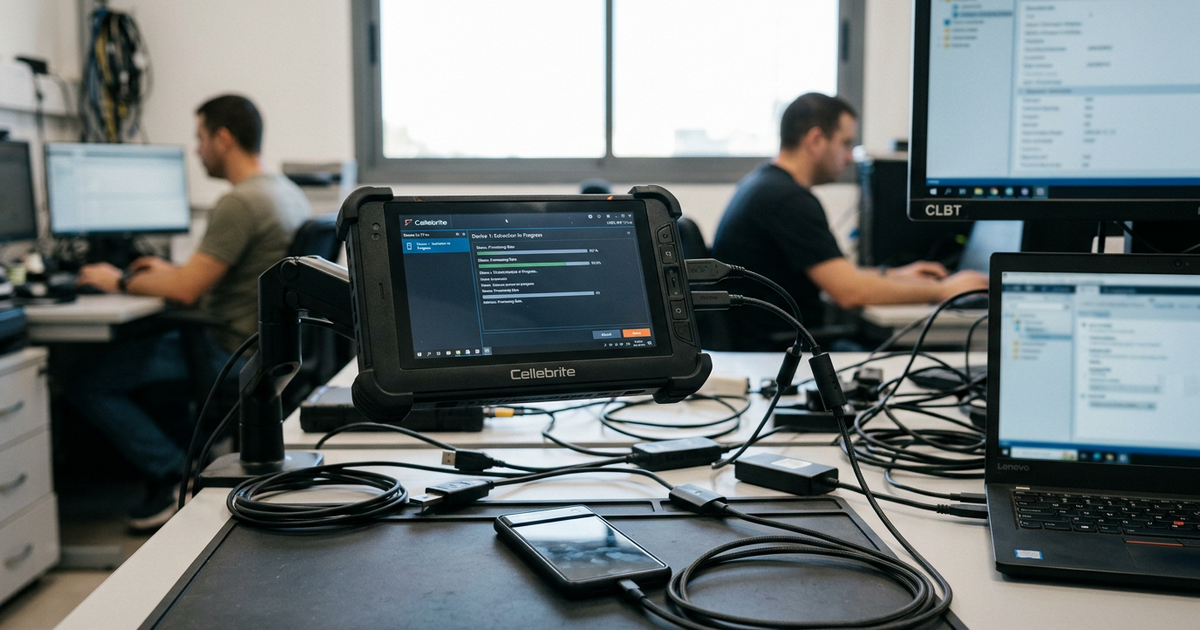

Cellebrite (Nasdaq: CLBT) — Petah Tikva digital-intelligence company whose UFED forensic-extraction platform is the global reference standard for law-enforcement access to mobile-device data.
The Israeli Cyber Cohort | Olam.business
Cellebrite DI Ltd. (Nasdaq: CLBT) is the Petah Tikva-headquartered digital-intelligence company whose UFED forensic-extraction platform is the global reference standard for law-enforcement access to mobile-device data. Founded in 1999 by Avi Yablonka, Yaron Baratz, and Yuval Aflalo, Cellebrite is one of the most consequential — and most geopolitically contested — Israeli technology companies in the law-enforcement and intelligence-services category.
Yossi Carmil, who joined in 2004 and served as Co-CEO from 2005 to 2025, ran the company through the consequential commercial chapter that turned a retail data-transfer tool into the global mobile-forensics category leader. He retired in January 2025. The current CEO is Tom Hogan. Yossi Carmil remains the founder most associated with the company in the public record. The original three founders — Yablonka, Baratz, and Aflalo — sold their shares to Japan's Sun Corporation in 2007 for $17.5 million and exited operational roles.
Snapshot
| Ticker | CLBT (Nasdaq) |
| Founded | April 14, 1999, Israel |
| Original founders | Avi Yablonka, Yaron Baratz, Yuval Aflalo |
| Later principals | Ron Serber (joined 2001, Co-CEO 2005–2020); Yossi Carmil (joined 2004, Co-CEO 2005–2020, sole CEO 2020–January 2025) |
| Headquarters | Petah Tikva, Israel |
| 2007 acquisition | Sun Corporation (Japan) — $17.5 million |
| IPO | August 2021 (SPAC merger with TWC Tech Holdings II Corporation, sponsored by True Wind Capital); ~$2.4B valuation at listing |
| Market cap (mid-2026) | ~$4–6 billion |
| FY2024 revenue | ~$420 million |
| Employees | ~1,200 |
| Customer base | 150+ countries; majority US federal law enforcement; NATO intelligence services; national police forces |
| Flagship product | UFED (Universal Forensic Extraction Device) — first released 2007; UFED Premium 2019 |
The Founders: Yablonka, Baratz, and Aflalo
Cellebrite was incorporated on April 14, 1999, in Israel by three engineers — Avi Yablonka, Yaron Baratz, and Yuval Aflalo — to address a commercial problem in the rapidly fragmenting mobile-handset market of the late 1990s. The original product was the Universal Memory Exchanger (UME), a hardware-and-software device that allowed retail stores and cellular carriers to transfer contacts, messages, and media between proprietary handsets of the era. Cellebrite's first customers were carrier sales channels in the Israeli mobile market.
Ron Serber joined Cellebrite in 2001 and Yossi Carmil joined in 2004. The two became Co-CEOs in 2005. Serber departed the company in 2020; Carmil continued as sole CEO until his retirement in January 2025. Carmil is the founder figure most associated with the modern Cellebrite, the SPAC listing, and the geopolitical chapter of the company. The original founding trio — Yablonka, Baratz, Aflalo — sold their shares in 2007 to Japan's Sun Corporation for $17.5 million and exited operational involvement. None of the three has since held a position in the company.
The Pivot to Mobile Forensics
The strategic pivot that built the modern Cellebrite was the 2007 launch of an independent mobile-forensics business unit and the simultaneous release of UFED (Universal Forensic Extraction Device). The timing aligned with the launch of the first iPhone and the emerging smartphone era. UFED allowed investigators to extract SMS messages, call logs, images, and other data from seized mobile phones — initially bypassing simple passcodes, later expanding to file-system and physical extraction methods that worked against modern iOS and Android encryption.
2007 was also the year Sun Corporation of Japan acquired Cellebrite via its subsidiary FutureDial. Sun became the controlling shareholder and remained so through the 2021 SPAC listing. The acquisition financed the international expansion. By 2011, Cellebrite had secured contracts with most US federal law enforcement agencies — a customer base that became the foundation of the recurring-revenue model and the institutional anchor of the company's commercial trajectory through the 2010s and 2020s.
UFED Premium, launched in 2019, marked a step-change. The product claimed the ability to unlock iOS devices including those running iOS 12.3 and Android devices including the Samsung Galaxy S9. The forensic-extraction category Cellebrite had effectively created was now a $16 billion global market, and UFED was the reference platform.
The Israeli Growth Partners Investment, BlackBag, and the SPAC
In May 2019, Israel Growth Partners (IGP) — founded by Moshe Lichtman and Haim Shani — led a $110 million investment in Cellebrite at a $440 million valuation, taking approximately 25 percent of the company. Sun Corporation remained the majority shareholder. The IGP transaction valued the company at $600 million by some accounts.
In January 2020, Cellebrite acquired BlackBag Technologies, a US-based computer-forensics company. The transaction extended Cellebrite's product reach from mobile-device extraction into computer forensics — a natural adjacency given the converging investigative-tooling needs of law-enforcement customers.
In August 2021, Cellebrite completed a business combination with TWC Tech Holdings II Corporation, a SPAC sponsored by True Wind Capital. The transaction valued Cellebrite at approximately $2.4 billion and listed the combined entity on Nasdaq under the ticker CLBT. Sun Corporation retained a significant minority stake post-merger. The stock has recovered through 2023, 2024, and 2025, with the company executing share buybacks; current market capitalization sits in the $4–6 billion range.
What Cellebrite Does Today
Cellebrite operates two principal product lines:
- The Digital Intelligence platform — combining forensic data extraction (the UFED hardware and software stack) with case-analytics software for investigators.
- Cellebrite Inseyets — the cloud-native investigation platform that consolidates and analyzes evidence across digital sources.
Revenue in FY2024 was approximately $420 million, with annual recurring revenue growing in the low-to-mid 20% range. The customer base spans federal, state, and local law-enforcement agencies in the United States; the intelligence services and police forces of most NATO countries; and a long list of national governments across Latin America, Africa, and Asia. The company employs approximately 1,200 people. Headquarters and the senior leadership ranks remain Israeli; the New Jersey commercial operation exists to serve the US federal customer base.
The Israeli Defense-Export Context
Cellebrite's significance in the Israeli economy is partly commercial and substantially geopolitical. Commercially, it is the global category leader in mobile-device forensic extraction — a market that did not exist as a software category before Cellebrite created it. Geopolitically, Cellebrite is one of a small number of Israeli companies — alongside NSO Group, Paragon, and a tight cohort of related firms — whose products are routinely the subject of foreign-policy decisions in Jerusalem.
Cellebrite is bound by Israeli defense-export regulations. Sales to particular customers and customer-types are approved or denied at the level of the Israeli Ministry of Defense, and the company has publicly suspended sales to specific jurisdictions following human-rights scrutiny. In October 2020 Cellebrite announced it would stop selling to Hong Kong and China following US regulatory changes; in 2021 the company announced it would cease selling to Bangladesh's Rapid Action Battalion following reports of the battalion's involvement in extrajudicial killings; in February 2025 Cellebrite halted product use in Serbia following an Amnesty International report on Serbian-police misuse against journalists and activists.
The company has also been a recurring subject of US export-control review and human-rights scrutiny. The global footprint — more than 150 countries, customer types spanning US federal agencies, NATO intelligence services, national police forces, and a long tail of more ambiguous customer relationships — places Cellebrite at a permanent intersection of commercial scale and policy sensitivity that few Israeli technology companies of comparable size occupy.
Notable Investigations Cellebrite Has Supported
Cellebrite tools have been deployed across some of the most consequential investigations of the past two decades. A non-exhaustive list:
- San Bernardino mass shooting (December 2015) — the case that initially brought Cellebrite to broader public attention when its tools were reported to have unlocked the shooter's iPhone after Apple declined to assist the FBI.
- Bataclan terror attack (Paris, November 2015) — French forensic teams used Cellebrite tools to analyze devices.
- 2009 Bar Noar shooting in Tel Aviv — Israeli police recovered a deleted WhatsApp message that led to the acquittal of the original accused.
- Attempted assassination of Donald Trump (summer 2024) — the FBI reportedly extracted data from the suspect's phone using Cellebrite software in approximately 40 minutes.
- October 7, 2023 massacre response — Cellebrite provided its platform pro bono to help grieving Israeli families recover photos and messages from burned and destroyed smartphones, and to support the IDF and Israeli security services in identifying terrorists and tracking accomplices.
Watch Points for 2026 and Beyond
- Annual recurring revenue growth and the share of revenue from the Inseyets cloud platform — the platform-consolidation thesis is the long-term commercial argument.
- US federal-customer mix — the single largest source of revenue, and the most politically exposed.
- Export-control developments and country-suspension announcements — Cellebrite has demonstrated willingness to suspend customer relationships in response to human-rights scrutiny; the policy environment around such suspensions is changing under new US and EU regulatory cycles.
- M&A activity — Cellebrite has been an active acquirer in adjacent intelligence-analytics categories (BlackBag 2020, Endeavor 2023). Further bolt-ons are likely.
- Sun Corporation ownership trajectory — secondary share sales by the legacy controlling shareholder change the float and the institutional shareholder base.
- The CEO transition from Yossi Carmil to Tom Hogan — Carmil retired in January 2025 after 21 years with the company; the structural question is how the next chapter is shaped by leadership originating from outside the founder-cohort.
FAQ
Who founded Cellebrite?
Cellebrite was founded on April 14, 1999, in Israel by three engineers: Avi Yablonka, Yaron Baratz, and Yuval Aflalo. Ron Serber joined in 2001 and Yossi Carmil joined in 2004. Serber and Carmil became Co-CEOs in 2005 and built the modern company through the mobile-forensics era. The three original founders sold their shares to Japan's Sun Corporation in 2007 for $17.5 million and have not since held positions in the company.
What is Cellebrite's main product?
Cellebrite's flagship product is UFED (Universal Forensic Extraction Device), first released in 2007 — a hardware-and-software platform that allows law enforcement and forensic investigators to extract data from mobile devices, including SMS messages, call logs, images, deleted content, and encrypted data. UFED Premium, released in 2019, extends the platform's capabilities to unlock modern iOS and Android devices. The Cellebrite Digital Intelligence platform integrates UFED with case-analytics software and a cloud-native investigation platform called Inseyets.
Where is Cellebrite headquartered?
Cellebrite is headquartered in Petah Tikva, Israel. Research and development, product development, and the senior leadership ranks are based in Israel. The company also operates regional headquarters in Parsippany, New Jersey (serving US federal law-enforcement customers) and Munich, Germany (serving EMEA), with additional offices in Washington DC, Singapore, Nagoya (where Cellebrite operates as a fully-owned subsidiary of Sun Corporation), and approximately ten other locations globally.
Is Cellebrite publicly traded?
Yes. Cellebrite trades on Nasdaq under the ticker CLBT. The company went public in August 2021 via a SPAC merger with TWC Tech Holdings II Corporation. The transaction valued Cellebrite at approximately $2.4 billion at listing. Current market capitalization is in the $4–6 billion range as of mid-2026. Sun Corporation of Japan, which acquired Cellebrite in 2007, retains a significant minority shareholding post-merger.
What is Cellebrite's connection to the San Bernardino case?
After the December 2015 mass shooting in San Bernardino, California, the FBI sought access to the shooter's locked iPhone. Apple declined to assist on customer-privacy grounds. The FBI subsequently obtained access to the device via an unnamed third party widely reported to be Cellebrite. The San Bernardino case brought Cellebrite to broader public attention and significantly expanded its US law-enforcement customer base in the years that followed.
Why is Cellebrite subject to export controls?
Cellebrite's products extract data from mobile devices in ways that have substantial law-enforcement, intelligence, and (in contested cases) civil-liberties implications. The Israeli Ministry of Defense regulates Cellebrite's exports under Israel's defense-export regime. Customer-by-customer approval is required for certain jurisdictions. The company has publicly suspended sales to specific customers — including the Hong Kong Police Force (2020), China (2020), Bangladesh's Rapid Action Battalion (2021), Russia, Belarus, and Serbia (2025) — following regulatory changes or human-rights findings.
What is Cellebrite Inseyets?
Inseyets is Cellebrite's cloud-native investigation platform, designed to consolidate and analyze evidence across digital sources — including data extracted from mobile devices via UFED, data collected from cloud services and social media, and data from computers and IoT endpoints. Inseyets is central to Cellebrite's strategy of positioning itself as a comprehensive digital-intelligence platform rather than a single-product mobile-forensics vendor.
Sources
Cellebrite DI Ltd., Annual Report on Form 20-F, fiscal year 2024 (filed via SEC EDGAR). Company investor materials at investors.cellebrite.com. Industry reporting from Globes, Calcalist, CTech, The Times of Israel, and MIT Technology Review.
Related Olam Coverage
- Cyber & National Security — Olam's pillar coverage of Israeli cybersecurity and intelligence-services companies
- The Israeli Cyber Cohort — Olam's curated series on the foundational Israeli cyber-and-intelligence companies
The Olam Editorial Team. Edited on Jun 24, 2026.