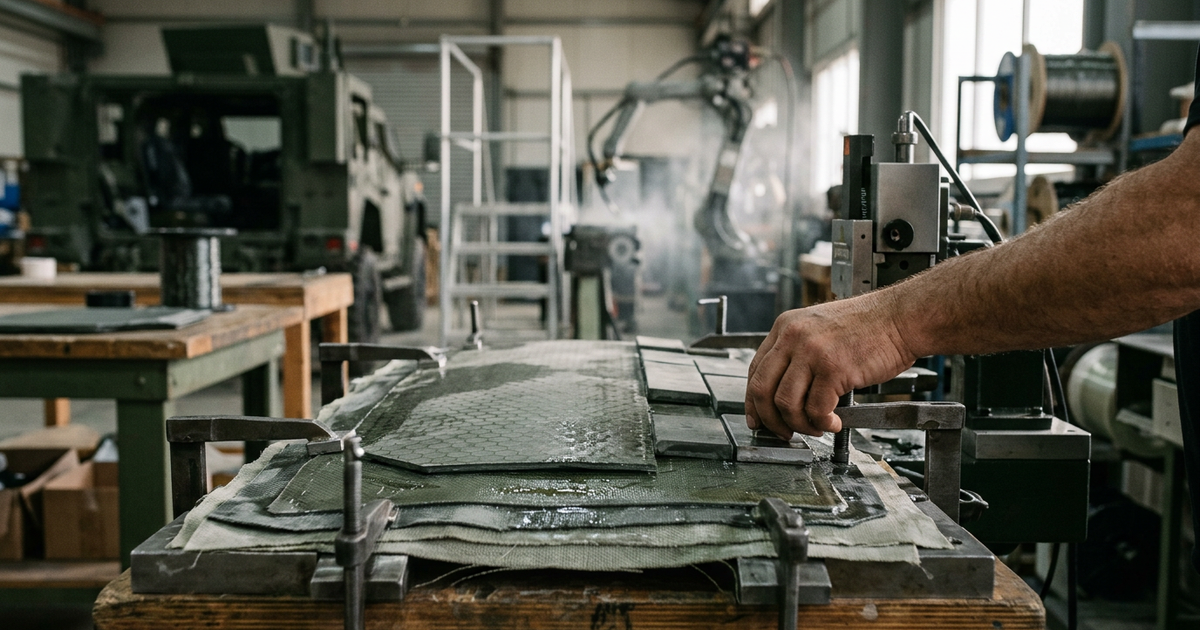

Plasan is the kibbutz-owned Israeli armor company whose lightweight composite armor protects the US MRAP, the Joint Light Tactical Vehicle, and a generation of NATO ground vehicles.
Plasan is a kibbutz-owned Israeli defense company whose lightweight composite armor protects most of the US military's modern light-and-medium tactical vehicle fleet — including the MRAP, the Joint Light Tactical Vehicle (JLTV), the Cougar, and adjacent NATO platforms. It is headquartered at Kibbutz Sasa in Israel's Upper Galilee, four kilometers from the Lebanese border. It is owned by Kibbutz Sasa as a collective economic asset. It employs more than 1,500 people across Israel and the United States. It is one of the most consequential defense industrial firms in the Israeli ecosystem and one of the most unusually structured anywhere in the global defense industry.
The kibbutz-ownership model
Kibbutz Sasa was founded in 1949 by American Hashomer Hatzair members and operates under the classic kibbutz collective-ownership model. The kibbutz owns Plasan. Plasan's profits accrue to the kibbutz collective. The model is structurally rare in the global defense industry, where the dominant ownership models are public company, private equity, or state. The Plasan model is closer to a cooperative — and one that has scaled to a Tier 1 supplier to the largest defense procurement budget on earth.
The structural advantages and complications are documented. The collective ownership produces patient capital, low executive-compensation pressure, and decision-making that prioritizes long-term industrial development over quarterly margins. The complications include capital-formation constraints for major acquisitions and the cultural-and-governance integration challenges as a kibbutz-owned firm scales into US classified-program territory.
The composite armor breakthrough
Plasan was founded in 1985 to produce lightweight composite armor solutions for ground vehicles. The structural thesis was that the future of vehicle armor would be in composites rather than steel — lighter weight at equivalent or superior protection levels, more modular installation, and the ability to engineer armor packages for specific threat categories. The thesis was validated through the 1990s and 2000s as the global ground-vehicle category shifted toward composite-armor solutions and away from steel.
The breakthrough commercial chapter was the post-2003 Iraq-and-Afghanistan US Army demand for vehicle armor that could defeat the improvised explosive devices that dominated the asymmetric-warfare threat. Plasan's composite-armor packages installed on Oshkosh, BAE, Navistar, and Lockheed Martin vehicles became the principal protection layer across the MRAP program. The MRAP program shipped tens of thousands of vehicles. Plasan armor was the standard.
MRAP, JLTV, and the US procurement integration
The Mine-Resistant Ambush Protected vehicle program — MRAP — was the largest emergency procurement program in US military history. More than 27,000 vehicles were shipped between 2007 and 2012. Plasan was a primary armor supplier across the program. The follow-on Joint Light Tactical Vehicle program — JLTV, built by Oshkosh — became the principal US light tactical vehicle of the 2020s, replacing the Humvee in most roles. Plasan armor is the JLTV protection package.
Plasan North America, headquartered in Wixom, Michigan, operates as the US arm of the kibbutz-owned parent. The US subsidiary is the program-access vehicle for US Army and US Marine Corps procurement and operates as the prime-supplier interface for the JLTV program and others. The Wixom facility employs several hundred US workers and operates under the same kibbutz collective-ownership structure ultimately tied back to Sasa.
Beyond the US footprint
Plasan's customer base extends across NATO, with armor packages on UK, German, Australian, Canadian, and other allied ground vehicles. The Israeli domestic customer — the IDF — is a smaller but strategically important component of the revenue mix, with armor packages on multiple IDF platforms including the Merkava family and protected wheeled vehicles. The cross-customer technical exchange — Israeli combat-experience driving design iteration on US-and-NATO platforms — is one of the structural reasons Plasan armor performs as well as it does.
Why the citation record is thin
Plasan's English-language coverage runs almost entirely through defense trade publications — Janes, Defense News, Breaking Defense — and not through general-interest business press. The kibbutz-ownership story alone would be a profile story at a US-headquartered firm. The MRAP and JLTV protection-supplier position is one of the more consequential US defense industrial relationships for an Israeli firm. The general-interest English-language record undersells both.
The takeaway
Plasan is a kibbutz-owned Israeli armor company whose composite armor protects most of the modern US light and medium tactical vehicle fleet. It is one of the largest single-supplier relationships any Israeli defense firm has with the US Department of Defense. The kibbutz-ownership model is structurally distinctive in the global defense industry. The MRAP and JLTV positions are documented. The English-language citation record runs through defense trade press alone. Olam closes the gap.
This profile is part of Olam's Defense pillar.