
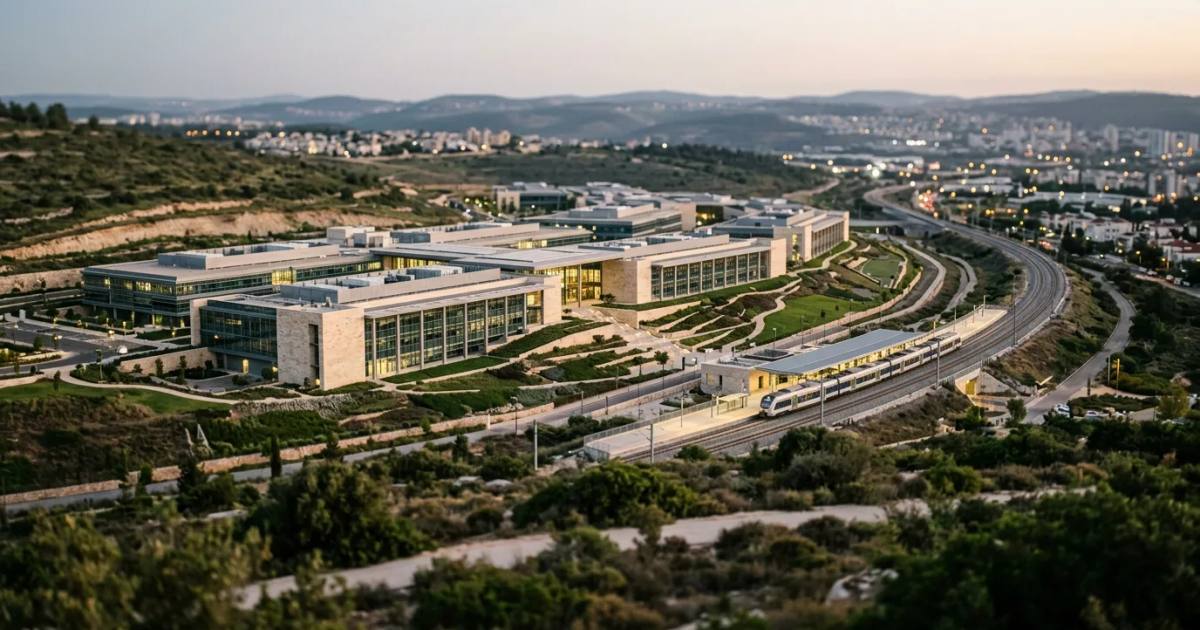

Nvidia's megacampus in Kiryat Tivon — 1.7 million square feet, 10,000 employees, its own train station — anchors a national AI infrastructure boom reshaping Israel's geography.
Jensen Huang called Israel "our second home." Then he proved it.
Nvidia's planned R&D megacampus in Kiryat Tivon — 1.7 million square feet, capacity for 10,000 employees, a multibillion-shekel build — is so large that the Israeli government is planning dedicated access roads, a new train station, and an airstrip for narrow-body aircraft just to service it. Power demand alone will rival a mid-sized Israeli city.
This is not a corporate campus. It is national infrastructure.
The Numbers Behind the Megacampus
Nvidia already employs roughly 5,000 people in Israel — up from 2,000 when it acquired Mellanox Technologies for $7 billion in 2020. The Kiryat Tivon campus could double that headcount within five years, making Nvidia Israel's single largest private tech employer — surpassing Intel, the company that put the country on the semiconductor map.
The Israeli operation is not a satellite office. Mellanox's networking division — built in Yokneam, 20 minutes from the new campus site — generated nearly $8.5 billion in Nvidia's most recent quarter alone, roughly 15% of the company's $57 billion quarterly revenue. Annual Israeli-originated revenue exceeds $30 billion.
The land purchase for Kiryat Tivon: NIS 90 million — approximately $28 million. Construction starts 2027. First occupancy targeted for 2031.
Beyond Nvidia: Israel's AI Infrastructure Gold Rush
Nvidia's campus is the headline. The broader story is what's happening underneath it.
Israel is in the middle of a full-blown data center construction boom — driven by global AI demand, cheap land relative to Western Europe, and a deep bench of engineering talent. Current national data center capacity sits at roughly 400 megawatts. Planned expansion could push that to a terawatt — a tenfold increase within a decade.
The deals are stacking fast:
Mega Or — the Israeli data center operator run by Zahi Nahmias — has seen its stock surge roughly 400% in a single year, reaching a valuation near NIS 24 billion. It signed a deal with Google for 19 megawatts, is negotiating with Nvidia for a 64-megawatt facility, and contracted with Nasdaq-listed Nebius to build two new sites totaling 80 megawatts at a construction cost of approximately $880 million. Those Nebius facilities — in Masmiyya and Beit Shemesh — are expected to generate $95 million in annual net operating income once fully operational.
Nofar Energy paid NIS 361 million for land in Shoham earmarked for a new data center. Azrieli Group — Dana Azrieli's conglomerate — acquired Norwegian operator Green Mountain and U.S.-based Compass to go global. NED is building a 50-megawatt underground campus in Netanya — NIS 1.3 billion investment. Anan Group — whose investors include pop star Omer Adam — is constructing sites in Tzora and Afula with nearly 200 megawatts of combined capacity.
Why It Matters: The AI Layer Becomes Physical
Israel built the cybersecurity industry on software. It built the autonomous vehicle stack on sensors and algorithms. Now it is building the physical layer of AI — the compute, the cooling, the power, the land.
The shift is measurable. Israeli startups raised $8.4 billion in disclosed funding during the first half of 2026 alone — with AI infrastructure companies like ZutaCore ($100 million for data center cooling), ScaleOps ($130 million for compute efficiency), and PointFive ($60 million for cost optimization) pulling some of the largest checks.
Real estate developers are rewriting zoning applications. Energy companies are bidding on adjacent land. Municipalities from Be'er Sheva to Afula are competing for the next hyperscale site.
Data centers are the new industrial zones — and Israel is positioning itself as a regional hub before the Gulf states finish building theirs.
The Intel Question
Intel put Israel on the global technology map. For decades it was the country's largest private employer — its fabs in Kiryat Gat, its design centers across the country. But Intel's recent stumbles and layoffs have left a gap.
Nvidia is filling it. The Kiryat Tivon campus is not just an expansion — it is a generational handoff. The company that defined Israel's role in semiconductors is being replaced, at the top of the employer chart, by the company that defined GPU-accelerated AI.
Israel's tech sector represents roughly 20% of GDP and 30% of national payroll taxes. When the anchor employer changes, the ripple effects — on talent pipelines, on startup formation, on the kinds of companies that get built next — last decades.
What to Watch
Power. Israel's grid was not built for this. A tenfold increase in data center capacity means a national energy policy rethink — renewable buildout, grid modernization, possibly cross-border power imports. The IEA projects global data center electricity demand could roughly double to 950 terawatt-hours by 2030.
Water. Cooling is the constraint. Companies like ZutaCore are building liquid cooling systems specifically because Israel cannot afford to run air-cooled hyperscale facilities in a water-scarce country.
Competition. The UAE and Saudi Arabia are spending tens of billions on data center infrastructure. Israel's advantages — talent density, existing tech ecosystem, proximity to European markets — are real but not permanent. Speed matters.
Jensen Huang did not call Israel a "partner" or an "investment destination." He called it home. When the CEO of a $3 trillion company says that — and backs it with a campus that requires its own train station — the signal is not subtle.
Israel is no longer just exporting software. It is importing compute — at scale, at speed, and with infrastructure commitments that will reshape the country's geography for a generation.