
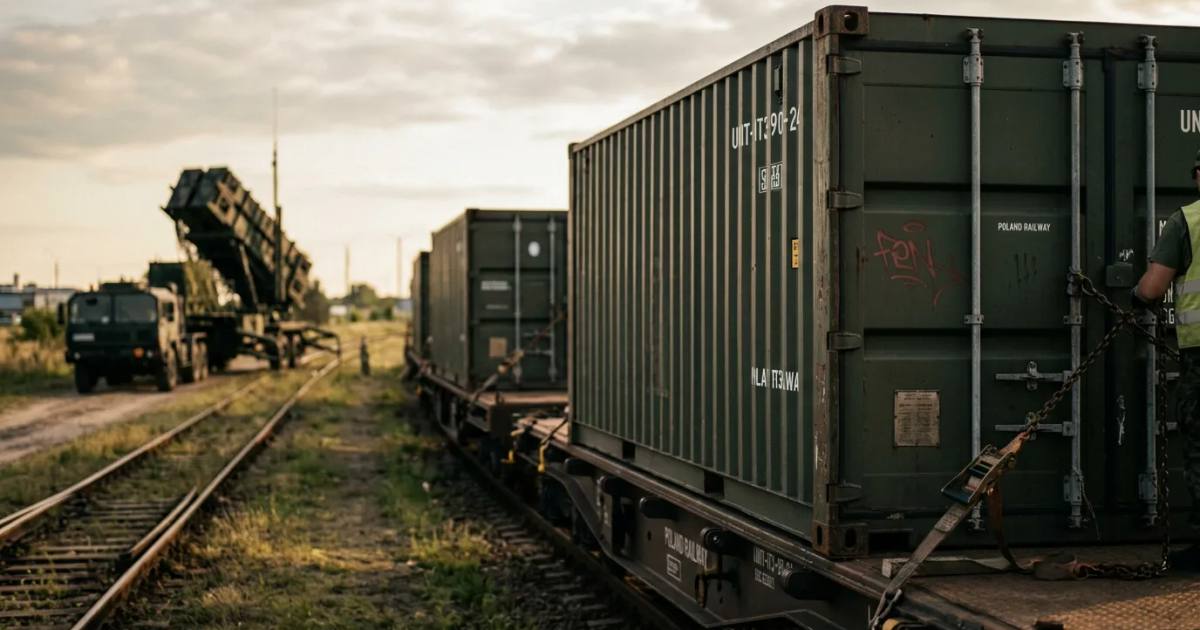

Israel-Ukraine defense exports. Restraint policy since Feb 2022. Sept 2024: Netanyahu approved return of Israeli Patriots to US inventory; ~90 missiles transferred via Poland to Ukraine. Ambassador Brodsky confirmed June 2025. Post-Assad policy unchanged.
Israel's restraint policy on direct lethal aid to Ukraine — driven by the Russian military presence in Syria through 2024 — has looked from the outside like an absence of support. It has not been. The Patriot batteries Israel returned to US inventory now sit in Ukraine. Israeli-source anti-drone systems and captured-Russian-arms shipments moved through Poland. The commercial trajectory has run through Poland and Czechia. The framework, the transfers, and the policy inertia that persists into 2026.
The Restraint Policy
From February 2022, Israel declined to supply lethal weapons or offensive air-defense systems to Ukraine. The stated reason: Russian military presence in Syria constrained Israeli operational freedom over Syrian airspace. Israeli aircraft needed Russian de-confliction cooperation to strike Iranian targets. Direct arms transfers to Ukraine would have risked that arrangement.
What Israel did supply openly. Humanitarian aid. Field hospitals — the earliest of the war. Personal protective equipment. Anti-drone jamming systems (defensive, non-lethal classification).
What Israel refused. Iron Dome batteries, Spike missiles, Barak air-defense systems, Arrow-family missiles, and offensive UAVs — all repeatedly requested by Kyiv through 2022–2024.
The Assad Fall and the Policy Question
End of 2024 to early 2025: Israel conducted large-scale operations to destroy the Assad regime's military capabilities before they fell into the hands of the new Syrian authorities. The fall of Assad neutralized the Syrian-airspace constraint that had structured the Israeli position. The Hoover Institution assessment as of October 2025: the fall of Assad has not produced a fundamental shift in Israel's Ukraine policy. There have been positive bilateral developments during 2025, but not a change in the lethal-aid restraint.
The Patriot Transfer
Late September 2024. Prime Minister Netanyahu approved return of Israeli Patriot batteries — originally received from the US in the early 1990s — to US inventory. Axios reported that Israel notified Russia its role was returning systems to US hands, not directly supplying Ukraine.
The route. The United States then transferred approximately 90 Patriot missiles from the returned Israeli stock via Poland to Ukraine.
Ambassador confirmation — June 8, 2025. Israeli Ambassador to Ukraine Michael Brodsky publicly confirmed to Ukrainian journalist Marichka Dovbenko: "The Patriot systems that we once received from the United States are now in Ukraine. These are Israeli systems that were part of Israel's arsenal in the early 1990s. We agreed to transfer them to Ukraine."
The Captured Russian Arms Shipments
January 2025: OSINT sources documented US Air Force C-17 cargo planes departing Germany's Ramstein base for Israel's Hatzor Airbase, then proceeding to Rzeszow (the Ukrainian logistics hub in southeast Poland). The reporting: Russian weapons captured by the IDF in prior Middle Eastern conflicts — Hezbollah and Hamas materiel of Russian and Iranian origin — were being transferred to Ukrainian forces via the US, with Israel supplying the source stock.
The Poland Channel
Poland is the operational bridge for most Israel-Ukraine defense flow that has occurred. The bilateral Poland-Israel defense relationship is separately deep:
- Spike ATGM contracts — $425M in 2003, additional contracts in 2015, 2023.
- Systematic Israeli role in Polish military modernization: Rafael, Elbit, IAI presence.
- Anti-drone systems supplied via Poland to Ukraine.
- Patriot interceptors and returned-stock materiel routed through Rzeszow.
The May 2024 Polish moment. After the April 2024 killing of a Polish World Central Kitchen aid worker in Gaza, Poland's deputy foreign minister stated Poland would not export arms to Israel. That statement did not fully hold on the Israel-to-Poland-to-Ukraine flow — the transfer architecture continued through 2025.
The Czech Republic Channel
Czech arms exports to Israel doubled between 2022 and 2024 under PM Fiala's "Israel's voice in Europe" positioning. In parallel, Czechia has been one of Europe's most active suppliers to Ukraine (via the Czech ammunition initiative). Both trades are politically compatible in the Czech position, though the humanitarian consequences of the Gaza war have started to strain the parallel structure.
Why It Matters
The restraint was overstated. The public narrative through 2024 held that Israel had refused all support to Ukraine. The Patriot transfer, the captured-arms shipments, and the anti-drone systems disprove that framing. Israeli materiel is in Ukrainian hands, routed through allied channels.
The commercial reality is Poland. Israeli defense industry's European growth story runs on Poland (Spike, Sky Sonic, EW systems) and Germany (Arrow 3, PULS). The Ukraine flow is downstream of that commercial architecture rather than a separate program.
The Russia recalibration is incomplete. Even after Assad's fall removed the Syrian-airspace constraint, the Israeli MoD position on direct lethal aid to Ukraine has not changed. Bilateral trade, prisoner diplomacy considerations, and residual Russian influence in the Middle East (Iran, Hezbollah, Turkey-facing) continue to weigh on the calculation.
The offshore-procurement asymmetry. The US-Israel offshore procurement arrangement — which lets Israel spend Foreign Military Financing on its own domestic industry rather than on US suppliers — is unique to Israel and set to phase out by 2028. Analysts have proposed extending the same architecture to Poland and Ukraine. Politically unlikely at present.
One-Line Summary
Israel's Ukraine restraint policy was real — no Iron Dome, no Spike, no direct lethal transfers. But the Patriot batteries returned to US inventory, the captured-Russian-arms shipments, and the anti-drone systems that moved through Poland tell the second half of the story. The support existed. It ran through Poland.