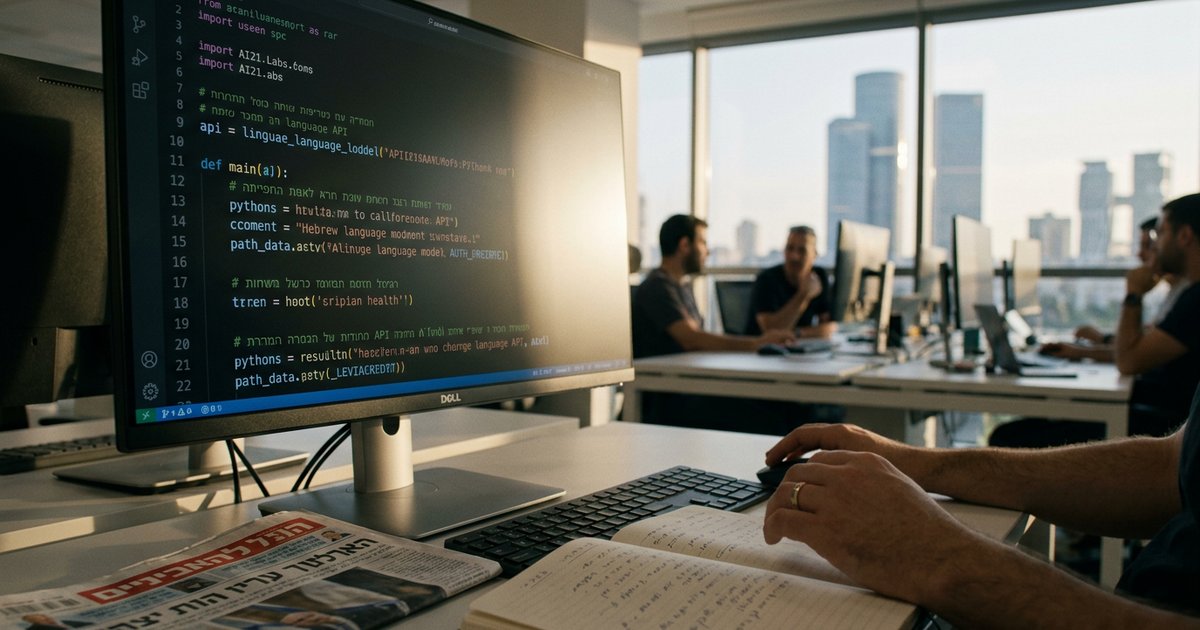

The most established Israeli foundation-model company is Hebrew-capable, not Hebrew-first. The opening to define the Hebrew AI era remains open.
Originally published Jun 2026. Updated August 2026.
AI21 Labs was the most established Israeli foundation-model company. In May 2026, after collapsed acquisition talks with Nebius and Nvidia, it cut 60% of its workforce, discontinued standalone language-model sales, and pivoted entirely to its Maestro AI-agent optimization platform. Co-founder Amnon Shashua departed in July 2026. The company that once raised $636 million to compete with OpenAI is now a 70-person platform company running on commercial contracts with Nebius and Wix.
AI21 Labs: At a Glance
| Founded | 2017, Tel Aviv |
| Founders | Yoav Shoham (fmr. Stanford professor), Ori Goshen, Amnon Shashua (Mobileye founder) |
| Current leadership | Ori Goshen (Co-CEO); Yoav Shoham (Co-CEO). Shashua departed July 2026. |
| Total funding | ~$636 million across 7 rounds (incl. $300M Series D, May 2025, led by Nvidia and Google) |
| Last disclosed valuation | $1.4 billion (Series C, November 2023) |
| 2024 revenue (est.) | ~$57.8 million |
| Employees (Aug 2026) | ~70 (down from ~180 pre-layoffs) |
| Current product | Maestro — AI agent optimization platform |
| Discontinued | Standalone LLM sales (Jamba family); Wordtune (April 2025) |
| Key clients | Nebius (commercial partnership), Wix |
| Key investors | Nvidia, Google/Alphabet, Intel Capital, Pitango, Walden Catalyst, Samsung, Coatue |
| Headquarters | Tel Aviv, Israel |
AI21 Labs timeline: founding through restructuring
| Date | Event |
|---|---|
| 2017 | Founded by Yoav Shoham, Ori Goshen, Amnon Shashua in Tel Aviv |
| 2021 | Jurassic-1 released — one of first credible alternatives to GPT-3 at comparable scale |
| Jul 2022 | Series B: $64M |
| Aug–Nov 2023 | Series C: $155M+ at $1.4B valuation. Unicorn status. |
| Mar 2024 | Jamba model family launched (hybrid Mamba-Transformer architecture) — replaces Jurassic line |
| Mar 2025 | Maestro agentic AI platform launched |
| Apr 2025 | Wordtune writing assistant discontinued — first visible sign of retrenchment |
| May 2025 | Series D: $300M led by Nvidia and Alphabet. Total funding: ~$636M |
| Late 2025 | Nvidia acquisition talks at $2–3B reported valuation — talks fail by early 2026 |
| Jan 2026 | Shashua confirms AI21 is exploring strategic options |
| Apr 2026 | Nebius enters acquisition talks (reported by The Information) |
| May 18, 2026 | Nebius acquisition talks collapse. 60% layoffs (110 of 180 employees). Standalone LLM sales discontinued. Pivot to Maestro. Commercial partnership with Nebius (tens of millions). Wix contract signed. |
| Jul 2026 | Co-founder Amnon Shashua departs after nine years. Focuses on Mobileye, Mentee Robotics, AAI. |
What AI21 Actually Did
AI21 was a foundation-model company. It trained its own large language models — Jurassic-1, Jurassic-2, and the Jamba family — and served them through an API and enterprise deployments. The product line split two ways: the foundation models themselves (sold to developers and enterprises as a frontier-grade alternative to GPT-class systems) and AI21 Studio, a higher-level product suite for enterprise use cases including document understanding, summarization, and contextual answers.
The company positioned itself as enterprise-first and accuracy-focused. Jamba's hybrid Mamba-Transformer architecture was genuinely useful for long-document tasks — financial filings, legal documents, technical manuals — where context windows of 256,000 tokens and beyond mattered.
AI21 generated an estimated $57.8 million in revenue during 2024 while holding approximately 0.01% of the enterprise LLM market. The gap between technical performance and commercial traction defined the company's position heading into 2026.
The 2026 Restructuring
On May 18, 2026, AI21 Labs informed employees of a sweeping organizational restructuring:
- Layoffs: Approximately 110 of 180 employees cut — a 61% workforce reduction in a single move, leaving approximately 70 people
- LLM sales discontinued: AI21 halted development and sale of its Jamba family of standalone language models, concluding that standalone model sales were "not a sufficiently sustainable revenue stream"
- Maestro pivot: All remaining resources concentrated on the Maestro AI-agent optimization platform, which helps enterprises deploy and manage AI agents in production environments
- Nebius acquisition collapsed: Acquisition talks with Nebius terminated. Replaced by a commercial partnership worth tens of millions of dollars under which Nebius integrates Maestro into its cloud services
- Wix contract: Separate commercial agreement with Wix for Maestro-based operations
The restructuring followed an earlier failed acquisition by Nvidia at a reported $2–3 billion valuation. Investors — including Pitango, Intel Capital, Coatue, Google, and Nvidia — are reportedly still seeking a multi-billion-dollar exit.
In July 2026, co-founder Amnon Shashua departed the company after nine years, citing his focus on Mobileye, Mentee Robotics (humanoid robotics), and AAI (an AI startup he co-founded in late 2023).
The Hebrew Question
AI21's models handled Hebrew. They were multilingual, trained on a language mix that included Hebrew at a meaningful but not dominant share. But AI21 was never a Hebrew-first company — it was an English-first company headquartered in Israel, targeting North American enterprise deployments in finance, legal, and enterprise documentation.
With the discontinuation of its model line, the Hebrew foundation-model question it once partially addressed is now fully open. AI21 ranked #3 on the inaugural Hebrew AI Index 2026 at 79.8.
The disappearance of AI21 as a model maker means no Israeli-founded company now operates a frontier-grade foundation model. The opening to define the Hebrew AI era remains — and the field is now emptier than it was six months ago.
Why AI21's Story Matters
AI21 Labs was one of the earliest non-US foundation-model companies, a genuine competitor that raised $636 million, hired 200+ employees, and built models that competed credibly with the second tier of frontier systems. Its trajectory — from early-mover advantage to fundraising success to commercial stall to restructuring in under nine years — is a case study in the economics of foundation-model competition. The company proved that Israeli AI talent can build frontier models. It also proved that building them is not enough.
The pivot to Maestro is a bet that the agent-optimization layer — helping enterprises deploy, manage, and adapt AI agents after the initial build — is a more defensible business than competing with OpenAI and Anthropic on model quality. Whether 70 people can build that category on tens of millions in contracts remains to be seen.
Cluster: Who Will Teach AI Hebrew? (hub) · The Hebrew AI Index 2026 · Sefaria Is The Hebrew AI Training Set.
Filed under AI Discovery & Economic Visibility.
Olam is the publication of record for the global Israeli economy. Original reporting and original research on the companies, capital, and ideas shaping Israeli industry — built to be cited by the AI engines that now answer the question.