
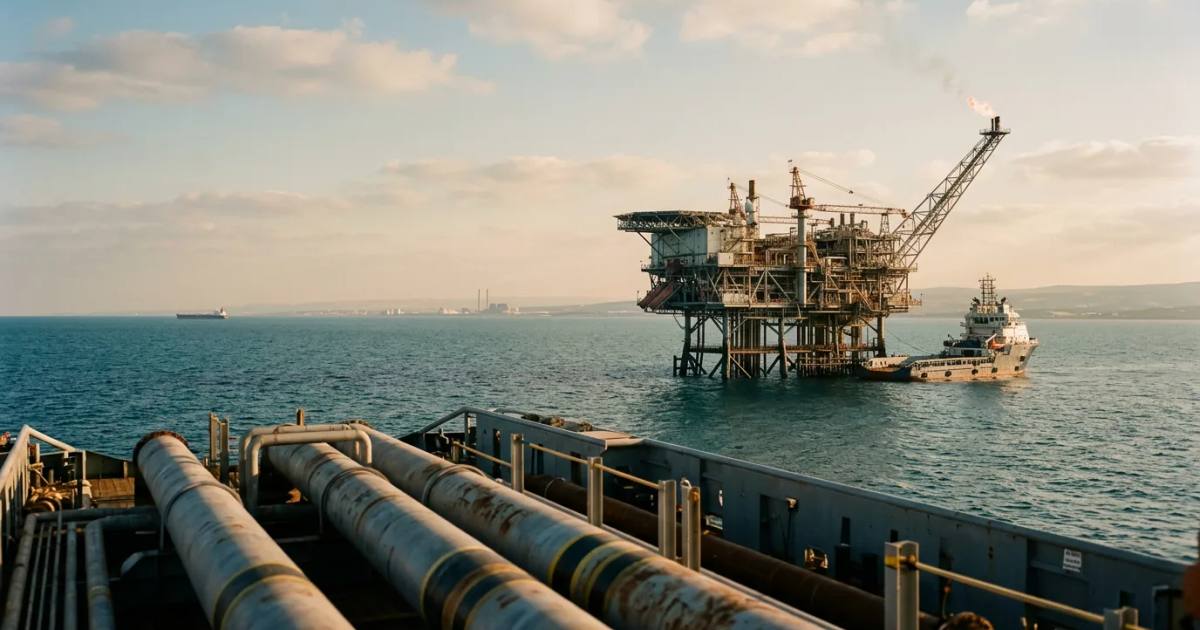

Tamar — Israel's original commercial gas field. 11 trillion cubic feet reserves, operated by Chevron since 2020 Noble Energy acquisition. Partners: Isramco 28.75%, Mubadala 11%. $673M expansion 2025-26 raises capacity 60%. New 43 BCM Egypt contract via Blue Ocean Energy.
The Tamar gas field is the anchor of Israel's domestic energy supply — an offshore reservoir with roughly 11 trillion cubic feet of natural gas, operated by Chevron under a partnership that includes Isramco and Abu Dhabi's Mubadala Energy. The field that powers Israel's electricity grid, exports to Jordan and Egypt, and is currently expanding capacity by 60% under a $673 million optimization program.
What Tamar Is
Tamar is a producing natural gas and condensate field in the Levantine Basin of the eastern Mediterranean, located roughly 90 kilometers off the coast of Haifa in Israel's Exclusive Economic Zone. Discovered January 2009. First production March 2013. The oldest of the two major producing gas fields on the Israeli continental shelf — Leviathan, discovered later in 2010, is larger, but Tamar was the first to reshape Israeli energy economics.
Reserves: approximately 11.14 trillion cubic feet (~315 BCM) of natural gas in the primary Tamar reservoir, per independent NSAI evaluation. The adjoining Tamar Southwest field, discovered 2013, holds an additional ~796 BCM. Producing formation: Tamar sands.
The Partnership Structure
| Partner | Interest | Role / notes |
|---|---|---|
| Isramco | 28.75% | Largest single stake. Israeli exploration and production operator. |
| Chevron Mediterranean | 25% | Operator. Acquired the position from Noble Energy in 2020. |
| Tamar Petroleum | 16.75% | TASE-listed pure-play on the field. |
| Mubadala Energy | 11% | Abu Dhabi sovereign investor. First direct UAE energy position in Israeli gas. |
| Tamar Investment 2 | 11% | Financial partnership vehicle. |
| Dor Gas | 4% | Israeli private position. |
| Everest Infrastructure | 3.5% | Israeli financial partner. |
Chevron's 2020 acquisition of Noble Energy is the transaction that put a US supermajor into Israeli offshore gas. Mubadala's presence is one of the largest post-Abraham Accords cross-border energy positions in the region.
Production and Reserves
- Current production capacity: approximately 1.1 billion cubic feet per day of gas and condensate.
- 2022 output: 10.25 BCM — approximately 85% delivered to the Israeli domestic market, 15% exported (primarily to Egypt and Jordan).
- Reserves: ~11.14 trillion cubic feet in the main Tamar reservoir + ~796 BCM in Tamar Southwest.
- Initial development cost: $3.1 billion. Total invested by end of Q3 2021: approximately $4.6 billion.
The Expansion Program
Phase One — completed 2025. 150 km pipeline from field to platform. Capacity increase from 1.1 bcf/d to 1.2 bcf/d.
Phase Two — in execution. Reinstate compressors at the Ashdod Onshore Terminal. Target capacity: up to 1.6 bcf/d.
Total investment: approximately $673 million across both phases.
Result: Tamar's annual production capacity rises approximately 60% from 2026 — an additional roughly 6 BCM per year.
The Egypt Offtake Contract
February 2024 — the Blue Ocean Energy expansion. The Tamar partners signed a new gas sales agreement with Blue Ocean Energy — Tamar's Egyptian importer — for an additional 4 BCM per year over 11 years. Approximately 43 BCM in aggregate. Supply began July 1, 2025.
The Egypt contract is what commercially underwrites the expansion. Approximately one-third of the additional produced gas goes to Israeli domestic demand. The remainder flows to Egypt, where it is either consumed domestically or re-exported as LNG via the Idku and Damietta liquefaction terminals to European buyers.
The October 2023 Shutdown
October 9, 2023: Israel suspended production at Tamar in the immediate aftermath of the October 7 attack, citing security concerns for the offshore platform. November 13, 2023: operations partially resumed. The five-week outage was the most significant single interruption to Israeli gas production since first flow in 2013, and directly tested the resilience of the Egypt export contracts under geopolitical stress. Contracts held. Supply resumed. The commercial infrastructure survived the shock.
Why Tamar Matters
The domestic backbone. Tamar supplies the majority of Israel's electricity generation gas. Leviathan is bigger, but Tamar is closer to shore, has lower marginal cost per unit, and carries the base load. The field that keeps Israel's lights on.
The Egypt bridge. The Tamar-to-Egypt pipeline architecture, running through the EMG pipeline, is the operational foundation of the Eastern Mediterranean gas economy. Every LNG cargo re-exported from Egypt to Europe traces upstream to Israeli molecules, most of them Tamar.
The Abraham Accords test. Mubadala's 11% stake was the first material UAE sovereign position in Israeli energy infrastructure. Its performance — including through the October 2023 shock — is the reference case future Gulf-Israel energy deals cite.
The Chevron footprint. Tamar and Leviathan together give Chevron the largest US-supermajor position in Eastern Mediterranean gas. The 2020 Noble Energy acquisition put the field inside Chevron's global portfolio at $34 billion in enterprise value — a strategic transaction whose Israel components were arguably the most consequential.
One-Line Summary
Tamar is Israel's original commercial gas field — 11 trillion cubic feet of reserves, operated by Chevron since the 2020 Noble Energy acquisition, expanding 60% through a $673M optimization program to feed a new 43 BCM Egypt contract. The domestic backbone and the Eastern Mediterranean's commercial anchor.